
Quick Verdict (2026)
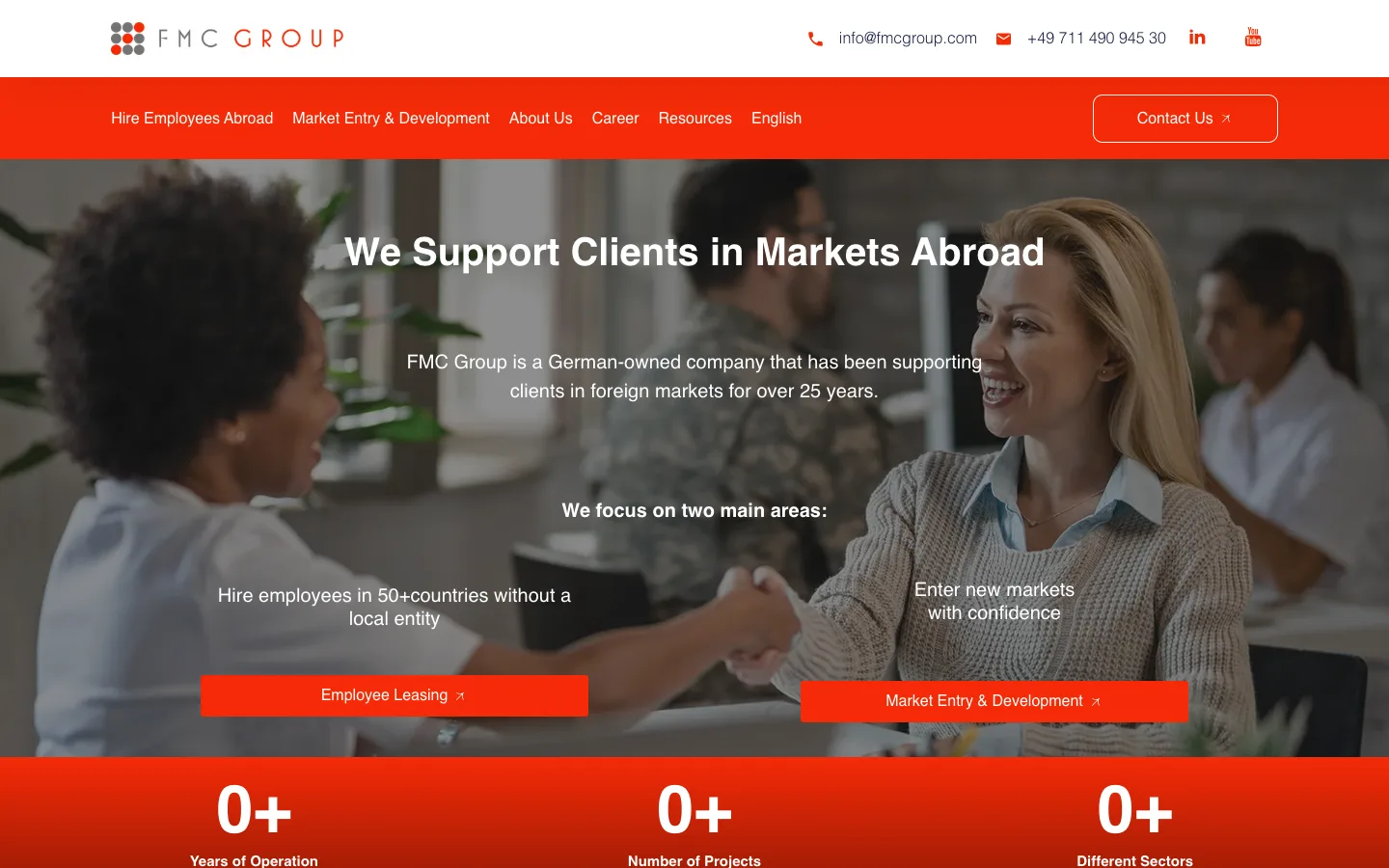
FMC Group is a strong fit when you need compliant hiring in 50+ countries and can work with a mixed entities model.
Best for
Teams balancing global coverage and practical speed across multiple markets.
Not ideal for
Teams that only need one country and can justify setting up a local entity immediately.
Entity model
Mixed entities
Primary tradeoff
Entity model consistency varies by country.
Summary
Pick FMC Group if you’re hiring 1-15 employees in Germany or the Gulf and want advisory depth over software automation. Founded in 1999, FMC covers 50+ countries with heavy DACH and Middle East concentration, and it holds a valid German AUG license that many tech-first providers still route through partners.
The trade-off is equally clear: there is no self-serve platform, no API, no integrations with your HRIS or ATS, and no public pricing. Every engagement starts with a phone call to Stuttgart. If you want to generate a compliant employment contract at 11pm on a Tuesday, Deel and Remote will do that. FMC Group will not. This is a provider for companies entering Germany, the Gulf states, or Turkey with 1–15 employees who value advisory depth over platform speed. If your hiring map is broader than DACH and MENA, or you need to onboard 30 people next month across 10 countries, look elsewhere.
Pick FMC Group if
You are hiring 1-15 employees in DACH or MENA and want direct human advisory support on issues like AUG limits, works councils, or Saudi quotas.
Skip FMC Group if
You need self-serve workflows, API integrations, or broad multi-region hiring at speed (for example, 30 hires across 10 countries in one quarter).
FMC Group: Key Facts
Before final sign-off on FMC Group, review EOR comparisons, benchmark budget assumptions in the EOR cost guide, and align legal terms in the Employer of Record glossary.
What FMC Group Does Well
German employment law expertise that goes beyond payroll
Most EOR providers can run German payroll. Fewer can explain why your planned termination will fail in front of a German labor court and what it will cost you. FMC Group holds a valid AUG license — the mandatory permit under Germany’s Employee Leasing Act (Arbeitnehmerüberlassungsgesetz) — and operates its own GmbH entity in Stuttgart. That matters because the AUG imposes strict rules that many foreign companies don’t know about until it’s too late: there’s an 18-month maximum assignment period per client, after which the employee must take a 3-month-plus-one-day cooling-off break. Some EOR providers try to work around this with “consultancy agreements.” FMC Group doesn’t. They’ll tell you about the 18-month cap on the first call and help you plan around it.
Their Germany-specific knowledge extends to works council (Betriebsrat) interactions, the social selection process required for operational terminations, and the Employee Inventions Act (Arbeitnehmererfindungsgesetz) that gives engineers compensation rights for patentable inventions regardless of what your contract says. If you’re hiring a small engineering team in Munich or a sales rep in Düsseldorf, this depth of local labor law knowledge is exactly what you need — and it’s where the consultancy DNA shows its value over a self-serve platform.
Middle East coverage with actual on-the-ground presence
FMC Group covers nine Middle East markets: UAE, Saudi Arabia, Kuwait, Qatar, Bahrain, Oman, Lebanon, Jordan, and Egypt. That’s a broader MENA footprint than Deel, Remote, or Multiplier offer with dedicated local teams. The UAE operation includes visa and work permit sponsorship, WPS (Wage Protection System) compliance, Emirates ID processing, and end-of-service benefit (EOSB) calculations — all handled by a local coordinator based in the Gulf, not a remote support team in Europe.
In Saudi Arabia, the Nitaqat (Saudization) quota system requires companies to employ a minimum percentage of Saudi nationals. Getting this wrong can result in blocked visas and Ministry of Labor penalties. FMC Group’s team understands these quotas and can advise on how your hiring plan interacts with them — something the tech-first EOR platforms handle reactively, if at all. For European industrial companies expanding into the Gulf states (which is FMC Group’s bread and butter), this regional depth is the primary reason to choose them.
Consultancy services that extend beyond just payroll processing
FMC Group started as a market-entry consultancy, not an EOR provider. That origin still shapes the service: alongside employee leasing, they offer distributor search, market research, supplier search, and company formation services in Turkey, UAE, Saudi Arabia, Morocco, Tunisia, Singapore, and Egypt. If you’re a German Mittelstand company entering the UAE and need help finding distributors, setting up a legal entity eventually, and hiring your first 3 employees through EOR in the meantime, FMC Group can handle all three workstreams. No other pure EOR provider offers this combination.
This matters practically because EOR is often a stepping stone, not a permanent solution. Companies hire 5–10 employees through EOR, validate the market, then set up their own entity. FMC Group can manage that transition in-house — from EOR to entity formation to employee transfer — without you switching providers midway. Deel and Remote will handle the EOR phase but hand you off to a law firm for entity setup.
Human-first support model with direct specialist access
Every FMC Group client gets a named contact person — not a shared inbox, not a rotating support queue. The chairman, Peter Heidinger, still lists his direct phone number on the website. The team in Stuttgart is small enough that when you call, you get someone who knows your account, your employees’ names, and the specific compliance situation in your market.
Trustpilot reviewers consistently highlight response speed: one client referred by the German-Emirati Chamber of Commerce described FMC Group’s response time as “lightning fast” and praised their ability to resolve issues they’ve “probably seen before.” For a company with 6 Trustpilot reviews, that’s a thin data set — but the qualitative signal is consistent. If your People team is 1–2 people managing 5–10 EOR employees, having a direct line to someone who knows German social security rates from memory is worth more than a polished dashboard.
Where FMC Group Falls Short
No technology platform whatsoever
This is the dealbreaker for most companies evaluating EOR providers in 2026. FMC Group has no self-serve dashboard, no employee portal for leave requests and payslip access, no API, and no integrations with any HRIS, ATS, or accounting software. Leave requests go through their internal HR software; expense management uses a basic digital tool for receipt scanning. But there’s no login for you, the client, to see real-time headcount, payroll costs, or contract status across your EOR employees.
Compare that to Deel’s dashboard (EOR, contractors, and direct employees in one view with 100+ integrations), Remote’s platform (contract generation, benefits enrollment, equity tracking), or even smaller providers like Multiplier or Oyster who offer full-featured portals. If your finance team needs monthly payroll data exported to NetSuite, or your HR team wants leave balances synced to BambooHR, FMC Group requires manual communication — emails, phone calls, and spreadsheets. For 3 employees, that’s manageable. For 15+, it’s a workflow bottleneck.
Coverage breadth is narrow compared to major EOR providers
FMC Group claims 50+ countries, but the website only lists dedicated EOR service pages for roughly a dozen: Germany, Switzerland, Portugal, Romania, Turkey, UAE, Saudi Arabia, Kuwait, Brazil, China, Kenya, and a handful of other Middle East markets. The remaining countries in the “50+” figure likely rely on local partners, with varying levels of FMC Group oversight. Deel covers 160+ countries. Remote covers 85+ with 100% owned entities. Even mid-tier providers like Multiplier and Oyster cover 150+ and 180+ respectively.
If your hiring map extends beyond DACH and the Middle East — say you need employees in the Philippines, Japan, Australia, or Mexico — FMC Group either can’t serve you or will sub-contract to a partner firm where you lose the direct relationship that’s the whole point of using them. For multi-region hiring, you’ll end up needing a second EOR provider anyway, which doubles your vendor management overhead.
Opaque pricing with no public benchmarks
FMC Group doesn’t publish pricing. Everything is “contact us for a quote.” Their own blog content discusses industry-wide EOR costs of $400–$700/mo per employee and percentage-based models of 8–20% of gross payroll, but they never confirm where FMC Group falls within those ranges. In the UAE, their content references a $199–$1,200/mo range for EOR providers in Dubai without stating their own position.
For buyers comparing 3–4 EOR providers, this lack of transparency is a friction point. Deel publishes $599/mo. Multiplier publishes $400/mo. Remote publishes $599/mo. You know what you’re comparing before the first sales call. With FMC Group, you’re scheduling a 30-minute consultation just to find out if they’re in your budget. Quote-based pricing also raises the question of consistency — are you getting the same rate as the next client, or does the price depend on how well you negotiate?
Germany’s 18-month AUG limitation is a structural constraint
This isn’t FMC Group’s fault — it’s German law — but it affects their core market more than any other provider’s. Under the AUG, an EOR employee can only be assigned to the same client for 18 consecutive months. After that, there’s a mandatory cooling-off period of 3 months and 1 day. Some providers attempt workarounds with consultancy agreements; FMC Group is transparent about the rule and won’t circumvent it, which is the right approach legally but creates a real operational problem for clients who need long-term EOR employees in Germany.
The practical impact: if you hire a sales manager in Frankfurt through FMC Group, at month 16 you need to start planning either a cooling-off rotation, an entity setup to hire them directly, or accept a 3-month gap. Deel and Remote face the same AUG constraint in Germany, but their broader platforms make it easier to absorb the disruption across a larger workforce. For FMC Group clients who might have only 2–3 EOR employees in Germany, losing one for 3+ months is a bigger proportional hit.
No contractor management, no payroll-only option, no flexibility
FMC Group offers EOR — employee leasing — and that’s it. No contractor management. No payroll processing for your own entities. No PEO-style co-employment. If you want to test a market with 2 contractors before committing to full-time EOR, you’ll need a separate tool (Deel’s free contractor platform, for instance). If your German entity eventually hires directly and you just need payroll processing, FMC Group can’t help — you’ll transition to a local payroll provider.
This single-service model contrasts with the platform consolidation trend: Deel, Remote, Rippling, and others now combine EOR, contractor, payroll, and HRIS into one interface. For a company whose international workforce includes a mix of contractors, EOR employees, and direct hires across multiple countries, FMC Group only covers one slice.
Pricing Breakdown
| Item | Cost |
|---|---|
| EOR per employee | Custom quote — typically $400–$700/mo depending on country |
| Setup / onboarding fee | Not published |
| Visa & work permit processing | Included in Middle East markets; varies elsewhere |
| Contractor management | Not offered |
| Payroll-only service | Not offered |
| Company car coordination (Germany) | Available, custom pricing |
| Market entry consulting | Quoted separately per project |
What’s included in the base EOR fee: Employment contract drafting, payroll processing, tax withholding and filing, statutory benefits administration, leave and attendance tracking, expense management, dedicated contact person, compliance oversight, and monthly payroll reporting.
What’s not included: Enhanced benefits above statutory minimums (quoted separately), company car arrangements in Germany, recruitment services (available but priced separately), market entry consulting (separate engagement), and entity formation services.
Pricing model: FMC Group uses both flat monthly fees and percentage-of-payroll models depending on the market and client. In the Middle East, percentage-based pricing of 8–20% of gross payroll is common in the industry; FMC Group’s position within that range isn’t publicly disclosed. For DACH markets, flat monthly fees per employee are more typical. Volume discounts may apply but aren’t published.
Annual cost example (estimated): 5 employees in Germany at an estimated $600/mo = $36,000/year. The same 5 on Deel at $599/mo = $35,940/year. The price difference is likely negligible — the decision comes down to whether you value FMC Group’s advisory depth or Deel’s platform and broader coverage. At 15+ employees, Deel’s volume discounts ($400–$500/mo) would make it materially cheaper.
FMC Group: Region-by-Region
Europe
Core market. Owned GmbH entity with AUG license. Strongest German compliance offering of any boutique EOR. 18-month AUG cap applies.
Country guide → SwitzerlandCovered through local entity or partner. Useful for DACH-region hires alongside Germany, but less depth than dedicated Swiss EOR providers.
Country guide → PolandAvailable through partner network. Limited local presence compared to providers like Remote or G-P with owned Polish entities.
Country guide → FranceAvailable through partner network. French labor law complexity makes owned-entity providers a safer pick for 5+ hires.
Country guide → NetherlandsAvailable through partner network. Deel and Remote have stronger owned-entity presences for Dutch hires.
Country guide → SpainAvailable through partner network. Not a focus market — consider dedicated Southern European EOR specialists.
Country guide →Middle East
Strong local presence with UAE-based coordinator. Visa sponsorship, WPS compliance, and EOSB calculations handled in-house.
Country guide → Saudi ArabiaUnderstands Nitaqat quotas and Saudization rules. Stronger advisory here than most tech-first EOR platforms.
Country guide → KuwaitDedicated country page with local employment law expertise. One of few EOR providers with specific Kuwait coverage.
Country guide → QatarCovered as part of GCC offering. Useful for companies already using FMC Group in UAE or Saudi.
Country guide → EgyptAvailable through MENA operations. Functional but thinner presence than Gulf states.
Country guide → IsraelNot listed as a covered market. Consider Papaya Global or Deel for Israeli hires.
Country guide →Asia-Pacific
Covered through partner. Deel and Multiplier have stronger owned-entity operations and faster onboarding here.
Country guide → SingaporeMarket entry consulting available, but EOR depth is thin. Multiplier (Singapore HQ) is a stronger pick.
Country guide → JapanNot a focus market. Consider G-P or Deel for Japanese hires requiring local compliance expertise.
Country guide → PhilippinesNot listed as a covered market. Remote and Deel both offer owned-entity EOR here.
Country guide → AustraliaNot a focus market. Rippling or Deel are stronger options for Australian hires.
Country guide → IndonesiaNot listed. Consider Multiplier or Deel for Indonesian EOR coverage.
Country guide →Deep dive: For detailed compliance analysis of EOR providers in Asia, see our eor.asia reviews.
Africa
Dedicated country page, likely partner entity. One of few African markets FMC Group actively promotes.
Country guide → South AfricaNot listed as a focus market. Deel and Remote have stronger South African operations.
Country guide → NigeriaNot covered. Deel and Playroll are better options for Nigerian hires.
Country guide → GhanaNot covered. Consider Deel or Oyster for West African EOR needs.
Country guide → RwandaNot covered. Few EOR providers have owned entities here; Deel is the most reliable option.
Country guide →Deep dive: For detailed compliance analysis of EOR providers in Africa, see our eor.africa reviews.
Americas
Dedicated service page, likely partner entity. Functional but Deel and Atlas HXM have deeper Brazilian operations.
Country guide → United StatesNot a focus market for FMC Group. Deel, Rippling, and Papaya Global are standard picks for US EOR/PEO.
Country guide → CanadaNot listed as a covered market. Deel and Remote both operate owned Canadian entities.
Country guide → MexicoNot listed. Deel, Remote, and Atlas HXM all cover Mexico with stronger local presence.
Country guide → ColombiaNot listed. Deel and Ontop are better options for Colombian hires.
Country guide → ArgentinaNot listed. Consider Deel or Multiplier for Argentine EOR coverage.
Country guide →Pros and Cons
How FMC Group Compares
Full self-serve platform with 100+ integrations and free contractor management. Far broader coverage, but less DACH/MENA advisory depth.
Full comparison → Remote100% owned entities with strong compliance positioning. Better platform and wider coverage, but no market-entry consulting.
Full comparison → WorkMotionBerlin-based competitor with a tech platform and broader coverage. Better for companies wanting German HQ + global scale.
Full comparison → Globalization PartnersEnterprise-grade with 100% owned entities and 14-year track record. Higher cost, slower onboarding, but unmatched compliance depth at scale.
Full comparison →Case Studies
FMC Group does not publish named case studies with source URLs on its website. The Trustpilot reviews provide the closest available client testimonials:
A company referred by the German-Emirati Chamber of Commerce and Industry has used FMC Group since 2023 for UAE operations. Praised the combination of service knowledge and fast response times for employee leasing in the Gulf region.
Read case study → Middle East sales representative placementFMC Group matched and onboarded a candidate for a German company seeking Middle East representation. Handled interview coordination, employment contracts, and ongoing HR administration through their EOR solution.
Read case study →Real User Feedback
| Platform | Rating | Reviews |
|---|---|---|
| Trustpilot | 4.2/5 | 6 reviews |
| G2 | Not listed | — |
| Capterra | Not listed | — |
The review footprint is the elephant in the room. Six Trustpilot reviews and no presence on G2 or Capterra makes it impossible to draw statistically meaningful conclusions. For comparison, Deel has 3,500+ G2 reviews, Remote has 1,000+, and even mid-tier providers like Multiplier have 500+. FMC Group’s boutique positioning partly explains this — they serve dozens of clients, not thousands — but it also means you’re taking their competence on faith rather than social proof.
What users praise:
- Fast response times from dedicated contacts — “lightning fast” cited repeatedly
- Depth of knowledge in specific markets, especially the German-UAE corridor
- Professional and flexible handling of employee management and payroll
- Long-term partnership orientation rather than transactional vendor relationship
- Personal service model where employees speak to real people, not support tickets
What users complain about:
- Very small review sample makes patterns hard to confirm
- No self-serve tools for clients to track payroll, leave, or compliance independently
- Limited public information about pricing, timelines, and service scope before initial consultation
- No contractor management for companies testing markets before committing to EOR
- Coverage gaps outside DACH and Middle East require a second EOR provider
- No visibility into how partner-entity markets are managed compared to owned-entity markets
Our Final Verdict
Use FMC Group if: You’re a European (especially DACH-based) company hiring 1–15 employees in Germany, the Gulf states, or Turkey, and you want an advisory partner who knows those markets deeply. You value having a named human contact who understands German works councils, Saudi Saudization rules, and UAE visa processing. You may also need market-entry consulting (distributor search, entity formation) alongside EOR, and want one firm handling both.
Skip FMC Group if: You need a self-serve platform with API integrations, contractor management, or real-time dashboards. Your hiring spans more than DACH and the Middle East. You’re comparing 3+ providers and need transparent published pricing to make a fast decision. You’re scaling past 15 EOR employees and need the workflow efficiency that only a tech platform provides. You want social proof from hundreds of G2 and Capterra reviews before committing.
Bottom line: FMC Group occupies a specific and defensible niche: it’s the consultancy-first EOR for companies entering Germany and the Middle East who prioritize compliance depth and human support over platform features and geographic breadth. In that niche, they’re genuinely strong — the AUG license, the 25 years of market-entry experience, and the direct-access support model are real advantages. But the absence of any technology platform, the narrow country coverage relative to major providers, and the opaque pricing model mean FMC Group is a specialist tool, not a general-purpose one. Use them for what they’re good at — DACH and MENA market entry with 1–15 employees — and pair them with a tech-first provider (Deel, Remote, or Multiplier) for everything else.
Frequently Asked Questions
How much does FMC Group cost?
Custom quote — no published pricing. Industry benchmarks: $400–$700/mo for DACH; 8–20% of gross payroll in Middle East. Roughly Deel and Remote level ($599). FMC Group includes advisory and dedicated contact; Deel/Remote include self-serve platform and free contractor management. Ask for line-item quote during consultation.
Does FMC Group have an AUG license for Germany?
Yes. FMC Group GmbH holds license 60101/010923/11901 from Bundesagentur für Arbeit. Required for employee leasing in Germany. Operating without it carries heavy penalties. Some EORs use partners; FMC owns and holds the license. Always verify license before signing.
What happens after 18 months of EOR in Germany?
AUG limit: 18 consecutive months assignment to same client, then 3 months + 1 day cooling-off. Switching EOR doesn’t reset — rule is per client. Solution: set up GmbH and hire directly before cap. FMC offers entity formation for that transition.
How fast is FMC Group’s onboarding?
Germany: 1–2 business days (owned entity). Middle East: 1–3 weeks (visa, medical, Emirates ID). Partner markets: variable. FMC is faster in Germany than most; Deel and Remote are 2–5 days globally. Confirm timelines per market.
Is FMC Group better than Deel for DACH/MENA?
Pick FMC for Germany (AUG license, 1–2 day onboarding), UAE, Saudi, GCC visa sponsorship. Pick Deel or Remote for broad global coverage, self-serve, contractor management. FMC is niche DACH/MENA; Deel/Remote are generalists. See Deel, WorkMotion reviews.
Who should skip FMC Group?
Hiring across 10+ countries globally — FMC is DACH/MENA focused; Deel or Remote as sole provider. Need contractor management — FMC is EOR only; Deel offers free contractors.
For market-level context beyond vendor features, see EOR pricing hidden costs and browse remote jobs by country to understand demand patterns.
Further Reading
- Deel EOR Review: The Default Global Hiring Platform
- Remote EOR Review: The Owned-Entity Purist
- WorkMotion EOR Review: Berlin’s Tech-First Alternative
- Employer of Record in Germany: Country Guide
- Employer of Record in UAE: Country Guide
- EOR comparisons

Was this page helpful?
Tell us or send a correction.