
Quick Verdict (2026)
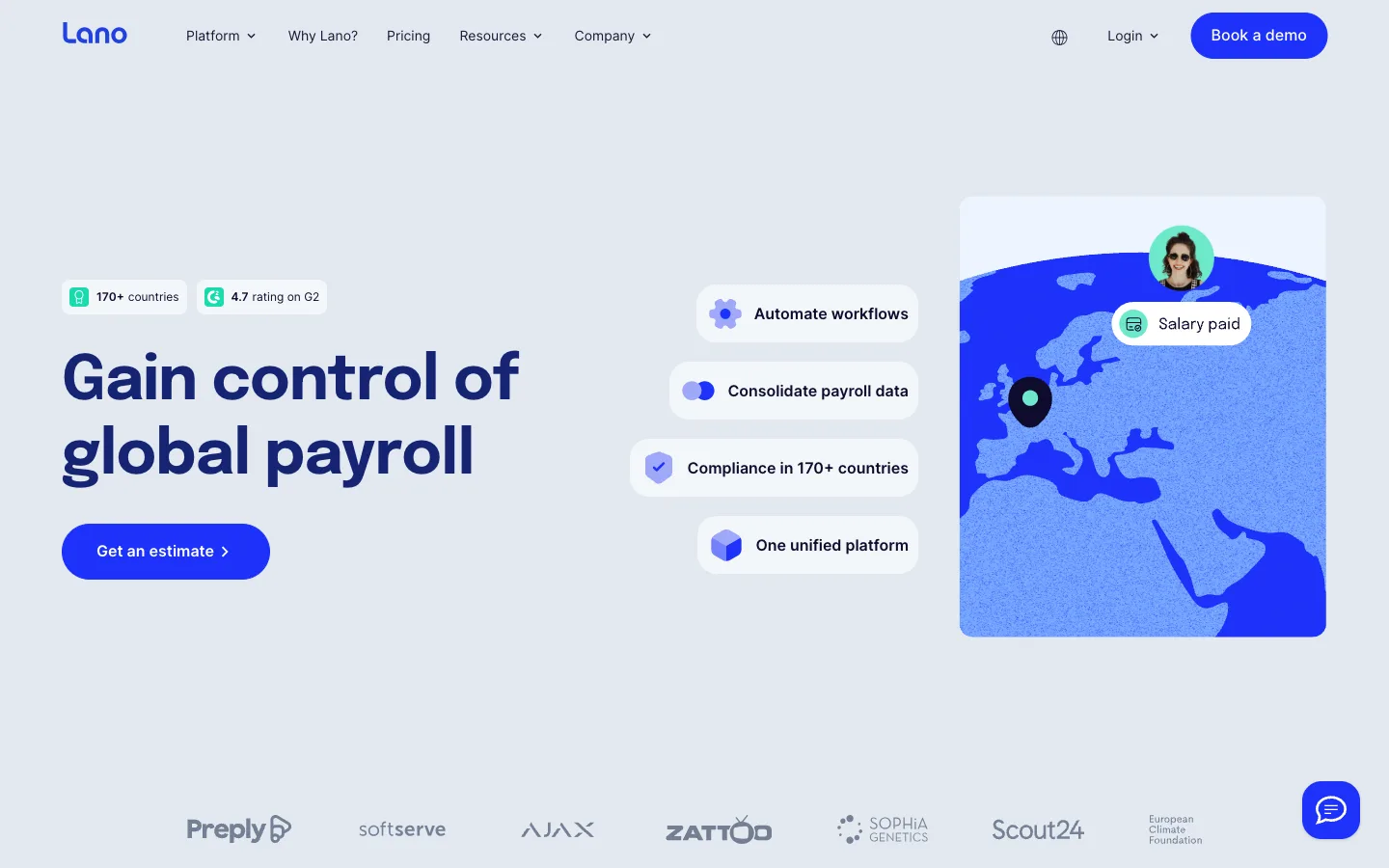
Lano is a strong fit when you need compliant hiring in 170+ countries and can work with a partner entities model.
Best for
Teams that prioritize country reach and can operate with partner-entity structures.
Not ideal for
Procurement workflows that require owned entities in every country.
Entity model
Partner entities
Primary tradeoff
Legal employer may be a local partner in some markets.
Summary
Pick Lano if you run a Europe-heavy workforce and need EOR, contractor payments, and payroll consolidation in one tool. It covers 170+ countries, supports 28 currencies, and is strongest for EU teams scaling from roughly 20 to 70 employees across mixed worker types.
The trade-offs are significant. Lano uses partner entities in every market — they own zero local entities. Pricing starts around €550/mo per employee, which puts it in the same range as Deel ($599/mo) but without Deel’s brand recognition, onboarding speed, or coverage depth. Support is business-hours only in European time zones, and the platform’s execution outside the EU — particularly in APAC and Africa — relies entirely on the quality of whatever local partner Lano has contracted. For companies with heavy hiring needs in Asia, the Americas, or the Middle East, Deel, Remote, or Multiplier are safer bets.
Pick Lano if
Your primary need is European workforce operations across contractors, EOR hires, and local payroll with one consolidated reporting layer.
Skip Lano if
You require owned entities, broad timezone support, or a lower-cost simple EOR setup without extra contractor module fees.
Lano: Key Facts
If Lano is on your shortlist, pressure-test feature fit in head-to-head comparisons, model all-in cost with the EOR cost guide, and validate talent demand in remote jobs by country.
What Lano Does Well
Contractor + EOR in one platform, with payroll consolidation on top
This is Lano’s actual differentiator, and it matters more than the marketing suggests. Most companies expanding internationally don’t start with 20 full-time employees. They start with 3–5 contractors, realize 2 of them need employment contracts for compliance or retention reasons, and then need both relationships managed without juggling separate platforms.
Lano handles this lifecycle natively. Contractors sit in the same dashboard as EOR employees, and the payroll consolidation product rolls up data from your existing local payroll providers into one reporting view. For a 50-person company with 15 contractors across Europe, 10 EOR employees, and 25 employees on local payroll through in-country providers, Lano gives you one invoice and one interface. Deel offers contractor management for free (Lano charges $29/user/month for it), but Deel’s payroll consolidation product is a separate sale. Remote doesn’t offer payroll consolidation at all.
The practical value shows up at month-end: instead of reconciling contractor invoices from one tool, EOR payroll from another, and local payroll reports from three different in-country providers, your finance team pulls everything from Lano. For companies with 30+ international workers of mixed types, that consolidation saves 5–10 hours per payroll cycle.
German engineering approach to compliance documentation
Lano’s German DNA shows up in the compliance paperwork. Employment contracts are detailed, locally reviewed, and come with country-specific addenda that cover statutory entitlements, notice periods, and benefits enrollment in granular detail. The platform generates compliance documentation — tax registrations, social security filings, employment certificates — through standardized templates that local partners execute.
For European markets where employment law documentation is dense (Germany, France, Netherlands, Spain), Lano’s templates are thorough. German employment contracts include works council provisions, fixed-term contract limitations under TzBfG, and vacation entitlement calculations that some competitors gloss over. French contracts handle the RTT (reduction du temps de travail) provisions and mutuelle requirements without requiring manual addenda.
This matters less in markets where employment contracts are simpler (UK, Singapore, most of LATAM), but for EU-heavy hiring, the documentation quality is above average for a partner-model provider.
Modular pricing means you don’t pay for what you don’t use
Unlike Deel or Remote, where you’re buying into an all-in-one platform whether you need every feature or not, Lano lets you pick modules. Need EOR in three countries and contractor payments in eight others? You pay for exactly that. Want to add payroll consolidation later when you set up your own entities? It bolts on without renegotiating the whole contract.
This modularity is genuinely useful for companies in transition. A startup that begins with 5 EOR employees might later establish its own entity in Germany and shift those employees to local payroll — but keep using Lano’s payroll consolidation to unify reporting. With Deel or Remote, you’d migrate off the platform entirely. With Lano, you adjust the module mix.
The flip side: à la carte pricing means Lano isn’t cheap for a simple use case. If all you need is EOR for 5 employees, Deel’s flat $599/mo with free contractor management is a cleaner value proposition. Lano’s modularity pays off when your workforce is complex enough to actually use multiple modules.
SOC 1 and SOC 2 Type II — both certifications, not just one
Lano holds both SOC 1 Type II (financial reporting controls) and SOC 2 Type II (security, availability, processing integrity, confidentiality, privacy) certifications, audited by Sensiba LLP with clean opinions and no exceptions. That’s a higher bar than most EOR providers clear. Deel has SOC 2 Type II. Remote has SOC 2 Type II. Neither publishes SOC 1 Type II.
For enterprise procurement teams that require SOC 1 documentation before a vendor can process payroll data — common in financial services, healthcare, and government contracting — Lano checks a box that many larger competitors don’t. If your company’s vendor security review requires both certifications, Lano passes without the exception-driven conversations that partner-model providers usually trigger.
Where Lano Falls Short
Zero owned entities — you’re always hiring through a local partner
This is the structural limitation that defines Lano’s risk profile. In every single one of Lano’s 170+ countries, the legal employer is a local partner firm, not Lano. Lano manages the commercial relationship, the platform, the invoicing, and the compliance coordination — but when a labor dispute, tax audit, or termination claim reaches a courtroom, the entity on the other side is a third-party partner.
Remote owns entities in every market it operates (85+ countries). Deel owns roughly half (80 of 160+). G-P owns entities in all 180+ markets. Lano owns zero. For a 3-person team in the Netherlands, this probably doesn’t matter. For a 15-person engineering team in Germany where termination protection is aggressive and works council disputes are real, the fact that your employees’ legal employer is a partner firm introduces a layer of separation that compliance-focused legal teams will flag.
Lano publishes a blog post explaining their partner model philosophy — essentially arguing that local partners provide deeper in-country expertise than a single multinational entity could. That argument has merit for small markets. It’s harder to defend for Germany, the UK, or France, where the major competitors have invested in owned entities specifically because the compliance stakes justify it.
Pricing is mid-range but feels expensive for what you get
Lano’s EOR pricing starts around €550/mo per employee and varies by country. That puts it roughly on par with Deel ($599/mo) and below Oyster ($699/mo), but above Multiplier ($400/mo) and Remofirst ($199/mo). The issue isn’t the price itself — it’s what you get relative to the price.
At €550/mo, you’re paying a Deel-level fee for a partner-entity-only provider with narrower brand recognition, slower onboarding, and a smaller support team. Deel at $599/mo gives you owned entities in half its markets, 2–5 day onboarding, free contractor management, and a platform used by thousands of companies. Lano at a similar price point gives you partner entities everywhere, 5–10 day onboarding, and charges $29/user/month for contractor management on top.
The math gets worse for simple use cases. One EOR employee plus five contractors: Deel costs $599/mo total (EOR fee + free contractor management). Lano costs roughly €550 + (5 × $29) = ~€695/mo. That’s a 15–20% premium for a provider with less brand trust and no owned entities. Lano’s pricing only makes sense when the payroll consolidation module or the modular approach adds enough operational value to justify the premium.
Support outside European business hours is thin
Lano’s support team operates primarily on CET/CEST hours. For German, Dutch, French, and Spanish companies — Lano’s core market — this is fine. Queries submitted during EU business hours typically get responses within a few hours, and dedicated account managers for larger clients respond faster.
The problem surfaces when your team operates in APAC or the Americas. A People ops manager in Singapore submitting a payroll question at 10 AM SGT (3 AM CET) won’t get a response until Lano’s team starts their day. That’s a 6–8 hour wait minimum. For US West Coast teams, afternoon queries sit overnight. Deel, Remote, and Multiplier all offer broader timezone support coverage — Multiplier’s Singapore headquarters provides native APAC support, and Deel has enough scale to cover US and EU hours responsively.
Lano doesn’t advertise 24/7 support, and they’re transparent about it. But if your international hiring extends beyond Europe, the support gap becomes a recurring friction point that adds hours of latency to routine questions about payroll timing, contract amendments, or benefits enrollment.
Limited currency support compared to larger competitors
Lano supports payments in 28 currencies. Deel handles 120+. Remote covers 75+. For a company paying contractors and employees across three European countries, 28 currencies is fine — EUR, GBP, CHF, SEK, and the other major European currencies are covered. But if you’re paying a contractor in Thai baht, Nigerian naira, or Colombian pesos, you may hit a wall.
The currency limitation disproportionately affects contractor payments, where workers often prefer receiving funds in their local currency to avoid exchange rate losses. If Lano doesn’t support the currency, the payment goes through in EUR or USD with the contractor absorbing the conversion cost. That’s a poor employee/contractor experience that larger platforms avoid.
Brand recognition and ecosystem are still early-stage
Lano has raised ~$17.4M in total funding. Deel has raised over $600M. Remote has raised $500M+. That funding gap shows up in ecosystem breadth: Lano’s integration marketplace is smaller, the partner network is less established, and the third-party content (implementation guides, community forums, consultancy partnerships) is thinner.
For a company whose People team needs to Google “how to do X in Lano” — whether that’s setting up a new country, configuring an integration, or troubleshooting a payroll issue — the available knowledge base is a fraction of what exists for Deel or Remote. The help center is functional but sparse compared to Deel’s extensive documentation library. This is the hidden cost of choosing a smaller provider: institutional knowledge doesn’t scale linearly with features.
Pricing Breakdown
| Item | Cost |
|---|---|
| EOR per employee | From €550/mo (varies by country) |
| Contractor management | $29/user/month |
| Payroll consolidation | From €3/employee/month |
| Multi-country payroll | From €19/employee/month |
| Background checks | Quoted per case |
| Work permits & visas | Quoted per case |
| Dedicated account manager | Included for larger accounts |
What’s included in the EOR base fee: Employment contract generation, local payroll processing through partner entities, statutory benefits administration, tax withholding and filing, compliance documentation, and platform access.
What’s not included: Contractor management (separate module), payroll consolidation (separate module), work permit/visa processing, background checks, and enhanced benefits above statutory minimums.
How the country-variable pricing works: Lano’s EOR cost calculator factors in employee location, gross salary, local statutory costs (social security, insurance, accrued benefits), and Lano’s service fee. The service fee component varies by country — more complex markets (Germany, France, Brazil) carry higher fees than straightforward ones (UK, Netherlands). This means your per-employee cost isn’t a flat rate; it shifts based on where you’re hiring. Ask for a country-specific quote before budgeting.
Annual cost example: 10 EOR employees at an average €550/mo = €66,000/year. Add 15 contractors at $29/user/month = $5,220/year. Add payroll consolidation for 20 entity-based employees at €3/mo = €720/year. Total: approximately €72,000/year. The same 10 EOR employees on Deel at $599/mo = $71,880/year, but Deel’s contractor management is free, saving $5,220/year on the contractor piece. Lano only wins the cost comparison if the payroll consolidation module eliminates a separate vendor that costs more than the differential.
Lano: Region-by-Region
Europe
Home market. Partner entity, but strongest local partner relationships here. Documentation quality is above average for works council and TzBfG compliance.
Country guide → United KingdomPartner entity. Functional execution but no advantage over Deel or Remote, both of which own UK entities.
Country guide → NetherlandsPartner entity. Solid for Dutch 30% ruling documentation. Onboarding runs 5–7 days.
Country guide → FrancePartner entity. Contracts handle RTT and mutuelle provisions well. Termination support quality depends on local partner.
Country guide → SpainPartner entity. Adequate for standard hires. Less tested than Deel or Remote in this market.
Country guide → PolandPartner entity. Cost-effective market for engineering talent. Limited user feedback on Lano's Polish execution.
Country guide →Americas
Partner entity. State-by-state compliance handled via partner. Deel and Rippling have stronger US infrastructure.
Country guide → CanadaPartner entity. Provincial payroll handled adequately. No owned-entity advantage over Deel or Remote here.
Country guide → BrazilPartner entity. Complex market where partner quality matters most. Onboarding likely 10+ days given registration requirements.
Country guide → MexicoPartner entity. Functional but thin local track record compared to Deel's established Mexico presence.
Country guide → ColombiaPartner entity. Adequate for LATAM expansion. Deel and Ontop have deeper Colombia-specific experience.
Country guide → ArgentinaPartner entity. Currency and inflation management depends entirely on local partner capability.
Country guide →Asia-Pacific
Partner entity. Functional for standard hires. Multiplier and Deel both have owned entities and faster support here.
Country guide → SingaporePartner entity. Adequate but Multiplier's Singapore HQ and Deel's owned entity make them stronger options.
Country guide → JapanPartner entity. Complex labor law market where partner quality is critical. Limited user feedback on Lano's Japan execution.
Country guide → PhilippinesPartner entity. Standard execution. Support timezone gap is a real issue for Philippine-based teams.
Country guide → IndonesiaPartner entity. Thin track record in this market. Deel and Multiplier are safer picks for Indonesia.
Country guide → AustraliaPartner entity. Straightforward market, but no advantage over Deel or Rippling's owned AU entities.
Country guide →Deep dive: For detailed compliance analysis of Lano in Asia, see our eor.asia review.
Middle East & Africa
Partner entity. Functional for Dubai free zone hires. Papaya Global and Remote have stronger UAE track records.
Country guide → Saudi ArabiaPartner entity. Saudization requirements add complexity. Verify partner's nitaqat compliance handling before committing.
Country guide → South AfricaPartner entity. Standard execution for a relatively straightforward market. Limited differentiation from competitors.
Country guide → NigeriaPartner entity. Thin track record. Deel has more established Nigerian operations with faster onboarding.
Country guide → KenyaPartner entity. Functional but limited user feedback. Consider Deel or Multiplier for East African hiring.
Country guide → EgyptPartner entity. Adequate for standard hires. Currency management and local compliance depend entirely on partner.
Country guide →Deep dive: For detailed compliance analysis of Lano in Africa, see our eor.africa review.
Pros and Cons
How Lano Compares
Broader coverage, faster onboarding (2–5 days vs. 5–10), free contractor management. Lano wins on payroll consolidation and modular pricing.
Full comparison → RemoteFewer countries but owns every entity. Stronger compliance guarantee. Lano wins on contractor payments and payroll consolidation.
Full comparison → Multiplier$150+/mo cheaper with native APAC support from Singapore HQ. Lano wins on EU compliance depth and payroll consolidation.
Full comparison → Papaya GlobalEnterprise-grade payroll engine with deeper analytics. Higher price point. Lano wins on mid-market simplicity and modularity.
Full comparison →Case Studies
Berlin-based platform engineering company scaled from 20 to 60 employees across 4 time zones. Lano reduced invoice approval and payment processing to seconds and resolves support issues in under 6 hours average.
Read case study → DeskbirdMunich-based workplace management startup scaled from 20 to 70+ employees across 9 countries in under a year. Lano onboarded new hires within 1 week and simplified contractor payments via the Lano Wallet.
Read case study → ZattooEuropean TV streaming platform with ~250 employees used Lano to hire their first remote employee in 1 month — a role that went unfilled for 3 years when limited to German and Swiss candidates only.
Read case study → Wacoal EuropeLingerie manufacturer consolidated payroll for 465 employees across multiple European entities. Reduced monthly payroll processing to 15 minutes with 24-hour average response times on payroll queries.
Read case study →Real User Feedback
| Platform | Rating | Reviews |
|---|---|---|
| Capterra | 4.7/5 | 50+ |
| G2 | Not listed | — |
| Trustpilot | Not listed | — |
Lano’s review footprint is significantly smaller than competitors like Deel (3,500+ G2 reviews) or Remote (1,000+ G2 reviews). The Capterra rating of 4.7/5 is solid, but based on a limited sample size. The absence of a visible G2 profile is a gap — most enterprise buyers check G2 during vendor evaluation, and Lano’s invisibility there means procurement teams can’t benchmark it against competitors using the same review platform.
What users praise:
- Single platform for managing contractors, EOR employees, and payroll consolidation without switching tools
- Compliance documentation quality for European markets, particularly Germany and France
- Modular pricing that lets companies add or remove services as their workforce mix changes
- Responsive account managers for mid-size accounts within EU business hours
- Clean onboarding flow with straightforward contract generation
- SOC 2 certification making vendor security reviews easier for enterprise procurement
What users complain about:
- Onboarding speed is slower than Deel or Remote — multiple users report 7–10 business days even in straightforward markets
- Support responses outside European business hours take 6–12 hours
- Platform documentation and help center content is thinner than larger competitors
- Contractor management at $29/user/month feels expensive compared to Deel’s free offering
- Currency limitations cause friction for contractors in non-major currencies
- Partner entity model raises questions from legal teams during compliance reviews — no owned-entity option available
Our Final Verdict
Use Lano if: You’re a European mid-market company (50–500 employees) managing a mix of contractors, EOR employees, and local payroll across multiple EU countries. The payroll consolidation module genuinely adds value when you’re running 3+ local payroll providers alongside EOR and contractor management. If your workforce is Europe-centric, your People team operates on CET, and you want one platform instead of three separate tools, Lano fills that niche well.
Skip Lano if: Your legal team requires owned entities (Remote is the answer). Your hiring is global rather than EU-centric and you need broad timezone support (Deel covers this). You’re price-sensitive and only need basic EOR (Multiplier at $400/mo or Remofirst at $199/mo). Your hiring is concentrated in APAC (Multiplier with Singapore HQ support). You only need EOR with no contractor payments or payroll consolidation (Lano’s modular pricing works against you for simple use cases).
Bottom line: Lano occupies a specific and defensible niche: the European company with a complex workforce that needs EOR, contractor management, and payroll consolidation in one platform. That’s a real problem, and Lano solves it with German thoroughness and solid compliance documentation. Outside that niche, the 100% partner entity model, EU-hours-only support, and Deel-level pricing without Deel-level execution make it a harder sell. For the EU-headquartered company running contractors, EOR employees, and local payroll across multiple European countries — and tired of reconciling three separate invoices — Lano is the right call: one platform, one invoice, genuine European compliance depth.
Frequently Asked Questions
How much does Lano cost?
From €550/mo per employee (frontmatter). Contractor management: $29/mo per contractor — Deel is free. Payroll consolidation standalone: €3/employee/month. 20 contractors = $6,960/year that Deel doesn’t charge. Lano’s contractor product justifies cost only if you use payroll consolidation and need unified reporting.
Does Lano use owned or partner entities?
100% partner. All 170+ countries — a local partner firm is the legal employer, not Lano. For 1–5 employees per market, usually fine. For larger teams in Germany, France, Brazil — ask your legal team. Remote owns all entities. Lano argues partners provide deeper local expertise.
How fast is Lano’s onboarding?
5–10 business days. Netherlands/UK: ~5 days. Brazil/Germany: ~10. Slower than Deel (2–5 days); in line with Remote (3–5) in simple markets. Work permits: 4–8 weeks.
Is Lano better than Deel for European companies?
Lano: Berlin-based, GDPR compliant, SOC 1+2 Type II, payroll consolidation (€3/emp). Deel: faster onboarding, free contractors, 120+ currencies. Lano’s German domicile and data residency matter for EU procurement. Deel’s platform and contractor product win for most buyers.
Who should skip Lano?
Need 120+ currencies for contractor payments — Lano supports 28; Deel supports 120+. Want owned entities — Remote. Large contractor base — Deel’s free contractor management. Lano fits EU companies valuing GDPR + payroll consolidation; get transition plan in writing before signing.
For market-level context beyond vendor features, see EOR pricing hidden costs and browse remote jobs by country to understand demand patterns.
Further Reading
- Deel EOR Review — The market default. Compare Lano’s modular approach against Deel’s all-in-one platform.
- Remote EOR Review — 100% owned entities everywhere. The compliance-first alternative to Lano’s partner model.
- Multiplier EOR Review — $400/mo with Singapore HQ. The APAC-first option that undercuts Lano on both price and Asian coverage.
- Papaya Global EOR Review — Enterprise payroll with deeper analytics. Compare against Lano’s payroll consolidation module.
- Omnipresent EOR Review — Another European EOR with owned entities. Worth evaluating if you want EU-based provider with owned entities instead of partners.
- EOR comparisons

Was this page helpful?
Tell us or send a correction.