
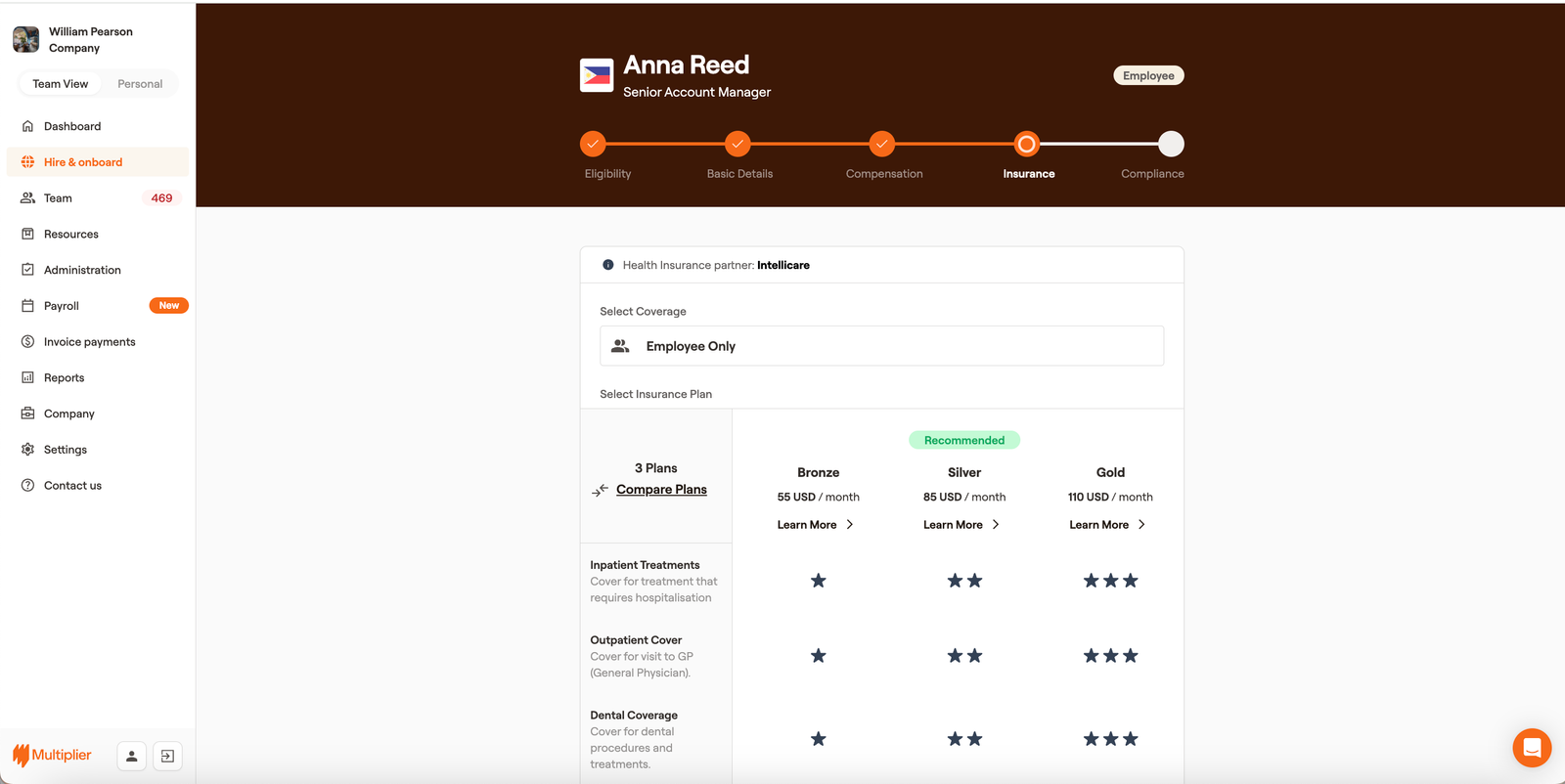
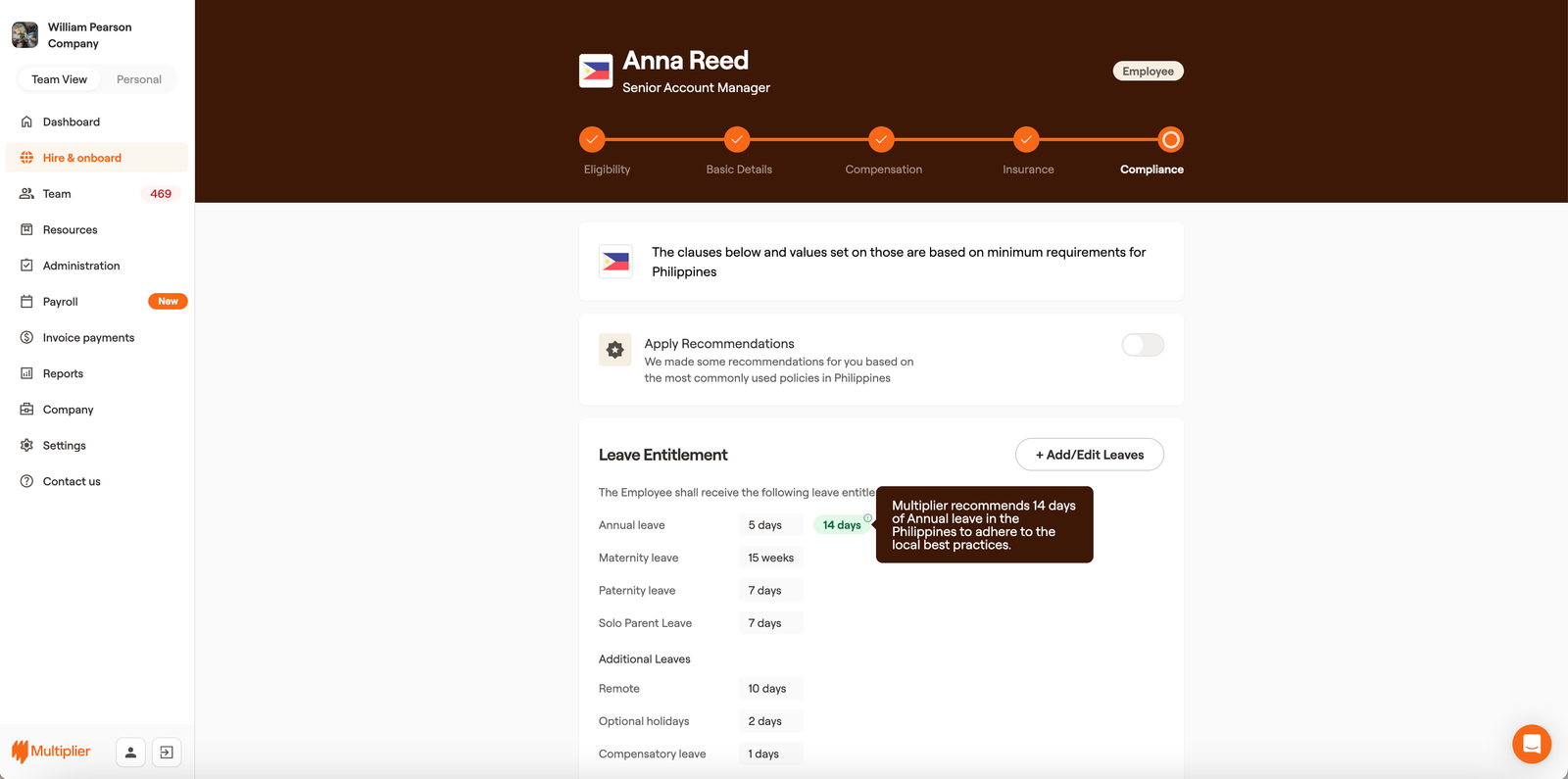
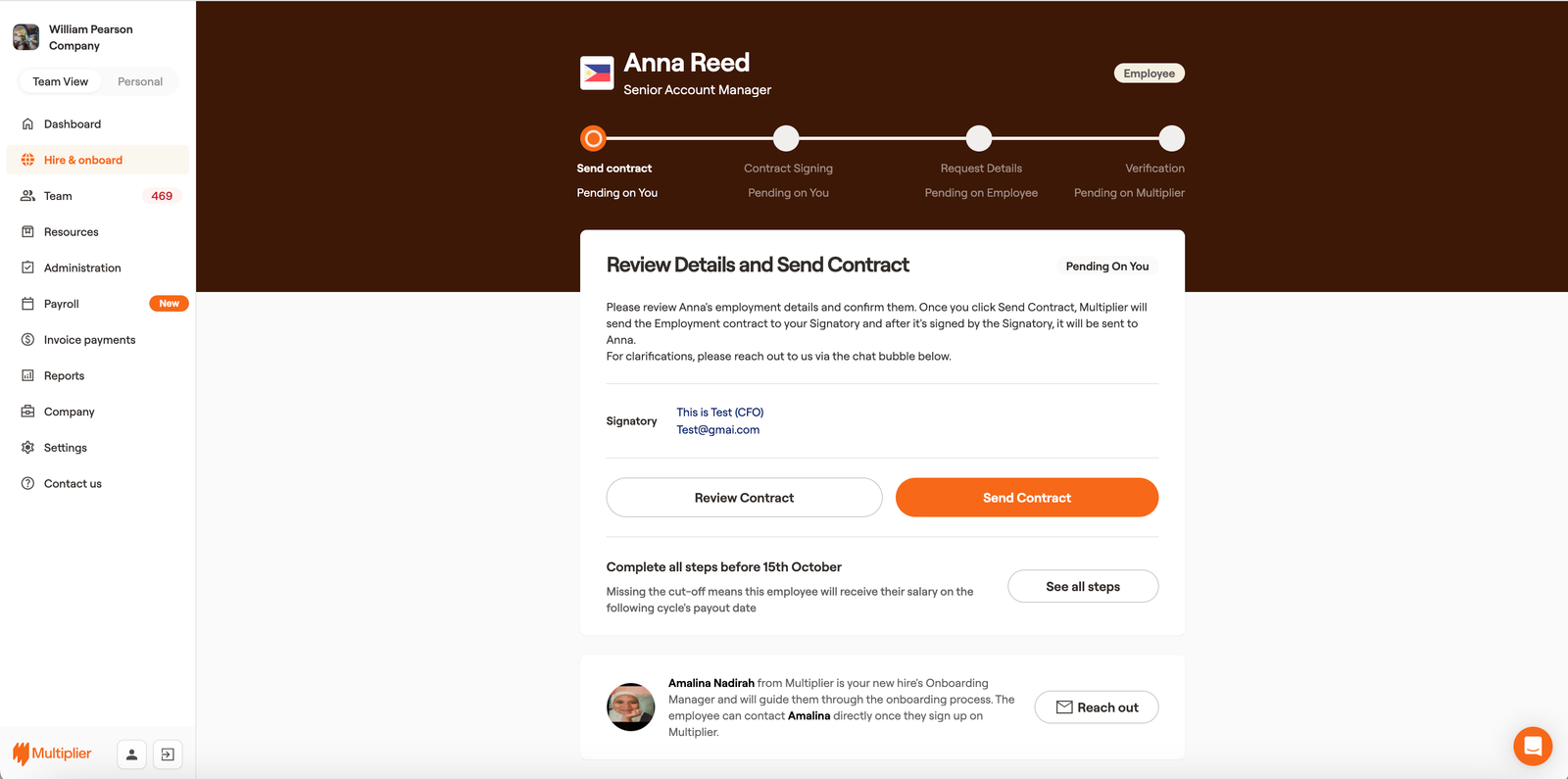
Quick Verdict (2026)
Multiplier is a strong fit when you need compliant hiring in 150+ countries and can work with a mixed entities model.
Best for
Teams balancing global coverage and practical speed across multiple markets.
Not ideal for
Teams that only need one country and can justify setting up a local entity immediately.
Entity model
Mixed entities
Primary tradeoff
Entity model consistency varies by country.
Summary
Multiplier is the price leader among serious EOR providers, and the $199/mo gap between Multiplier and Deel is real money — $23,880/year on a 10-person international team. If your hiring is weighted toward Asia-Pacific and cost discipline matters, Multiplier is the strongest pick in the category. Singapore HQ means your APAC team gets same-timezone support, and owned entities in India, Singapore, the Philippines, and Australia give you direct employer relationships in the markets where most APAC hiring actually happens.
The trade-offs are straightforward. The platform feels a generation behind Deel’s self-serve polish. Entity transparency is weaker — you’ll need to press your account manager for country-by-country ownership details. European and Latin American coverage leans on partner entities, and the support experience outside APAC hours drops noticeably. For companies hiring primarily in Europe or needing enterprise-grade integrations, Deel or Remote will serve you better despite the higher per-head cost.
Our take: pick Multiplier if this sounds like you
- You are APAC-heavy and need materially lower per-head EOR cost without giving up core compliance coverage.
- Your team operates in APAC time zones and wants support that responds during your business day.
Skip Multiplier if these are non-negotiable
- You need top-tier product polish, deeper integrations, and more automation depth out of the box.
- You require proactive transparency on owned-vs-partner entity model in every target country.
Multiplier: Key Facts
If Multiplier is on your shortlist, pressure-test feature fit in head-to-head comparisons, model all-in cost with the EOR cost guide, and validate talent demand in remote jobs by country.
What Multiplier Does Well
The pricing advantage is structural, not promotional
$400/mo per employee. That’s not an introductory rate or a volume-discounted number — it’s the published starting price. Deel charges $599/mo. Remote charges $599/mo. Oyster HR charges $699/mo. At 10 employees, the annual difference between Multiplier and Deel is $23,880. At 25 employees, it’s $59,700. That’s a headcount worth of savings, not a rounding error.
The pricing discipline makes sense given Multiplier’s positioning. Founded in 2020, they entered a market where Deel and Remote had already established the $500–$600/mo price band. Multiplier undercut by ~33% to win market share and has held that position through 2026. The per-employee economics work because Multiplier’s operational costs are lower — Singapore HQ, leaner team, and a narrower product surface than Deel’s full-stack HR platform.
Volume discounts push the price further. Teams of 15+ employees on annual billing can negotiate to $300–$350/mo per employee. At that rate, a 20-person international team costs $72,000–$84,000/year in EOR fees. The same team on Deel at $599/mo (without negotiation) costs $143,760/year. Even with Deel’s volume discount to $475/mo, it’s $114,000/year. Multiplier saves you $30,000–$70,000/year depending on headcount and negotiation.
APAC depth that Deel and Remote can’t match from San Francisco
Multiplier’s Singapore headquarters isn’t just an address — it shapes how the entire APAC operation runs. Owned entities in Singapore, India, the Philippines, and Australia mean Multiplier is the legal employer in the four markets where most APAC hiring volume concentrates. Your Singapore-based finance hire, your Bangalore engineering team, your Manila customer support pod, your Sydney sales rep — all employed by Multiplier entities, not third-party partners.
The support difference is tangible. Multiplier’s APAC team operates during SGT/IST business hours with dedicated account managers who understand local employment law nuance. When your India-based employee has a question about PF withdrawal at 10 AM IST, they get a response in minutes, not 8–12 hours. Deel’s support team, optimized for US and European hours, consistently draws complaints about APAC response lag. If your People team is based in Singapore or your workforce skews APAC, Multiplier’s support model is a genuine operational advantage.
Onboarding in owned-entity APAC markets is faster too. Singapore hires close in 3–4 business days. India runs 3–5 days. The Philippines finishes in 4–5 days. These timelines match or beat Deel in the same markets, and they’re faster than Remote, which takes 5–7 days across APAC due to additional compliance review steps.
Multi-country payroll that actually runs on time
Payroll accuracy sounds like table stakes until you’ve dealt with a provider that botches statutory deductions in India or misses CPF contribution deadlines in Singapore. Multiplier’s payroll engine handles multi-currency processing, country-specific tax calculations, and statutory contribution deadlines from a single dashboard. Payroll runs are consistent — employees get paid on time, in the correct amount, with accurate local tax withholding.
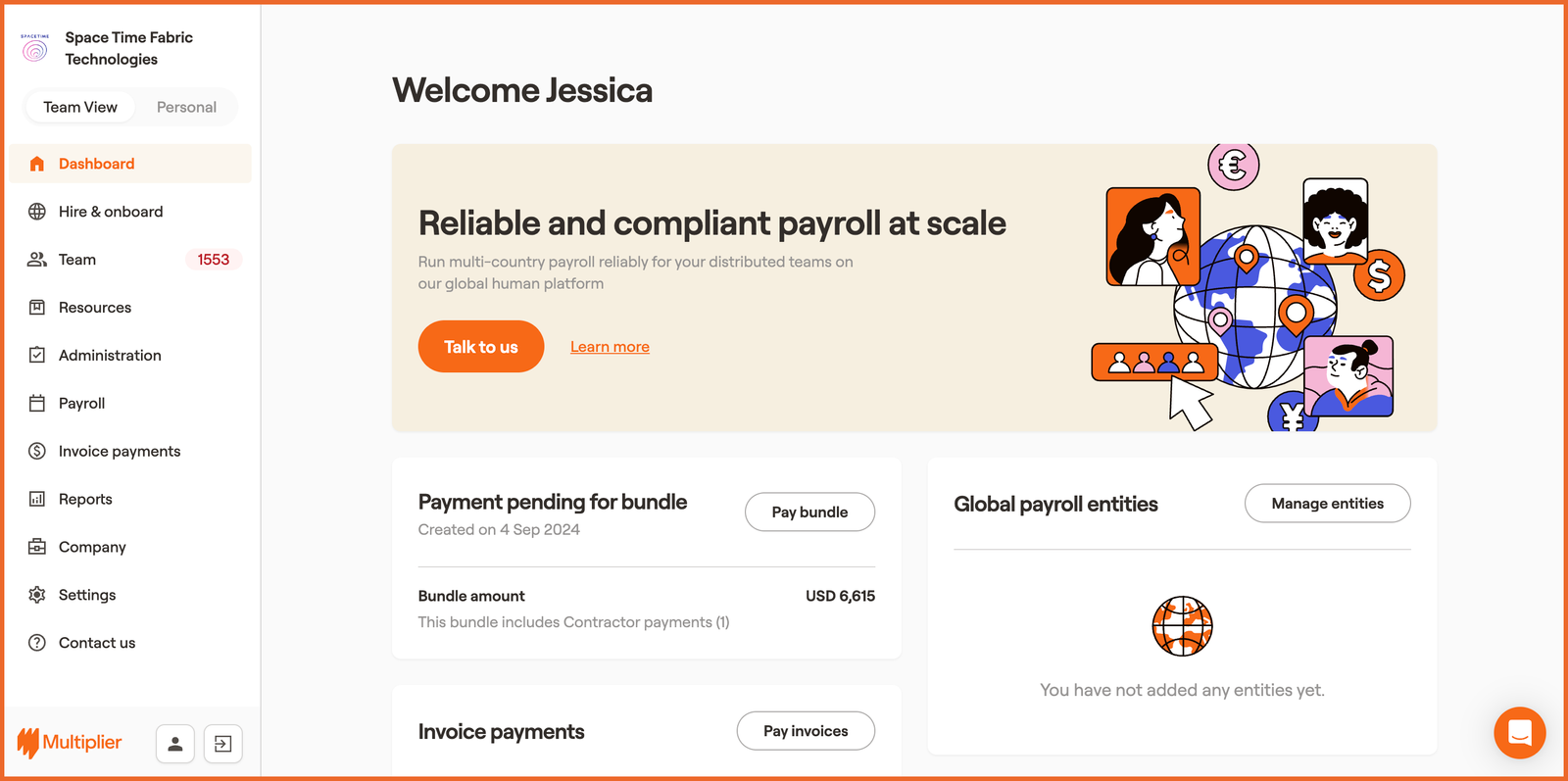
The dashboard consolidates payroll across all active countries into one view. You see gross salary, employer contributions, net pay, and EOR fees per employee per country. For a CFO reconciling international labor costs, this eliminates the manual spreadsheet work that a multi-provider setup requires. One invoice, one payroll calendar, one dashboard. The execution isn’t flashy, but it’s reliable, and reliable payroll is the foundation of everything else.
Contractor management and PEO for US companies
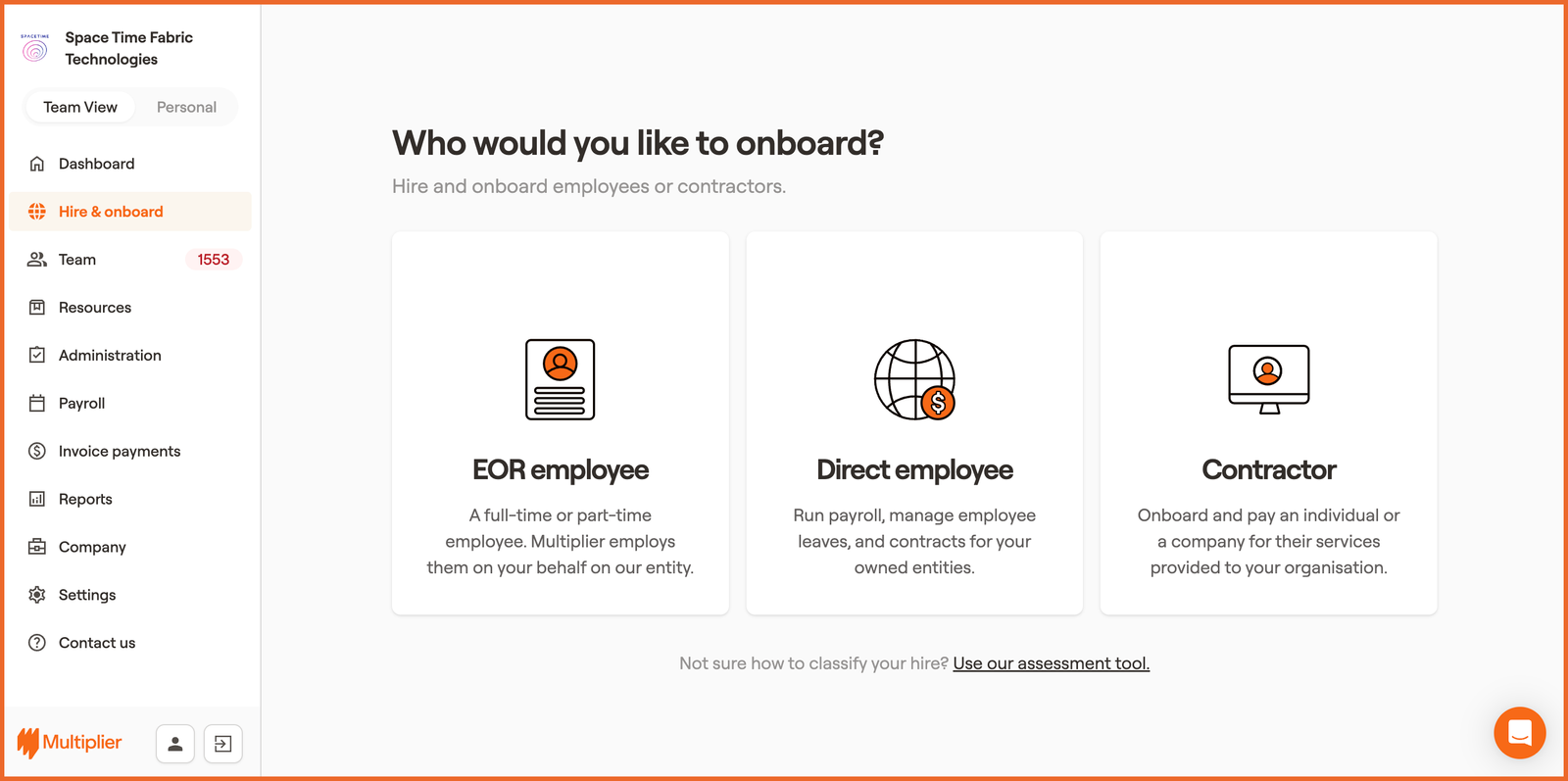
Multiplier offers contractor management alongside EOR, letting you manage contractors and full-time employees through the same platform. Unlike Deel’s free contractor tier, Multiplier charges for contractor management, but the integration between contractor and EOR workflows makes conversion straightforward when you need to move someone from a 1099-equivalent arrangement to full-time employment.
The PEO option for US-based companies is a differentiator that Deel and Remote don’t offer directly. If you’re a US company with domestic employees who need co-employment benefits (group health insurance, 401(k) access, workers’ comp) alongside your international EOR hires, Multiplier handles both. That eliminates the need for a separate PEO provider for your US team while using Multiplier for international hires. One vendor for domestic and international employment.
SOC 2 compliance and data handling
Multiplier holds SOC 2 Type II certification, which means their data handling, access controls, and operational security have been independently audited. For companies in regulated industries — fintech, healthcare, enterprise SaaS — this is a checkbox requirement. Multiplier clears it. Employee PII, payroll data, and contract documents are encrypted in transit and at rest, with role-based access controls and audit logging. It’s not a differentiator (Deel and Remote also have SOC 2), but it’s a prerequisite Multiplier doesn’t miss.
Where Multiplier Falls Short
Platform UX is functional but dated
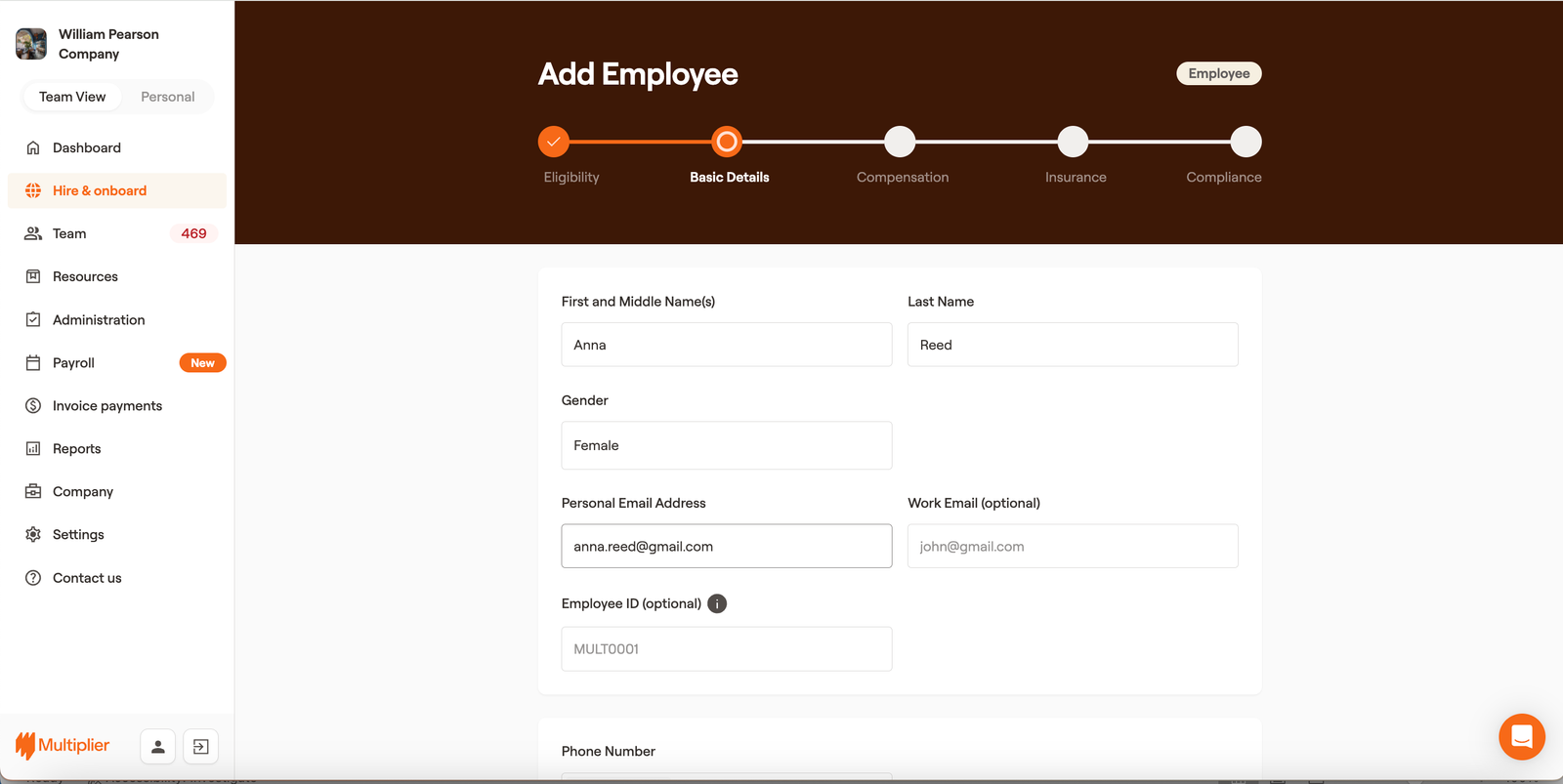
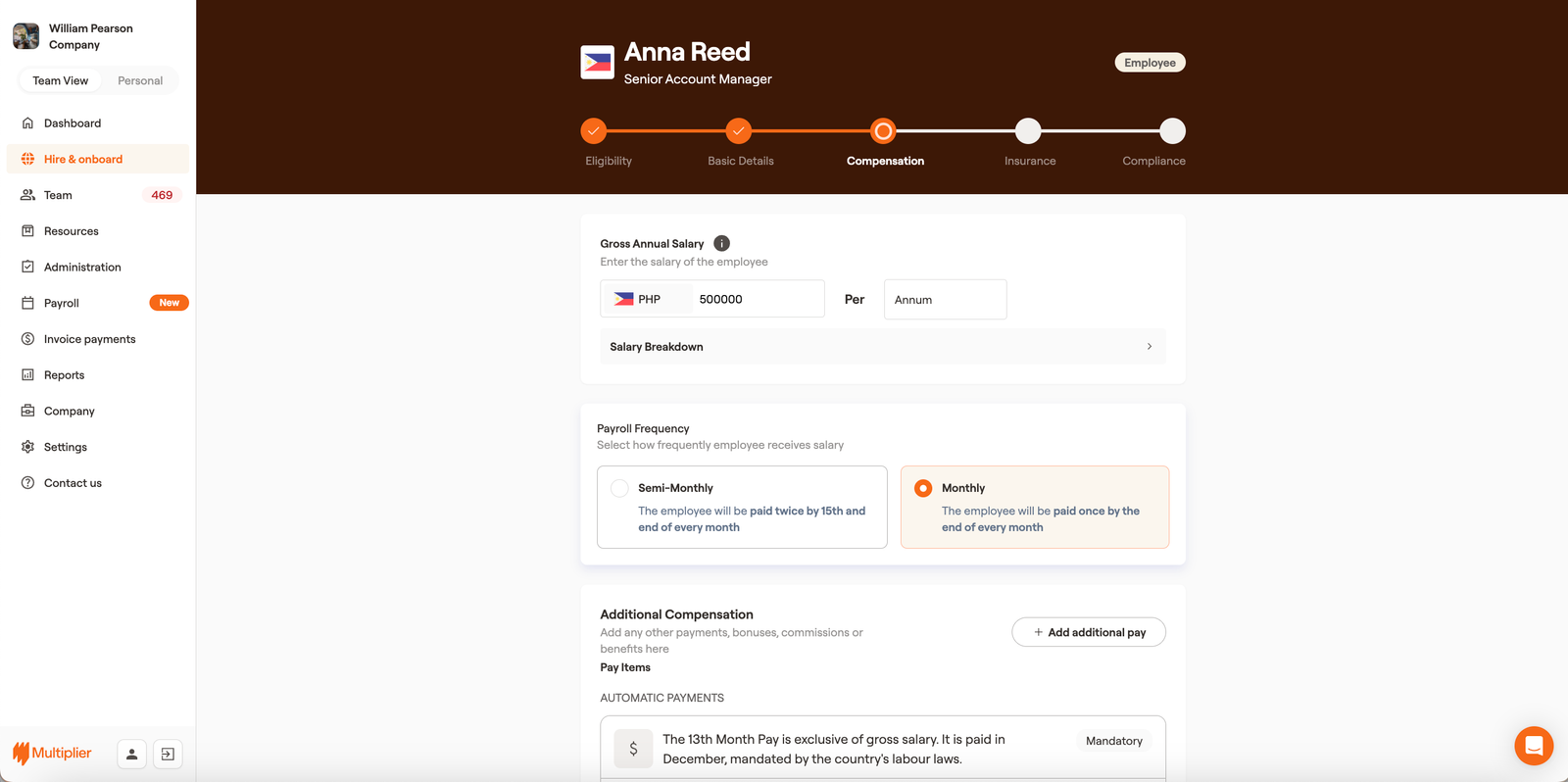
The Multiplier dashboard does what you need, but every interaction takes more clicks and more patience than the same task on Deel. Contract generation requires more manual input — where Deel auto-populates country-specific clauses and benefits based on the hire’s location, Multiplier’s flow involves more review steps and CSM coordination. Document uploads occasionally hang. The search function across employees and contracts is slow on larger teams. The mobile experience is bare-bones.
For a People ops manager adding their 3rd international hire, none of this is a dealbreaker. For a team managing 50+ international employees across 10 countries and interacting with the platform daily, the friction compounds. Deel’s platform has had a four-year head start on UX investment, and it shows. Multiplier’s engineering team is iterating — the 2025 redesign improved navigation and payroll views — but the gap remains visible in contract workflows, document management, and reporting.
The API is functional but limited compared to Deel’s. Multiplier integrates with BambooHR, Greenhouse, and Workday, which covers the core HRIS and ATS connections. But Deel connects to 100+ tools including QuickBooks, Xero, NetSuite, and custom webhook endpoints. If your Finance team needs automated payroll cost sync to your accounting platform, Deel’s integration depth is materially better.
Entity transparency is a persistent weak spot
Multiplier uses a mixed entity model — owned entities in some countries, partner entities in others. That’s the same model as Deel. The difference: Deel is reasonably upfront about which markets are owned versus partnered (roughly 80/80). Multiplier is less forthcoming. The sales process doesn’t proactively disclose entity ownership by country, and the website doesn’t publish a clear breakdown.
This matters because the entity model determines your compliance risk profile. In an owned-entity country, Multiplier is the legal employer — they sit across from your employee in a labor dispute. In a partner-entity country, a local third-party firm holds the employment relationship and Multiplier manages the commercial layer. The practical difference in a severance dispute or regulatory audit is real. You need to ask, specifically and per-country, before signing. Multiplier will answer, but they should volunteer this information, and they don’t.
From what we’ve confirmed, Multiplier owns entities in Singapore, India, the Philippines, the UK, and Australia. Everything else — most of Europe, Latin America, Africa, the Middle East — is partner-based. That’s a heavier partner dependency than Deel’s ~50/50 split and much heavier than Remote’s 100% owned model.
Younger track record means fewer edge cases tested
Multiplier was founded in 2020. Deel launched in 2019 with a wider client base; G-P has been operating since 2012. In EOR, track record matters because the hardest work happens at the edges: wrongful termination claims in Germany, severance disputes in Brazil, tax authority audits in India, works council negotiations in the Netherlands. A provider’s ability to handle these situations depends on institutional knowledge built over hundreds of cases.
Multiplier has grown fast — they claim thousands of corporate clients — but they haven’t processed the volume of complex terminations, disputes, and regulatory interactions that Deel or G-P have. For straightforward hires (onboarding, payroll, basic benefits) this doesn’t matter. For your first employment tribunal hearing in the UK or a social justification challenge in Germany, the depth of your EOR’s in-house legal team is the difference between a clean resolution and a protracted, expensive mess.
If you’re hiring in markets with aggressive labor protections (Germany, Brazil, France, the Netherlands), ask Multiplier specifically about their termination case history in that jurisdiction. The answer will tell you whether their local team has handled enough disputes to navigate yours confidently.
European and LATAM support is thinner
Multiplier’s APAC support is excellent. The same isn’t true for Europe and Latin America. Support for European markets runs through a smaller team, and the response times during CET business hours are slower than what Deel offers. Complex queries about German works councils, French convention collective classifications, or Dutch 30% ruling applications take longer to resolve and sometimes get routed to local partners rather than handled in-house.
Latin American coverage — Brazil, Mexico, Colombia, Argentina — relies entirely on partner entities. Onboarding in Brazil takes 7–10 business days through Multiplier versus 5–7 through Deel. Support for LATAM-specific compliance questions (Brazil’s eSocial system, Mexico’s PTU profit sharing, Colombia’s integral salary thresholds) is competent but not specialized. If your hiring plan is LATAM-heavy, Deel’s deeper partner network and faster onboarding in the region give it the edge.
Integrations are limited compared to the field
Three core integrations — BambooHR, Greenhouse, Workday — cover the basics for HR and recruiting workflows. But modern People teams run on more than three tools. If you use Lever for ATS, NetSuite for accounting, or Slack for employee self-service queries, Multiplier doesn’t have native connections. Deel’s 100+ integrations and well-documented API give it a clear advantage for teams that need their EOR platform to fit into a broader tech stack without manual data transfers.
Multiplier’s API exists but is less mature. Custom integrations are possible but require more engineering effort than Deel’s webhook-driven approach. For a 10-person startup, this is irrelevant. For a 100-person company with established HR and finance tooling, integration limitations create real operational friction.
Pricing Breakdown
| Item | Cost |
|---|---|
| EOR per employee | $400/mo |
| Contractor management | From $40/mo per contractor |
| PEO (US employees) | Custom pricing |
| Background checks | Quoted by country and screening scope |
| Work permits & visas | Quoted per case |
| Equipment procurement | Varies (coordinated through partners) |
| Premium support / dedicated CSM | Custom pricing |
| Benefits add-ons (above statutory) | Varies by country |
Volume discounts: Teams of 15+ employees on annual billing typically negotiate to $300–$350/mo per employee. The discount scales with headcount and contract length. Multiplier’s sales team has flexibility here, especially if you bring a competing Deel or Remote quote to the table.
What’s genuinely included in the base fee: Employment contract generation, local payroll processing, statutory benefits administration, tax withholding and filing, basic support via chat and email, and compliance documentation including employment agreements, offer letters, and termination support.
What’s not included: Work permit/visa processing, hardware procurement and shipping, enhanced benefits above statutory minimums, dedicated CSM support, and background checks. The PEO product for US employees is priced separately.
Annual cost example: 15 employees at $400/mo = $72,000/year. At a negotiated $325/mo on annual billing = $58,500/year. The same 15 employees on Deel at $599/mo = $107,820/year. At Deel’s negotiated $475/mo = $85,500/year. The difference: $13,500–$49,320/year depending on negotiation. At 25 employees, the savings range grows to $22,500–$82,200/year. That’s not marginal — it’s budget for another hire or two.
Cost comparison at scale:
| Headcount | Multiplier ($400/mo) | Multiplier (negotiated $325/mo) | Deel ($599/mo) | Deel (negotiated $475/mo) |
|---|---|---|---|---|
| 5 | $24,000/yr | N/A | $35,940/yr | N/A |
| 10 | $48,000/yr | $39,000/yr | $71,880/yr | $57,000/yr |
| 25 | $120,000/yr | $97,500/yr | $179,700/yr | $142,500/yr |
| 50 | $240,000/yr | $195,000/yr | $359,400/yr | $285,000/yr |
Multiplier: Region-by-Region
Owned entity. Home market advantage — fastest onboarding (3–4 days), dedicated local support team, and deepest compliance knowledge. The strongest market in Multiplier's portfolio.
Country guide → IndiaOwned entity. 3–5 day onboarding. Strong for scaling engineering and operations teams. Home-region support means IST-hours responsiveness that Deel can't match.
Country guide → PhilippinesOwned entity. 4–5 day onboarding. Popular for customer support and BPO hires. Local team handles 13th month and SSS coordination directly.
Country guide → AustraliaOwned entity. Clean execution for standard hires. Superannuation and Fair Work compliance handled in-house. Consider Rippling if you already run their AU payroll.
Country guide → United KingdomOwned entity. Solid execution but benefits packages lean compared to Oyster HR. Onboarding in 4–5 days, a step behind Deel's 2–3 day UK floor.
Country guide → GermanyPartner entity. Functional but complex terminations are better handled by G-P or Remote, who have deeper in-house German legal teams.
Country guide → BrazilPartner entity. Onboarding runs 7–10 days, slower than Deel's 5–7. Adequate for standard hires but not the provider you'd pick if Brazil is your primary market.
Country guide → CanadaPartner entity. Provincial payroll tax handling is competent. Deel's owned entity and faster onboarding (2–3 days vs 5–7) give it the edge here.
Country guide →Deep dive: For detailed compliance analysis of Multiplier in Asia, see our eor.asia review.
Pros and Cons
How Multiplier Compares
Better platform, faster onboarding, 100+ integrations. Costs $199/mo more per employee. Worth the premium if UX and coverage breadth are top priorities.
Full comparison → Remote100% owned entities in every market — the compliance gold standard. Fewer countries and $199/mo more. Choose Remote if entity ownership is non-negotiable.
Full comparison → RipplingAll-in-one HR platform with EOR as one module. Fewer countries but unmatched if you're already on Rippling for US payroll and HRIS.
Full comparison → Papaya GlobalEnterprise-focused with deeper payroll analytics and workforce intelligence. All partner entities. Higher cost, better suited for 100+ employee deployments.
Full comparison →Case Studies
Singapore fintech onboarded 80+ employees from India through Multiplier's EOR, saving over $1M annually compared to setting up a local entity. Cited speed, competitive pricing, and responsive support as key factors.
Read case study → DB ResultsAustralian consulting firm scaled from 0 to 100+ employees in the Philippines in 10 months — averaging 10 new hires per month. Multiplier handled compliance, payroll, and localized benefits without DB Results needing a local entity.
Read case study → FarEyeLogistics SaaS platform consolidated global payroll across 5 countries through Multiplier, onboarding 10+ employees while cutting operational costs by 40% annually. Switched from a previous provider citing better support and transparent pricing.
Read case study →Real User Feedback
| Platform | Rating | Reviews |
|---|---|---|
| G2 | 4.7/5 | 800+ |
| Capterra | 4.6/5 | See live profile |
| Trustpilot | 4.9/5 | 1,700+ |
What users praise:
- Pricing that delivers real savings, especially for teams of 10+ international employees
- APAC support quality and responsiveness during SGT/IST business hours
- Payroll reliability — on-time payments with accurate statutory deductions across countries
- Account managers who are responsive and knowledgeable about APAC employment law
- Onboarding speed in owned-entity markets (Singapore, India, Philippines) matching or beating Deel
- PEO + EOR combination for US companies that eliminates the need for a separate domestic provider
What users complain about:
- Platform UX feels clunky compared to Deel, especially contract generation and document management
- Lack of clarity on which countries use owned entities versus partners until you explicitly ask
- Slower onboarding in partner-entity markets (7–10 days in Brazil vs Deel’s 5–7)
- Limited integrations — no native connection to accounting tools like QuickBooks, Xero, or NetSuite
- European support response times lag behind US and APAC hours
- Complex compliance questions (German terminations, French works council, Dutch 30% ruling) sometimes get escalated to partners rather than resolved directly
Our Final Verdict
Use Multiplier if: Your hiring plan is APAC-weighted and cost is a top-three decision factor. Multiplier’s $400/mo price point saves $23,880/year over Deel at 10 employees, and the savings scale linearly. If you’re building engineering teams in India, operations in the Philippines, or sales coverage across Singapore and Australia, Multiplier’s owned entities and Singapore HQ support team give you a better day-to-day experience than any US-headquartered provider. The PEO option for US employees is a genuine convenience if you need one vendor for domestic and international employment.
Skip Multiplier if: Your hiring is concentrated in Europe or Latin America, where Multiplier’s partner-entity coverage and thinner support team put it behind Deel and Remote. If your People ops team values platform UX and needs deep integrations with their existing HR and finance stack, Deel’s 100+ integrations and more polished interface justify the $199/mo premium. If your legal team requires 100% owned entities in every market, Remote is the only option. And if you’re an enterprise with 100+ international employees and complex compliance needs across multiple European jurisdictions, G-P’s 14-year track record and fully owned entity model provide a level of institutional depth that Multiplier hasn’t built yet.
Bottom line: Multiplier is the right pick for cost-conscious companies hiring primarily in Asia-Pacific. The $400/mo price point with owned entities in the four biggest APAC markets (Singapore, India, Philippines, Australia) is a combination nobody else offers. The platform will catch up on UX, and the integration library will grow. What won’t change is the structural cost advantage — Multiplier can charge $199/mo less than Deel because of lower operational overhead and a Singapore cost base. For the majority of startups and mid-market companies building their first APAC team, Multiplier delivers the best value per dollar spent on EOR fees. Start here for APAC, and add Deel or Remote for European markets if your hiring map demands it.
Frequently Asked Questions
How much does Multiplier actually cost?
$400/mo base for standard EOR — contract generation, payroll, statutory benefits, basic support. Excluded: work permits, background checks, enhanced benefits, contractor management (paid add-on). Get a line-item quote for your countries before signing. On a 10-person team, Multiplier saves $23,880/year versus Deel at $599/mo.
Does Multiplier use owned or partner entities?
Mixed. Owned in Singapore, India, Philippines, UK, Australia, and a few others (~20 markets). Partner entities cover most of Europe, Latin America, Africa, and the Middle East (~130 markets). Multiplier doesn’t publish a country-by-country breakdown — ask your account manager for every target country. Partner markets mean a third-party firm is the legal employer; that affects dispute resolution and termination handling.
How fast is Multiplier’s onboarding?
In APAC owned-entity markets, Multiplier matches or beats Deel (3–5 days). In partner markets, expect 7–10 days in Brazil versus Deel’s 5–7; 4–5 days in UK versus Deel’s 2–3. If your hiring is APAC-heavy, Multiplier’s speed is competitive. If Europe or LATAM dominates, Deel is typically faster.
We’re hiring engineers in India and Singapore now, with plans to add EU coverage in 12 months. Should we use Multiplier everywhere from the start, or start with Deel and use Multiplier for APAC?
Start with Multiplier for your India and Singapore hires — owned entities, same-timezone support, and $199/mo cheaper than Deel per head makes this the right call for APAC. When EU coverage starts, evaluate honestly: if your EU hires are in straightforward markets (UK, Netherlands, Spain) with 3–5 employees, Multiplier’s partners are adequate and vendor consolidation has real operational value. If your EU hires include Germany or France with any termination risk, or your EU headcount is growing fast, add Deel as a second vendor for those markets — Deel’s EU owned entities and faster German/French onboarding justify running two platforms. Alternatively, Deel everywhere works if vendor consolidation matters more than the $199/mo savings at your headcount. The multi-vendor approach is operationally messier but directionally correct: best-in-region rather than best-overall. See Deel vs Multiplier and Remote vs Multiplier.
Can Multiplier handle US and international employees together?
Yes. Multiplier offers US PEO alongside EOR — group health, 401(k), workers’ comp, HR compliance. One platform for domestic and international. Deel and Remote don’t offer US PEO, so you’d otherwise need a separate US PEO provider. If you have both US and international needs, Multiplier eliminates one vendor.
How good is Multiplier support?
Best in APAC. Singapore HQ delivers responsive support during SGT/IST hours. European support lags; complex compliance questions (German terminations, French works council) sometimes get escalated to partners. If your People team runs on US or EU time only, Deel may be more responsive. APAC-heavy teams consistently rate Multiplier higher.
When should we set up our own entity instead?
Around 15–20 employees in one country, entity overhead usually beats EOR fees. Below that, Multiplier at $400/mo is one of the most cost-efficient ways to hire internationally. No minimum headcount or mandatory annual contract — month-to-month is available for testing single markets.
Who should skip Multiplier?
Europe-first or LATAM-heavy hiring — partner coverage and support are thinner than Deel and Remote. Companies that need 100% owned entities — Remote or G-P. Contractor-heavy teams (20+ contractors) — Deel’s free contractor platform is cheaper. Enterprise buyers wanting platform polish and deep integrations — Deel justifies the premium.
For market-level context beyond vendor features, see EOR pricing hidden costs and browse remote jobs by country to understand demand patterns.
Further Reading
- Deel vs. Multiplier: Scale vs Specialization
- Remote vs. Multiplier: Owned Entities vs APAC Value
- Remofirst EOR Review: Budget EOR at $199/mo
- Ontop EOR Review: LatAm Specialist EOR

Was this page helpful?
Tell us or send a correction.