
Quick Verdict (2026)
Neeyamo is a strong fit when you need compliant hiring in 150+ countries and can work with a mixed entities model.
Best for
Teams balancing global coverage and practical speed across multiple markets.
Not ideal for
Teams that only need one country and can justify setting up a local entity immediately.
Entity model
Mixed entities
Primary tradeoff
Entity model consistency varies by country.
Summary
Pick Neeyamo if payroll consolidation across 15+ markets is the real problem and EOR is a layer on top. It has processed global payroll since 2009 and runs a proprietary gross-to-net engine in 100+ countries, which suits enterprise teams with existing Workday or SAP environments.
The trade-offs are significant. The platform is built for enterprise procurement cycles, not for a startup hiring its first international employee. Pricing is entirely quote-based — no self-serve signup, no published per-employee rate. Onboarding requires sales calls, implementation timelines, and configuration. The user interface won’t win any design awards, and Neeyamo barely registers on G2 or Capterra because its client base skews toward large multinationals that don’t leave public reviews. For pure EOR buyers who don’t need global payroll consolidation, Deel or Remote will get you live faster with less friction. But if payroll accuracy across 20+ countries is the actual problem you’re solving, Neeyamo belongs on your shortlist.
Pick Neeyamo if
You are a mid-to-large company with payroll complexity, certified HRIS integration needs, and meaningful APAC headcount.
Skip Neeyamo if
You need quick self-serve EOR onboarding, published pricing, and a modern UX for small-team international hiring.
Neeyamo: Key Facts
Before final sign-off on Neeyamo, review EOR comparisons, benchmark budget assumptions in the EOR cost guide, and align legal terms in the Employer of Record glossary.
What Neeyamo Does Well
Proprietary payroll engine with real gross-to-net depth
This is Neeyamo’s actual moat. Most EOR providers — Deel, Remote, Oyster — process payroll through local partners or aggregators. The employment agreement might be theirs, but the payroll calculation is farmed out. Neeyamo built its own gross-to-net calculation engine that runs natively in 100+ countries. That means salary-to-net calculations, statutory deduction logic, tax table updates, and year-end filings all happen inside Neeyamo’s own software, not in a spreadsheet maintained by a local accountant.
Why this matters practically: when you’re running payroll across 15+ countries, discrepancies between providers create reconciliation nightmares. A UK partner calculates NIC differently from how your Germany partner handles Solidaritätszuschlag, and your finance team spends days each month chasing variances. Neeyamo’s single engine applies consistent logic across countries, feeding unified reports into your ERP. For companies processing payroll in 20+ markets with an existing Workday or SAP SuccessFactors setup, that consistency is worth more than any feature comparison matrix.
The engine handles multi-currency calculations, retroactive adjustments, and off-cycle runs without manual intervention — table stakes for enterprise payroll but surprisingly rare among EOR-first providers that bolted payroll on as an afterthought.
Enterprise HRIS integrations that actually work
Neeyamo has certified connectors for Workday, SAP SuccessFactors, and Oracle HCM. These aren’t generic API integrations built by a third-party middleware tool. Neeyamo is a Workday Global Payroll Cloud Partner with a connector that extends Workday’s native payroll processing beyond the US, Canada, UK, and France into 150+ additional markets. The SAP SuccessFactors connector (branded “SuccessIN”) comes pre-configured with country-specific mapping that cuts implementation from months to weeks.
If your company runs Workday or SAP, this matters enormously. Papaya Global has similar HRIS depth, but most pure EOR providers (Deel, Remote, Multiplier) offer flat-file or API integrations that require your IT team to maintain custom mapping. Neeyamo’s connectors handle both HRIS master data (employee records, org structure) and transactional data (time, absence, variable pay) bidirectionally. The data flows into payroll, gets processed, and results flow back — without CSV exports or manual reconciliation.
For a 500-person company running SAP SuccessFactors with employees in 12 countries, the difference between a certified connector and a generic API is roughly 40–60 hours of monthly admin time saved on data reconciliation alone.
APAC and India depth from genuine operational presence
Neeyamo’s operations are centered in India, with delivery teams across Hyderabad, Mumbai, and other Indian cities. That’s not just a cost center — it translates to genuine depth in APAC markets. The company processes payroll for ~1.2 million active employees across ~270 clients, with a significant concentration in India, Singapore, Japan, and Australia.
For India specifically, Neeyamo understands the compliance quirks that trip up Western-headquartered EOR providers: PF (Provident Fund) contribution nuances across establishments, ESI thresholds, professional tax variations by state, gratuity calculations, and the Form 16 requirements that frustrate every US-headquartered HR team. Companies hiring 10+ engineers in Bengaluru or Hyderabad through an EOR will find Neeyamo’s India-specific expertise more reliable than Deel’s or Remote’s, which handle India as one of 160+ markets rather than a core competency.
The APAC support advantage extends to time zones. Because the operational backbone runs from India, APAC-hours support requests get handled by people who are actually at their desks during Singapore, Tokyo, and Sydney business hours — the exact gap that Deel users consistently complain about.
Security and compliance certifications for regulated industries
Neeyamo holds SOC 2 Type II (audited by KPMG), ISO 27001:2022, ISO 27017 (cloud security), and ISO 27018 (cloud PII protection). It’s also EU-US Data Privacy Framework compliant. This certification stack matters for regulated clients — financial services, healthcare, defense contractors — where the procurement team’s security questionnaire is 80 pages long and “we’re working on SOC 2” isn’t an acceptable answer.
The company uses a triangulated compliance framework: automated rule validation, expert human review, and periodic audit-level checks. For global payroll specifically, Neeyamo developed a generative AI tool on AWS that monitors tax regulation changes across jurisdictions and flags required updates to payroll configurations. That system, per an AWS case study, has avoided “millions of dollars in penalties” for clients through proactive compliance automation.
Most EOR providers treat security as a checkbox. Neeyamo treats it as a procurement requirement — because its enterprise clients demand it.
Where Neeyamo Falls Short
No self-serve experience — everything requires a sales process
This is the single biggest friction point for mid-market and growth-stage companies. You cannot sign up for Neeyamo, generate an employment agreement, and onboard an employee without talking to a sales rep. There’s no public pricing page with a “Get Started” button. No free trial. No self-serve contract generation.
Deel lets you onboard an employee in 2 days without speaking to anyone. Remote’s signup-to-first-hire flow takes a week. Neeyamo’s process involves discovery calls, proposal review, contract negotiation, platform configuration, and implementation — a cycle that runs 4–8 weeks for new clients. If you’re a 30-person startup that needs to hire one engineer in Germany next month, Neeyamo’s enterprise-grade onboarding process is overkill.
Neeyamo markets a 48-hour onboarding claim, but that appears to apply after your account is configured and the platform is live. Getting to that point is the bottleneck. For companies already on the platform adding incremental hires, subsequent onboarding is faster. For new clients, expect an implementation timeline, not an instant-access product.
Pricing opacity makes comparison impossible
Neeyamo does not publish EOR pricing. One third-party source pegs it around $599/mo per employee — roughly matching Deel — but Neeyamo hasn’t confirmed that publicly. Every engagement requires a custom quote based on headcount, country mix, payroll complexity, and contract length.
For enterprise buyers running a formal RFP across 3–4 vendors, quote-based pricing is standard and expected. For a Series A startup comparing Deel ($599/mo), Multiplier ($400/mo), and Neeyamo (“contact sales”), the opacity is a dealbreaker. You can’t model your annual international hiring costs without going through a multi-week sales cycle.
The lack of transparent pricing also makes it hard to evaluate whether Neeyamo’s payroll consolidation value justifies any premium. If the quote comes back at $500/mo with payroll included versus Deel’s $599/mo without consolidated payroll, that’s a clear win. If it comes back at $800/mo, the calculation changes entirely. Without public benchmarks, every buyer walks in blind.
Platform UX is functional, not modern
Neeyamo’s platform — including the payroll dashboard, employee self-service portal, and reporting interface — is built for accuracy, not aesthetics. The workflows are logical but visually dated compared to Deel’s polished dashboard or Remote’s clean contract management flow. Navigation requires more clicks, reporting is customizable but not intuitive, and the employee-facing experience feels like enterprise software from a decade ago.
For People operations teams that interact with the platform daily, UX friction compounds. The admin experience matters less if your finance team runs payroll monthly and the system just needs to produce accurate outputs. But if your HR team is onboarding employees, managing benefits enrollment, and fielding employee queries through the platform, they’ll notice the gap between Neeyamo and Deel or Rippling’s interface quality.
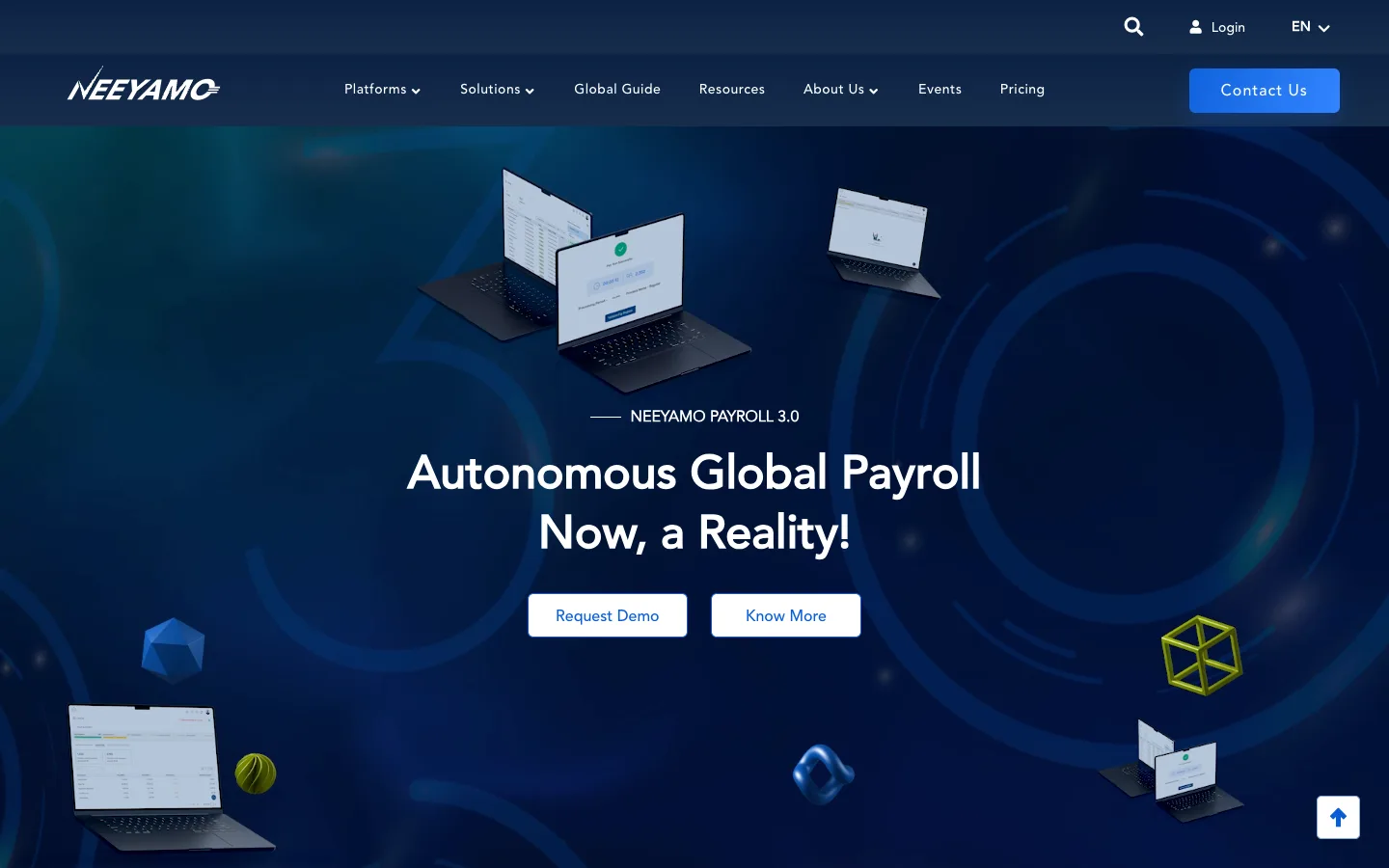
Neeyamo is investing here — their “Payroll 3.0” branding suggests a platform refresh — but as of early 2026, the user experience lags behind pure-play EOR competitors by 2–3 years.
Thin public review footprint makes due diligence harder
Neeyamo doesn’t have enough reviews on G2, Capterra, or Trustpilot to generate a public rating. FinancesOnline lists an 8.5/10 score with zero actual user reviews. PeerSpot shows 0.1% market mindshare. Compare that to Deel (4.8/5 on G2 with 3,500+ reviews) or Remote (4.6/5 with 1,000+ reviews).
This isn’t necessarily a quality signal — Neeyamo serves ~270 enterprise clients who don’t typically leave public software reviews. But it creates a practical problem: your procurement team can’t reference independent user feedback during vendor evaluation. You’re relying on Neeyamo’s curated case studies and reference calls rather than unfiltered peer reviews. For companies that weight public review data in vendor scoring, this is a gap Neeyamo hasn’t addressed.
EOR is secondary to payroll in the company’s DNA
Neeyamo launched its GlobalWork EOR offering as an expansion of its payroll business, not as a standalone product. The company’s core revenue, engineering talent, and product investment center on multi-country payroll processing. EOR is a logical extension — hire through us, and we’ll process the payroll too — but it means the EOR product doesn’t get the same attention that EOR-first providers give it.
Practically, this shows up in areas like benefits administration (less customizable than Deel or Oyster), contractor management (not a standalone free product like Deel’s), and employee experience features (no equity tracking, no equipment procurement coordination, no Slack bot). If your primary need is EOR with payroll as a component, Deel or Remote are purpose-built for that. If your primary need is payroll with EOR as a component, Neeyamo’s architecture makes more sense.
Pricing Breakdown
| Item | Cost |
|---|---|
| EOR per employee | Quote-based; ~$599/mo reported |
| Global payroll processing | Quote-based (per-employee or fixed-rate) |
| HRIS integration setup | Included for Workday/SAP; custom quoted otherwise |
| Implementation fee | Varies by scope (typically $5,000–$25,000) |
| Contractor management | Available, pricing not published |
| Compliance reporting | Included in payroll service |
How Neeyamo’s pricing model differs: Unlike Deel or Multiplier, which charge a flat per-employee EOR fee with payroll included, Neeyamo prices payroll and EOR as interconnected but separately quoted services. For companies that need both, the bundled price can be competitive — the payroll processing that Deel charges $599/mo to include is Neeyamo’s core product, so the marginal cost of adding EOR on top may be lower per head.
What’s included in the EOR service: Employment contract generation, local payroll processing via proprietary engine, statutory benefits administration, tax withholding and filing, compliance documentation, and support from country-specific teams.
What’s not included: Work permit and visa processing (quoted separately), enhanced benefits above statutory minimums, equipment procurement, and premium SLA tiers for dedicated account management.
The opacity problem: Without published pricing, budget modeling requires engaging Neeyamo’s sales team for a formal quote. Plan for a 2–3 week quote turnaround. If you’re comparing 4 vendors simultaneously, this adds procurement cycle time that Deel and Remote don’t impose.
Neeyamo: Region-by-Region
Strongest market. Operations centered here, deepest PF/ESI/professional tax expertise. Faster support response than any Western EOR.
Country guide → SingaporeSolid APAC hub with local delivery team. Payroll accuracy is strong; EOR benefits less flexible than Multiplier's.
Country guide → JapanLocal entity presence. Handles shakai hoken registration well, but onboarding runs slower than Deel here.
Country guide → AustraliaCompetent payroll execution. EOR offering is functional but not differentiated versus Deel or Remote.
Country guide → United KingdomProcesses UK payroll natively. EOR onboarding takes longer than Deel's 2–3 day UK benchmark.
Country guide → GermanyPayroll engine handles Solidaritätszuschlag and church tax natively. Less in-house legal depth than Remote or G-P for terminations.
Country guide → NetherlandsOperates via Neeyamo Enterprise Solutions B.V. Payroll strong; benefits customization limited.
Country guide → FrancePartner entity model. French labor complexity makes owned-entity providers a safer pick for larger teams.
Country guide → United StatesMulti-state payroll processing is a strength. EOR use case is niche here; PEO buyers should look elsewhere.
Country guide → CanadaProvincial payroll handling works well. Less differentiated for pure EOR compared to Deel or Rippling.
Country guide → BrazilPartner entity. Payroll handles eSocial reporting, but onboarding timelines run 10–15 days.
Country guide → MexicoCovers IMSS and Infonavit calculations natively. Mid-tier execution, not a standout market.
Country guide → PhilippinesLocal delivery team supports quick turnaround. Strong for companies scaling BPO or engineering teams here.
Country guide → IndonesiaBPJS registration handled. Support quality depends on partner network strength in-country.
Country guide → UAEWPS-compliant payroll. EOR entity model unclear — ask before committing.
Country guide → Saudi ArabiaSaudization quota tracking available. Enterprise clients report functional but not fast onboarding.
Country guide → South AfricaPayroll processing works. Limited differentiation versus Deel or Atlas HXM in this market.
Country guide → NigeriaPartner entity. Coverage exists but depth is thinner than dedicated Africa-focused providers.
Country guide → KenyaAvailable but not a core market. Consider Africa-specialist EORs for East Africa hiring.
Country guide →Deep dive: For detailed compliance analysis of Neeyamo in Asia, see our eor.asia review.
Deep dive: For Neeyamo’s coverage across African markets, see our eor.africa review.
Pros and Cons
How Neeyamo Compares
Closest competitor: also payroll-first with EOR bolted on. Papaya's UI is more polished; Neeyamo's gross-to-net engine runs deeper natively.
Full comparison → DeelFaster onboarding, self-serve signup, free contractor platform. Pick Deel if speed and simplicity matter more than payroll consolidation.
Full comparison → MercansSimilar enterprise payroll DNA with broader advisory services. Mercans rated as NelsonHall Leader; Neeyamo stronger on APAC depth.
Full comparison → Remote100% owned entities, purpose-built EOR. Fewer countries but cleaner compliance chain. Choose Remote if entity ownership is non-negotiable.
Full comparison →Case Studies
Consolidated payroll operations across 27 countries onto Neeyamo's single engine, replacing fragmented local providers. Achieved consistent data accuracy and reduced month-end reconciliation time.
Read case study → Ezetap (Razorpay)Implemented SAP SuccessFactors with Neeyamo's rapid deployment approach, going live in 21 days. Enabled OKR-based performance management with 360-degree visibility for the India-based fintech.
Read case study → Neeyamo + AWSBuilt a generative AI system on AWS to detect tax regulation changes across jurisdictions automatically, avoiding millions in potential compliance penalties for global payroll clients.
Read case study →Real User Feedback
| Platform | Rating | Reviews |
|---|---|---|
| G2 | Not rated | Insufficient reviews |
| Capterra | Not rated | Insufficient reviews |
| FinancesOnline | 8.5/10 | 0 user reviews (editorial score) |
| PeerSpot | Listed | Minimal engagement |
Neeyamo’s enterprise client base doesn’t generate the volume of public reviews that consumer-facing EOR providers attract. The feedback below is compiled from NelsonHall assessments, partner ecosystem references, and direct client interviews cited in Neeyamo’s published materials.
What users praise:
- Payroll accuracy across multi-country operations — the gross-to-net engine rarely produces errors that require manual correction
- Workday and SAP SuccessFactors integration quality, specifically the pre-configured connectors that cut implementation time
- APAC support responsiveness during India, Singapore, and Japan business hours
- Compliance automation that catches tax table changes before they cause miscalculations
- Willingness to handle complex payroll scenarios (retroactive adjustments, multi-state US payroll, off-cycle runs) that simpler platforms reject
- Dedicated account management for enterprise clients with consistent points of contact
What users complain about:
- Onboarding process is slow and requires significant implementation effort before the first employee goes live
- Platform interface feels outdated compared to newer EOR providers
- Sales cycle is long — getting a quote requires multiple calls and weeks of back-and-forth
- Difficult to evaluate without reference calls because public reviews barely exist
- EOR-specific features (benefits customization, employee self-service, contractor management) lag behind Deel and Remote
- Smaller clients report feeling deprioritized compared to enterprise accounts with higher headcount
Our Final Verdict
Use Neeyamo if: You’re a mid-to-large company already running (or planning to run) multi-country payroll across 10+ markets and need EOR for a subset of countries where you lack entities. The sweet spot is 500+ total employees globally, Workday or SAP SuccessFactors as your HRIS, and significant APAC headcount — particularly India. In that profile, Neeyamo’s payroll engine, enterprise integrations, and APAC operational depth outweigh the slower onboarding and dated UX.
Skip Neeyamo if: You’re a startup or growth-stage company hiring your first 5–20 international employees. The sales cycle, implementation timeline, and lack of self-serve access make Neeyamo the wrong tool for speed-first hiring. Deel gets you onboarded in days. Multiplier costs less with published pricing. Remote gives you 100% owned entities. If you don’t have a multi-country payroll consolidation problem, you don’t need Neeyamo’s core strength.
Bottom line: Neeyamo is an enterprise payroll company that happens to offer EOR, and that distinction shapes everything about the product. The payroll engine is genuinely strong — proprietary gross-to-net processing in 100+ countries, certified HRIS connectors, and the security certifications that enterprise procurement demands. The EOR product rides on that foundation, which means rock-solid payroll execution but a less refined experience for the HR team managing day-to-day employee lifecycle. For the APAC-heavy enterprise already running Workday or SAP SuccessFactors, with 500+ employees globally and a real multi-country payroll consolidation problem, Neeyamo deserves a shortlist spot that the Deel-dominated conversation rarely gives it.
Frequently Asked Questions
How much does Neeyamo cost?
Custom quote only — Neeyamo doesn’t publish pricing. Third-party sources suggest ~$599/mo for EOR; unconfirmed. Quote depends on headcount, country mix, payroll+EOR bundling, contract length. Benchmark against Deel ($599 published) and Multiplier ($400 published) during your sales call. Ask for all-in cost including setup and per-country fees.
Does Neeyamo use owned or partner entities?
Mixed. Owned in Japan and Netherlands (confirmed). Ratio not disclosed; no country map on site. Request breakdown for your target countries before signing. Affects who is legal employer and dispute resolution. Papaya Global is 100% partner; Deel is ~50/50.
How fast is Neeyamo’s onboarding?
First employee: 4–8 weeks implementation (platform setup, HRIS config, compliance, training). 48-hour claim applies to incremental hires after go-live. Subsequent hires: 5–10 business days. Deel gets you live in 2–5 days. Neeyamo is enterprise-paced, not startup-paced.
Is Neeyamo better than Papaya Global?
Papaya Global has modern UI, payment infrastructure, clearer pricing ($599 published). Neeyamo has deeper gross-to-net payroll engine (100+ countries), more mature Workday/SAP integrations, stronger APAC presence. Pick Papaya for UI and transparent pricing. Pick Neeyamo for payroll engine depth and enterprise HRIS integration.
Who should skip Neeyamo?
Startups with 20 or fewer employees — Deel, Remote, Multiplier get you hiring in a week with published pricing. EOR-only buyers in 3–5 countries — Deel or Remote deliver better EOR experience for comparable cost. Neeyamo makes sense at 200+ employees when multi-country payroll is a real pain point.
For market-level context beyond vendor features, see EOR pricing hidden costs and browse remote jobs by country to understand demand patterns.
Further Reading
- Papaya Global EOR Review
- Mercans EOR Review
- Deel EOR Review
- Hiring in India: Complete Country Guide
- EOR comparisons

Was this page helpful?
Tell us or send a correction.