
Quick Verdict (2026)
Ontop is a strong fit when you need compliant hiring in 150+ countries and can work with a partner entities model.
Best for
Teams that prioritize country reach and can operate with partner-entity structures.
Not ideal for
Procurement workflows that require owned entities in every country.
Entity model
Partner entities
Primary tradeoff
Legal employer may be a local partner in some markets.
Summary
Pick Ontop if most of your international hiring is in Latin America. At $499 per employee monthly, it undercuts Deel and Remote by $100-$200 and is strongest in Colombia, Brazil, Mexico, and Argentina. For US startups hiring 5-15 engineers across LatAm, it is a credible budget-first option.
The problem is everything outside Latin America. Ontop covers 150+ countries on paper, but the partner-entity model in most non-LatAm markets means you’re relying on third-party firms for employment compliance with limited visibility into who’s actually managing your people. Support quality drops sharply outside LatAm time zones, Trustpilot reviews paint a rough picture (1.8/5 stars from 81 reviews), and the platform lacks the depth of features that Deel, Remote, or Rippling offer for multi-region teams. Ontop is a regional specialist wearing a global jersey — and the fit shows.
Pick Ontop if
Your headcount is Americas-heavy (often 70%+) and you want transparent, lower-cost EOR pricing plus USD wallet features for workers.
Skip Ontop if
You need consistent compliance and support quality across Europe, APAC, and Africa or enterprise-grade security and integrations.
Ontop: Key Facts
If Ontop is on your shortlist, pressure-test feature fit in head-to-head comparisons, model all-in cost with the EOR cost guide, and validate talent demand in remote jobs by country.
What Ontop Does Well
LatAm payroll expertise that goes deeper than coverage maps
Ontop was founded in Colombia by Santiago Aparicio, Julian Torres, and Jaime Abella. That matters because LatAm payroll is not a feature you bolt on — it’s a regulatory maze that changes by country and sometimes by state. Colombia’s payroll involves 13th-month salary (prima de servicios), transportation allowances, mandatory severance fund deposits (cesantías), and healthcare/pension contributions that total roughly 52% of base salary in employer costs. Brazil adds FGTS, INSS, and a termination penalty structure that can cost 40% of the employee’s accumulated severance fund.
Most global EOR providers handle these calculations correctly. The difference with Ontop is institutional knowledge. Their compliance team has worked inside LatAm payroll systems for years, not months. When a Colombian labor reform changes the rules around fixed-term contract renewals — as happened in 2023 — Ontop’s team had client communications out within days. Deel’s LatAm partner entities typically take a week or two to surface the same updates.
For companies hiring 5–20 people across Colombia, Brazil, Mexico, and Argentina, that depth translates to fewer payroll errors and faster resolution when something goes wrong. If LatAm is 70%+ of your international headcount, Ontop’s local knowledge is a genuine advantage over the big generalists.
Pricing that undercuts the market by $100–200/mo
At $499/mo per employee for EOR services, Ontop is $100/mo cheaper than Deel ($599/mo) and $200/mo cheaper than Remote’s starting rate. For a 10-person LatAm team, that’s $12,000–$24,000/year in savings on management fees alone. Contractor management runs $49/mo per contractor — not free like Deel, but still affordable for small teams.
The pricing is transparent and publicly listed, which is increasingly rare in the EOR space where “contact sales” is the norm. No per-country surcharges, no setup fees, no hidden compliance add-ons baked into the monthly rate. For seed-stage and Series A startups stretching runway, that cost difference and pricing predictability matters.
One caveat: Ontop doesn’t appear to offer the same volume discount structure that Deel and Remote negotiate for teams of 20+. If you’re scaling past 25 employees, Deel’s negotiated rate of $400–$475/mo can actually undercut Ontop’s flat $499. The pricing advantage is strongest for small-to-mid teams.
Ontop Wallet and Visa card for worker payments
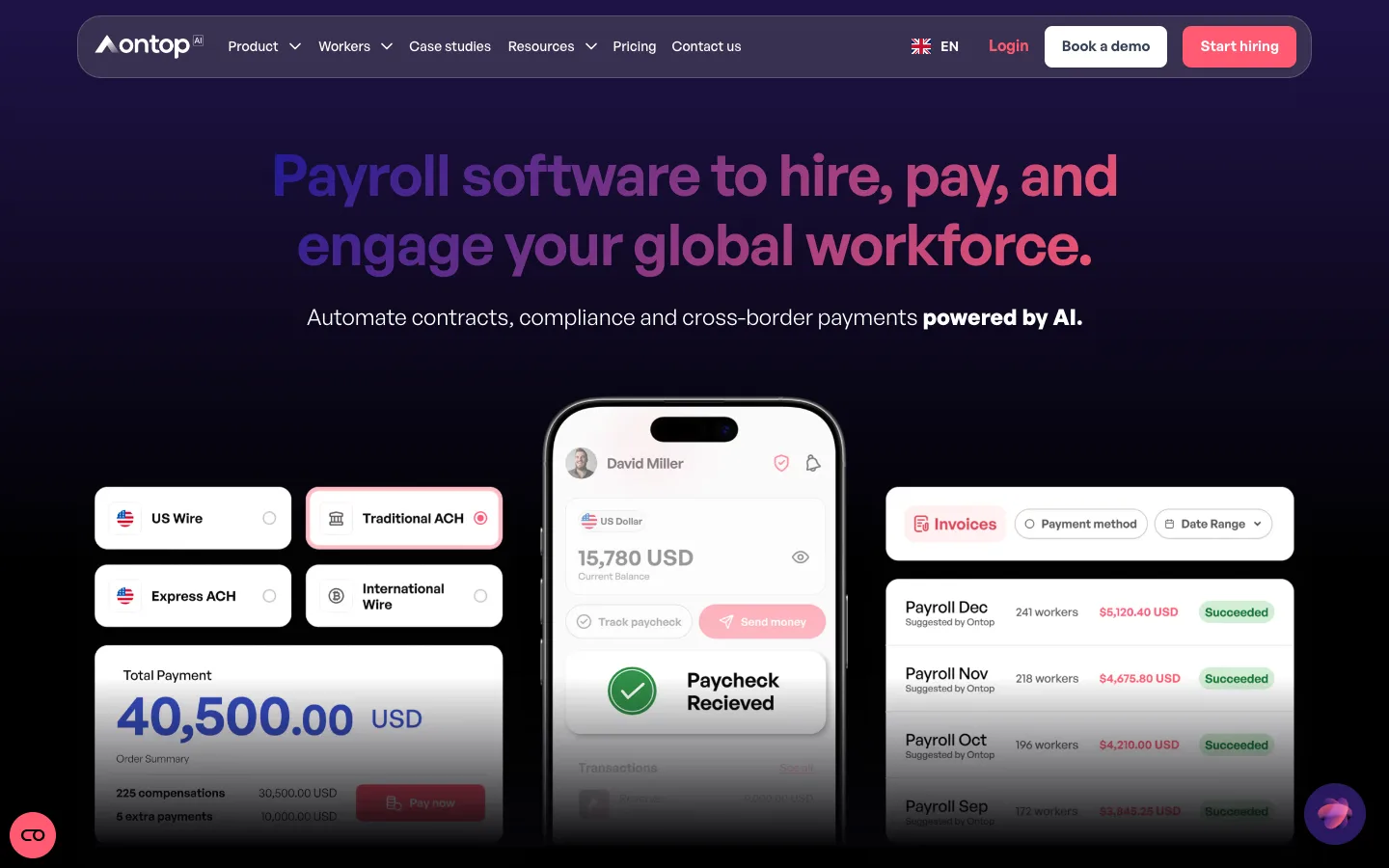
This is Ontop’s most distinctive feature. Employees and contractors get access to the Ontop Wallet — a USD-denominated digital account with an attached Visa card. Workers can receive payments in USD, convert to local currency at their discretion, and spend directly via the Visa card. The wallet also supports salary advances and investment features.
Why does this matter? In LatAm markets where local currencies fluctuate against the dollar (the Argentine peso lost over 50% of its value against USD in 2023 alone), receiving salary in USD and controlling the conversion timing is a meaningful financial benefit for workers. It’s a recruiting advantage: “we pay in USD through Ontop Wallet” is a tangible offer improvement over “we pay in local currency through Deel.”
For contractors especially, the wallet eliminates the friction of international wire transfers, which in markets like Colombia can take 3–5 business days and cost $25–50 per transaction through traditional banking. The Visa card makes the funds immediately accessible.
Self-serve Quick Start onboarding
Ontop offers a self-serve signup flow that lets you start onboarding workers without scheduling a sales demo. You can skip the call, create an account, and begin generating contracts within minutes. For companies that need to hire one or two people quickly and don’t want to sit through a 30-minute sales pitch, this is a welcome departure from the enterprise-sales-heavy approach that G-P, Atlas HXM, and Safeguard Global still insist on.
The Quick Start flow is designed for teams onboarding 1–10 workers. Contracts are generated through the platform, compliance documentation is handled automatically for supported countries, and the first payment can be set up on the same day. It’s not as polished as Deel’s contract generation UI, but it gets the job done without the gatekeeping.
Where Ontop Falls Short
Partner-entity model outside LatAm creates real risk
Ontop maintains direct operational presence in select LatAm markets (Colombia, Brazil, Peru). Everywhere else — and that’s the majority of the 150+ countries they list — employment runs through third-party partner entities. The practical implication: in Germany, the UK, or Singapore, you’re not being employed by Ontop. You’re employed by a local firm that Ontop has a commercial relationship with.
This matters because you lose visibility into the compliance chain. When a payroll question arises in Germany, it goes from your People team to Ontop’s support team to the partner entity’s local compliance team. That’s two handoffs before someone with local expertise even sees the question. Deel has the same challenge in its partner markets, but Deel owns entities in roughly 80 countries. Ontop’s owned-entity footprint is significantly smaller.
For companies hiring across 3+ continents, this partner dependency adds risk. If the partner entity in, say, the Netherlands makes a payroll error, your recourse is through Ontop’s commercial agreement with that partner — not a direct employment relationship. Remote, which owns entities in every market it operates, eliminates this intermediary entirely.
Support quality is inconsistent — and Trustpilot tells the story
Ontop’s 1.8/5 rating on Trustpilot (81 reviews) is a red flag that can’t be explained away. The recurring themes: slow response times (days, not hours), generic automated replies to specific compliance questions, payment processing delays, and verification processes that stall without resolution. Multiple reviewers describe being unable to reach a human when payments are stuck.
G2 paints a friendlier picture at 4.4/5 (61 reviews), but G2 skews toward buyers (the companies using Ontop to hire), while Trustpilot captures more contractor and employee experiences. If your workers are the ones experiencing delayed payments and unresponsive support, that’s your employer brand taking the hit — even though Ontop is the one dropping the ball.
Deel and Remote aren’t perfect on support either. But Deel’s Trustpilot sits around 4.6/5, and both invest heavily in chat support that responds within 30 minutes during business hours. Ontop’s support infrastructure appears understaffed relative to its 150-country coverage claim.
Global coverage is wide but thin
Listing 150+ countries is a marketing number, not an operational one. Ontop’s genuine depth — where they have local expertise, tested compliance workflows, and responsive partner entities — covers maybe 20–30 markets, heavily weighted toward the Americas. Ask Ontop to hire someone in Japan, Poland, or Nigeria, and you’ll likely get routed to a partner entity where Ontop has limited oversight of the day-to-day compliance management.
This matters when something goes wrong. A termination in France requires specific procedures (entretien préalable, notice periods tied to tenure, mandatory severance above two years). A good EOR has in-house counsel or a deeply integrated partner who’s handled hundreds of French terminations. A thin-coverage EOR has a partner firm that Ontop may have worked with for a year or two, with limited control over process quality.
Deel, Remote, and G-P all invest in deep market-specific compliance infrastructure even in their partner markets. Ontop’s model works when things go smoothly; it’s the edge cases — terminations, disputes, audits — where thin coverage gets expensive.
Platform features lag behind Deel and Remote
Ontop’s platform handles contract generation, payroll, and payments. That’s the core, and it works. But it’s missing the feature depth that Deel, Remote, and Rippling have built: expense management, equity tracking, advanced analytics, multi-entity views for companies with both EOR and owned entities, and deep HRIS functionality.
The integration list is short: QuickBooks, BambooHR, and Zapier. Deel connects to 100+ tools natively. Remote integrates with major ATS and accounting platforms. If your People team runs Greenhouse for recruiting, Xero for accounting, and HiBob for HRIS, you’ll need Zapier workarounds or manual data entry to connect Ontop to your stack.
For a 5-person team hiring contractors in LatAm, this doesn’t matter. For a 50-person company with international employees across three continents, the feature gap creates real operational friction.
No confirmed SOC 2 certification
Ontop’s security page mentions GDPR compliance, NIST guidelines, MFA/2FA, and WAF protection. What it doesn’t confirm is SOC 2 Type II certification — the standard security audit that most enterprise buyers require from any vendor handling employee data and payroll. Deel, Remote, and Rippling all hold SOC 2 Type II.
For startups and SMBs, this might not be a dealbreaker. For any company with an InfoSec team that reviews vendor security posture, the absence of SOC 2 will stall procurement. If Ontop has completed SOC 2 and simply doesn’t list it publicly, that’s a communication failure. If they haven’t, it’s a real gap for mid-market and enterprise buyers.
Pricing Breakdown
| Item | Cost |
|---|---|
| EOR per employee | $499/mo |
| Contractor management | $49/mo per contractor |
| Ontop Wallet + Visa card | Included for workers |
| Background checks | Not publicly listed |
| Work permits & visas | Not publicly listed |
| Setup fees | None advertised |
| Custom benefits | Quoted separately |
What’s included in the base EOR fee: Employment contract generation, local payroll processing, statutory benefits administration, tax withholding and filing, Ontop Wallet access for the employee, and basic support.
What’s not included: Work permit/visa processing (if available), enhanced benefits above statutory minimums, hardware procurement, and dedicated account management for smaller teams.
Annual cost example: 10 employees at $499/mo = $59,880/year. The same 10 employees on Deel at $599/mo = $71,880/year. On Remote at $599/mo = $71,880/year. The savings are $12,000/year versus both — meaningful for a startup, though Deel’s negotiated rates at 20+ headcount can close or eliminate that gap.
Contractor cost comparison: Ontop at $49/mo per contractor vs. Deel’s free contractor management. For 20 contractors, that’s $11,760/year on Ontop vs. $0 on Deel. If you’re running a large contractor workforce, Deel’s free tier is hard to beat. But Ontop’s Wallet and Visa card features may justify the cost for workers who value USD payment flexibility.
Ontop: Region-by-Region
Americas (strongest)
Ontop's home market. Direct operational presence, fastest onboarding, and deepest compliance knowledge. The strongest country in their portfolio.
Country guide → BrazilDirect presence. Handles FGTS, INSS, and 13th salary natively. Stronger local knowledge than most global EOR partners.
Country guide → MexicoSolid coverage with LatAm-experienced compliance team. Good for startups scaling nearshore engineering teams.
Country guide → ArgentinaHandles complex peso/USD dynamics well. Ontop Wallet is particularly valuable here given currency volatility.
Country guide → United StatesCovered but not a differentiator. Deel or Rippling are stronger picks for US-based employees.
Country guide → CanadaAvailable through partner entity. No particular advantage over Deel or Remote here.
Country guide →Europe (adequate, not strong)
Partner entity. Ontop has some LatAm-adjacent cultural familiarity, but Remote and Deel have deeper Spanish compliance teams.
Country guide → United KingdomPartner entity. Functional but not differentiated. Deel's owned UK entity onboards faster.
Country guide → GermanyPartner entity. German labor law is complex (works councils, termination protections). Thin coverage here is a risk.
Country guide → FrancePartner entity. French labor code demands deep local expertise. Remote's owned entity is the safer choice for France.
Country guide → NetherlandsPartner entity. Adequate for basic hires but lacks the benefits customization that Dutch talent expects.
Country guide → PolandPartner entity. Available but limited track record. Deel and Remote both have stronger European footprints.
Country guide →Asia-Pacific (limited)
Partner entity. Covered but not a strength. Multiplier or Deel are stronger picks for Indian hires.
Country guide → PhilippinesPartner entity. Available but Ontop has minimal track record in Southeast Asia.
Country guide → SingaporePartner entity. Multiplier (HQ'd in Singapore) is the obvious better choice for this market.
Country guide → AustraliaPartner entity. Functional coverage but no local operational depth.
Country guide → JapanPartner entity. Japanese labor law is notoriously complex. Thin partner coverage here carries risk.
Country guide →Deep dive: For detailed compliance analysis of Ontop in Asia, see our eor.asia review.
Africa & Middle East (minimal)
Listed as available. Extremely limited track record in African markets. Proceed with caution.
Country guide → South AfricaPartner entity. Deel and Remote have far more established African operations.
Country guide → KenyaListed as available but no visible case studies or operational depth in East Africa.
Country guide →Deep dive: For detailed compliance analysis of Ontop in Africa, see our eor.africa review.
Pros and Cons
How Ontop Compares
$100/mo more expensive but far broader coverage, free contractor management, and deeper platform features. The default for multi-region teams.
Full comparison → Remote100% owned entities everywhere — no partner risk. Fewer countries but stronger compliance guarantees. Pick Remote if entity ownership matters.
Full comparison → MultiplierEven cheaper than Ontop with stronger APAC coverage. If your LatAm needs aren't specialized, Multiplier offers more for less.
Full comparison → Papaya GlobalEnterprise-focused with payroll analytics and multi-entity support. Overkill for SMBs but stronger if you need advanced reporting.
Full comparison →Case Studies
Colombian fintech onboarded 24 international employees through Ontop — nearly 50% of their total workforce. Moved from informal hiring processes to compliant, cross-border contracts with payroll transparency.
Read case study → BrightChampsIndian edtech platform switched to Ontop after their previous payment provider couldn't process payroll in Lebanon and Egypt. Reduced payment delays for their global teaching staff and cut transaction costs vs. PayPal.
Read case study → OLIVERSpanish sports tech company replaced manual one-by-one contractor payments through traditional banking with Ontop's automated payroll. Redirected time savings toward business expansion.
Read case study →A note on these case studies: they skew toward small-to-mid companies (under 100 employees) with straightforward contractor and EOR needs. Ontop doesn’t publish enterprise-scale case studies the way Deel (Turing, FICO) or Remote (GitLab) do. That’s not necessarily a negative — Ontop is built for startups and SMBs — but it means there’s limited public evidence of how the platform handles complex, high-volume operations.
Real User Feedback
| Platform | Rating | Reviews |
|---|---|---|
| G2 | 4.4/5 | 61 |
| Trustpilot | 1.8/5 | 81 |
| Product Hunt | 3.0/5 | 14 |
The gap between G2 and Trustpilot is worth dissecting. G2 captures the buyer’s perspective — companies using Ontop to manage hires — and those reviews praise the platform’s simplicity and LatAm expertise. Trustpilot captures the worker’s experience — contractors and employees who receive payments through Ontop — and those reviews consistently cite payment delays and unresponsive support. Both are true simultaneously, and which matters more depends on whether you weight your own admin experience or your workers’ payment experience.
What users praise:
- LatAm payroll handled with genuine local expertise, not outsourced to a generic partner
- Competitive pricing with no hidden fees or surprise surcharges at invoice time
- Ontop Wallet gives workers real flexibility in how they receive and spend USD payments
- Quick Start onboarding removes the friction of mandatory sales calls and demos
- Contract generation for LatAm markets is fast and locally compliant
- Y Combinator pedigree and VC backing provide confidence the company won’t vanish overnight
What users complain about:
- Payment delays that stretch from days into weeks, with limited visibility into why
- Support tickets met with automated responses before (eventually) reaching a human
- Verification processes that stall without clear communication on what’s needed
- App instability and UX issues, particularly on mobile
- Partner-entity markets feel like a different, lower-quality product
- Lack of advanced reporting and analytics — the dashboard shows basics but doesn’t help with workforce planning
- Transfer fees ($9 per transaction reported by some users) eat into the cost savings
Our Final Verdict
Use Ontop if: Your international hiring is concentrated in Latin America — Colombia, Brazil, Mexico, Argentina — and you’re a startup or SMB that values cost savings and LatAm-specific payroll expertise over global platform depth. If 70%+ of your international headcount is in the Americas and you’re hiring fewer than 20 people, Ontop’s $499/mo pricing, Wallet feature, and regional knowledge make it a smart pick. The self-serve onboarding also fits teams that want to move fast without sales cycles.
Skip Ontop if: You’re hiring across multiple continents and need consistent compliance quality in Europe, Asia-Pacific, or Africa. The partner-entity model outside LatAm, thin support infrastructure, and limited platform features make Ontop a poor fit for companies managing 50+ employees globally. Enterprise buyers who require SOC 2 certification will hit a wall during procurement. And if you’re running a large contractor workforce (20+), Deel’s free contractor management wipes out Ontop’s pricing advantage.
Bottom line: Ontop found a real niche: LatAm-focused EOR for startups and SMBs, with the Wallet/Visa card feature as a genuine differentiator for workers in volatile-currency markets. Inside that niche, it’s a credible alternative to Deel and Remote. Outside it, the product thins out quickly. For a US-based startup hiring 5–15 engineers across Colombia, Brazil, Mexico, and Argentina, Ontop is the pick — the $100/mo savings over Deel, the Wallet’s USD flexibility for workers, and the institutional LatAm compliance knowledge make the trade-offs on platform depth and global coverage entirely acceptable.
Frequently Asked Questions
How much does Ontop cost?
$499/mo per employee — $100/mo less than Deel or Remote. Saves $12k/year on a 10-person team. Contractor management: $49/mo (Deel is free). Deel volume discounts (20+ employees) can undercut Ontop’s flat rate. Run the math on EOR vs. contractor mix.
Does Ontop use owned or partner entities?
Mostly partners. Direct presence in Colombia, Brazil, Peru. Remaining 150+ countries via partners. Outside Americas, a local firm holds the employment relationship. Ask for country-by-country breakdown before signing. LatAm is Ontop’s strength; Europe/APAC/Africa are partner-dependent.
What is the Ontop Wallet?
USD-denominated account with Visa card for workers. Receive in USD, convert when desired, spend via card. In volatile-currency markets (Argentina, Colombia, Brazil) this gives workers real flexibility. Main differentiator vs. Deel and Remote — they use standard bank transfers.
How fast is Ontop’s onboarding?
~6 business days standard. Colombia/Brazil: faster. Outside LatAm: depends on partner. Deel: 2–5 days. Remote: 3–5 days. Adequate, not category-defining.
Is Ontop better than Deel for LatAm?
Yes for LatAm concentration. Built in Colombia; deepest LatAm payroll expertise. Deel has broader global coverage, free contractors, faster onboarding. Pick Ontop if 70%+ of international headcount is Americas and you’re under 20 people. Pick Deel for multi-region or contractor-heavy needs. See Deel, Remote reviews.
Who should skip Ontop?
Multi-continental hiring with Europe/APAC/Africa — partner quality thins out. Enterprise (50+ employees globally) — no SOC 2, limited integrations. Large contractor base (20+) — Deel’s free tier wipes Ontop’s pricing edge. Trustpilot 1.8/5 reflects worker payment/support issues — factor in if employer brand matters.
For market-level context beyond vendor features, see EOR pricing hidden costs and browse remote jobs by country to understand demand patterns.
Further Reading
- Deel EOR Review: Pricing, Pros, Cons & Ratings
- Remote EOR Review: Pricing, Pros, Cons & Ratings
- Multiplier EOR Review: Pricing, Pros, Cons & Ratings
- Hiring in Colombia: EOR & Employment Guide
- Hiring in Brazil: EOR & Employment Guide
- EOR comparisons

Was this page helpful?
Tell us or send a correction.