
Quick Verdict (2026)
Pebl is a strong fit when you need compliant hiring in 185+ countries and can work with a mixed entities model.
Best for
Teams balancing global coverage and practical speed across multiple markets.
Not ideal for
Teams that only need one country and can justify setting up a local entity immediately.
Entity model
Mixed entities
Primary tradeoff
Entity model consistency varies by country.
Summary
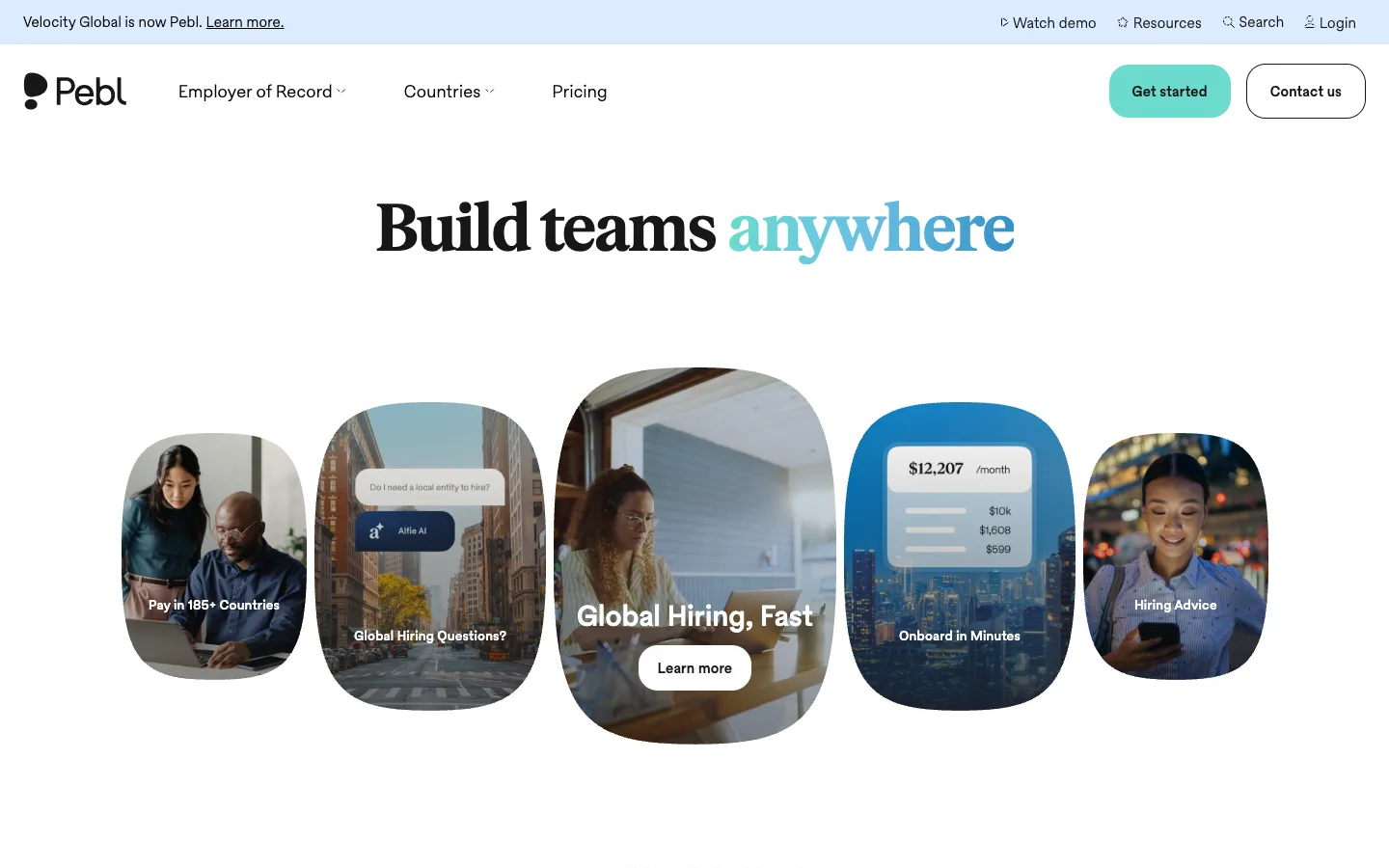
Pebl (formerly Velocity Global) is the provider you pick when country coverage and immigration support matter more than platform polish. With 50+ countries, a built-in immigration team (acquired, not partnered), and $550/mo pricing that undercuts Deel by $49/mo per head, it fills a real gap for mid-market companies scaling across Latin America or relocating employees between jurisdictions. The company was founded in 2014 as Velocity Global and rebranded to Pebl in September 2025, positioning itself as an AI-first global hiring platform. The decade-long track record means fewer first-time-in-this-market surprises, which matters more than most buyers realize until they’re stuck waiting three weeks for a compliance answer in a market their provider just added.
The trade-offs are clear. Pebl’s platform is a generation behind Deel’s and Remote’s on UX, though the rebrand brought a refreshed platform with an AI assistant called Alfie for instant compliance answers. Onboarding runs 5–10 business days, roughly double Deel’s floor in major markets. The entity model is mixed — owned in 65 countries, partner in the rest — and the company hasn’t published that breakdown, so you’ll need to ask before signing. Self-serve is limited; this is a sales-led operation, which is fine for a 50-person international expansion and frustrating if you just need to hire one engineer in Mexico next week. For LATAM-heavy hiring or combined EOR-plus-immigration needs, Pebl earns a spot in your top three. For everything else, compare carefully.
Pick Pebl if
- You need 185+ country coverage and built-in immigration support in one workflow.
- You’re hiring across LATAM and can work with 5-10 day onboarding and a sales-led process.
Skip Pebl if
- You need the fastest self-serve onboarding or a top-tier product UX.
- Your legal team requires full owned-entity transparency before procurement.
Pebl: Key Facts
Teams comparing Pebl usually make better decisions when they cross-check comparison pages, estimate true spend via how to choose an EOR, and use remote jobs by country to prioritize markets.
What Pebl Does Well
50+ countries with a decade of operational depth
185 countries is the widest coverage in the EOR market. That number alone is easy to wave away — several providers claim 150+ — but the operational depth behind it is what matters. Pebl has been running payroll and managing employment relationships in markets like Colombia, Kenya, and the Philippines since 2014 and 2015 (under the Velocity Global name), years before Deel, Remote, or Multiplier existed. That tenure translates into established relationships with local tax authorities, tested compliance playbooks, and — critically — faster escalation paths when something goes wrong.
The practical difference shows up in edge cases. A provider that added Uruguay in 2024 might technically “cover” it but takes four weeks to generate a compliant employment agreement because their local partner is still learning the playbook. Pebl has processed hundreds of hires in that same market. For companies building a global workforce across 10–15 countries, including markets that aren’t on every provider’s highlight reel, that operational maturity reduces risk in ways that a feature comparison spreadsheet can’t capture.
Immigration and visa support under one roof
This is Pebl’s most differentiated capability. Rather than partnering with a third-party immigration firm (what Deel and Remote do) or referring you to outside counsel, Pebl acquired a global immigration services company and integrated visa sponsorship, work permit processing, and relocation support directly into the EOR workflow. The practical impact: when you hire a Brazilian engineer and need to relocate them to Canada, one team handles the employment contract, the work permit application, and the payroll setup. No coordination across three vendors, no duplicated document collection, no conflicting timelines.
Work permit processing still takes 4–12 weeks depending on the destination — that’s government timeline, not Pebl’s — but eliminating the vendor coordination overhead shaves 1–2 weeks off total time-to-start compared to a split EOR-plus-immigration-lawyer setup. For companies that regularly relocate employees across borders or hire foreign nationals who need sponsorship, this single-provider model saves real operational hours. Deel charges $1,500–$5,000 per visa case as a quoted add-on. Pebl’s immigration pricing is also additional, typically $2,000–$6,000 per case, but the integrated workflow is worth the premium for complex relocations.
The strongest LATAM bench in the EOR market
Pebl’s roots are in the Americas, and the LATAM coverage shows it. Mexico, Brazil, Colombia, Argentina, Chile, and Peru all have dedicated local compliance teams — not generalists routing questions to a shared compliance inbox, but specialists who handle Brazil’s CLT framework, Mexico’s PTU profit-sharing obligations, and Colombia’s mandatory benefits fund contributions day in and day out.
Onboarding in these markets runs 5–7 business days, competitive with Deel and faster than G-P or Oyster HR. More importantly, terminations in LATAM — where missteps are expensive — get handled with the kind of local-law fluency that only comes from years of in-market operation. A wrongful termination in Brazil can cost 40% of accumulated FGTS plus accrued 13th salary and notice period. In Argentina, severance calculations change based on tenure and the specific collective bargaining agreement. Pebl’s LATAM team has processed enough of these to know where the traps are.
For companies whose international hiring is concentrated in Latin America, Pebl is a top-three pick alongside Deel and Atlas HXM. The pricing undercuts Deel, and the immigration integration adds value if you’re relocating talent within the region.
Competitive pricing that undercuts the market leaders
At $550/mo per employee, Pebl is $49/mo cheaper than Deel and Remote ($599/mo each) and $149/mo cheaper than Oyster HR ($699/mo). For a 15-person international team, that’s an $8,820/year saving over Deel before volume discounts — not transformative, but not trivial either, especially for mid-market companies watching burn rate.
The price includes a dedicated customer success manager on standard plans, which Deel gates behind higher tiers. Volume discounts bring the per-employee cost to $450–$500/mo at 25+ employees on annual contracts. Multiplier ($400/mo) is still cheaper on base price, but Pebl’s included CSM and broader country coverage narrow the gap on total cost of ownership. The value case is strongest for companies hiring across 8+ countries where Multiplier’s thinner market coverage would force you to add a second provider anyway.
A decade of track record in a market full of 5-year-olds
Pebl was founded in 2014 as Velocity Global. Deel launched in 2019. Remote in 2019. Multiplier in 2020. Oyster HR in 2020. That five-to-six-year head start matters less for platform features — the newer entrants have invested heavily in UX — and more for compliance and operational resilience. Pebl has survived multiple economic cycles, processed thousands of terminations across dozens of jurisdictions, and dealt with regulatory changes (like India’s 2022 payroll tax reforms or Brazil’s 2023 CLT amendments) with existing client portfolios at stake, not hypothetically.
For risk-averse buyers — regulated industries, public companies, or legal teams that ask “how long have you been doing this?” before signing — that track record is a real asset. It won’t show up in a feature matrix, but it shows up when a labor inspector in Mexico asks to see two years of compliant payroll records and your EOR has them.
Where Pebl Falls Short
Platform UX that’s a generation behind
The Pebl dashboard gets the job done, but “gets the job done” isn’t competitive in 2026. The 2025 rebrand brought a refreshed interface and an AI assistant (Alfie) for compliance queries, but generating an employment contract still requires more manual steps than Deel’s self-serve flow. Pulling a payroll cost report across multiple countries involves more clicks than it should. The mobile experience is minimal — there’s no real functionality beyond viewing basic employee details. Employee self-service for pay stubs, leave requests, and document uploads exists but feels bolted on rather than native.
Deel and Remote have invested hundreds of millions of dollars in product and engineering since 2020. Pebl, which raised $400M from FTV Capital in 2022, has been upgrading its platform, but the gap is still noticeable. If your People operations team spends two hours a day in the EOR dashboard, those extra clicks and slower page loads compound into real productivity loss. For companies that prioritize platform experience, Deel is the clear winner.
Mixed entity model with less transparency than competitors
Pebl operates owned entities in 65 countries and uses local partners for the remaining 120+ markets in its 185+ country coverage. That ratio — about 35% owned, 65% partner — is the inverse of what Remote offers (100% owned) and roughly in line with Deel (50/50 split). The structural issue isn’t the mix itself; it’s the transparency. Pebl doesn’t publish a country-by-country breakdown of entity ownership. You have to ask your account manager, and the answer sometimes arrives slowly.
The compliance implications are straightforward. In an owned-entity country, Pebl is the legal employer, and their in-house legal team handles disputes and regulatory audits directly. In a partner-entity country, a local firm holds the employment relationship, and Pebl manages the commercial layer. If a labor dispute escalates in a partner country, there’s an intermediary in the chain. For most hires, this works fine. For 20+ employees in a single market where labor law is complex (Germany, France, Brazil), the partner model introduces risk that an owned entity avoids.
Sales-led process that slows down simple hires
You can’t sign up for Pebl and generate an employment contract in 20 minutes the way you can with Deel. The process starts with a sales conversation, moves to scoping, and then to contract setup with a customer success manager. For a 50-person international expansion, this high-touch approach adds value: the CSM helps navigate country-specific compliance questions, structures the rollout timeline, and coordinates immigration if needed.
For a startup that needs to hire one developer in Colombia next Tuesday, it’s overkill. The sales cycle adds 3–5 days before onboarding even starts. Deel and Multiplier let you generate a compliant employment agreement within hours of signing up. If speed on individual hires matters more than white-glove implementation support, Pebl’s sales-led model is a friction point, not a feature.
Limited self-serve capabilities
Related to the sales-led model: routine tasks that should be self-serve often aren’t. Generating employment amendments, modifying benefits elections, or adding a new hire in an existing country sometimes requires CSM involvement. Deel automates these through the platform. Remote handles most of them through a self-serve workflow. Pebl still routes a meaningful percentage of routine requests through human intermediaries.
This is fine when your CSM is responsive — and most users report that Pebl’s CSMs are — but it creates bottlenecks during peak periods (fiscal year-end, Q1 hiring surges) and dependency on a single point of contact. If your CSM is on vacation and you need an urgent contract amendment, the fallback process is slower than it should be.
Smaller brand recognition and review footprint
Pebl has been around since 2014 (as Velocity Global), but Deel and Remote dominate G2 rankings, Google search results, and industry conferences. The rebrand to Pebl in 2025 adds a temporary awareness challenge — existing reviews and brand equity built under the Velocity Global name need time to transfer. The practical impact is twofold. First, candidates who receive an employment contract from an EOR they’ve never heard of sometimes ask questions. It’s resolvable — a brief explanation during the offer stage works — but it’s one more conversation. Second, the thinner review base on G2 (~100 reviews vs. Deel’s 3,500+) means less independent validation when your procurement team is evaluating providers.
This isn’t a reflection of service quality. It’s a reflection of marketing spend and venture-backed growth trajectories. But in competitive hiring situations, brand recognition has a small but measurable effect on candidate confidence.
Pricing Breakdown
| Item | Cost |
|---|---|
| EOR per employee | $550/mo |
| Contractor management | Available (pricing varies) |
| Background checks | $50–$250 per check (country-dependent) |
| Work permits & visas | $2,000–$6,000 (quoted per case) |
| Equipment procurement | Varies (coordinated through partners) |
| Dedicated CSM | Included on standard plans |
| Entity transition support | Custom pricing |
Volume discounts: Teams of 25+ employees on annual billing typically negotiate to $450–$500/mo per employee. At 50+ employees, expect 20%+ off list price. Annual commitments are required for the deepest discounts, and Pebl’s sales team will push for multi-year terms at scale.
What’s genuinely included in the base fee: Employment contract generation, local payroll processing, statutory benefits administration, tax withholding and filing, dedicated CSM, basic immigration guidance, and compliance documentation.
What’s not included: Full visa/work permit processing ($2,000–$6,000 per case), background checks ($50–$250), hardware procurement and shipping, equity administration, and enhanced benefits above statutory minimums.
Annual cost example: 15 employees at $550/mo = $99,000/year. At a negotiated $475/mo on annual billing = $85,500/year. The same 15 employees on Deel at $599/mo = $107,820/year. On Multiplier at $400/mo = $72,000/year. Pebl sits in the middle: cheaper than Deel with broader coverage, more expensive than Multiplier with deeper operational maturity and included CSM support.
Pebl: Region-by-Region
Deep local presence with years of operating history. Onboarding in 5–6 days. One of Pebl's strongest individual markets.
Country guide → BrazilPartner entity but experienced team. Onboarding in 5–7 days, faster than most. Termination handling is well-practiced here.
Country guide → ColombiaOwned entity with strong compliance team. Onboarding in 5–6 days. Pebl's LATAM roots show in this market.
Country guide → United KingdomOwned entity. Onboarding in 4–5 days, a step behind Deel's 2–3. Benefits packages are standard, not enhanced.
Country guide → GermanyPartner entity. Onboarding runs 7–10 days. Remote and G-P have deeper in-house German legal teams for complex matters.
Country guide → IndiaOwned entity. Onboarding 7–10 days, noticeably slower than Deel's 3–4. Solid for steady-state but not speed hires.
Country guide → ArgentinaStrong local knowledge in a notoriously complex labor market. Currency controls and severance rules handled with experience.
Country guide → JapanPartner entity. Onboarding 8–10 days. Functional but slower; consider Multiplier if Japan is your primary APAC market.
Country guide →Deep dive: For detailed compliance analysis of Pebl in Asia, see our eor.asia review.
Pros and Cons
How Pebl Compares
Faster onboarding (2–5 days), better platform UX, larger review base. Costs $49/mo more per head. Best for speed-first teams that value self-serve.
Full comparison → Remote100% owned entities in every market, half the country count. Pick Remote if entity ownership is non-negotiable for your legal team.
Full comparison → Multiplier$150/mo cheaper with strong APAC depth from Singapore HQ. Thinner LATAM coverage and less mature compliance playbooks.
Full comparison → G-PCategory pioneer with 100% owned entities. Higher price, slower platform. Better for enterprise compliance requirements.
Full comparison →Case Studies
Cybersecurity leader expanded into 13 countries with 90% of expansion decisions guided by the Pebl team, delivering significant cost savings by avoiding unnecessary entity setup.
Read case study → Hello YellowDigital marketing agency expanded into Australia, Vietnam, and South Africa, onboarding employees in as little as 48 hours and avoiding $45K+ in entity setup costs per market.
Read case study → SuperpathDigital marketing agency compliantly hired 8 employees across Brazil, India, Mexico, and the Philippines, reinvesting payroll savings to boost U.S. salaries and benefits.
Read case study →Real User Feedback
| Platform | Rating | Reviews |
|---|---|---|
| G2 | 4.5/5 | 100+ |
| Capterra | 4.4/5 | 40+ |
| Trustpilot | 3.9/5 | 50+ |
What users praise:
- Breadth of country coverage, especially in markets that other providers don’t reach or just added
- Responsiveness and proactiveness of dedicated customer success managers
- Immigration support quality and the convenience of handling visas through the same provider
- LATAM compliance expertise, particularly in Brazil and Mexico
- Willingness to work through complex termination scenarios with detailed cost modeling
- Smooth entity transition support when companies eventually set up their own local entity
What users complain about:
- Platform feels dated compared to Deel and Remote — contract generation, reporting, and employee self-service all lag
- Onboarding timelines occasionally slip in partner-entity countries, adding 2–5 days beyond quoted estimates
- Invoicing and billing can be confusing when immigration services and background checks are added as separate line items
- Limited self-serve capabilities for straightforward tasks like generating employment amendments or updating employee details
- Sales process takes multiple calls before you can start onboarding your first employee
- Smaller user community means fewer peer resources, templates, and third-party guides compared to Deel
Our Final Verdict
Use Pebl if: You’re hiring across 8+ countries and need a single provider that covers markets the newer entrants still treat as edge cases. You want immigration and visa support integrated into the EOR workflow rather than coordinated across separate vendors. Your hiring is concentrated in Latin America and you want a provider with genuine depth — not just a pin on a coverage map — in Mexico, Brazil, Colombia, and Argentina. You’re a mid-market company (20–500 employees) that values a dedicated CSM and hands-on implementation support over self-serve speed.
Skip Pebl if: Platform UX matters to your People team’s daily workflow — Deel is the clear winner there. You need sub-3-day onboarding consistently to compete for competitive candidates. Your legal team requires 100% owned entities in every market — Remote is the only option. You’re a startup hiring 2–3 people in a single country and want the lowest friction path — Multiplier or Deel’s self-serve flow will get you there faster. You care about independent review validation and want a provider with thousands of G2 reviews backing the claims.
Bottom line: Pebl occupies a specific and defensible position in the EOR market: widest coverage, built-in immigration, strong LATAM presence, and a pricing point that undercuts the market leaders. It won’t win a head-to-head demo against Deel on platform experience, and it won’t match Remote’s entity-ownership story. But for companies expanding into 10+ markets that include LATAM, relocating employees across borders, or wanting a provider with a decade of compliance battle scars, Pebl delivers where it counts. For LATAM-heavy hiring maps and teams that regularly move employees across borders, Pebl is the pick — no other EOR bundles immigration depth with 185-country coverage and a dedicated CSM at $550/mo.
Frequently Asked Questions
How much does Pebl cost?
$550/mo per employee — $49/mo less than Deel ($599). Saves $8,820/year on a 15-person team. CSM included at base (Deel charges extra). Visa processing: $2k–$6k. Background checks: $50–$250. Entity transition: custom quote. Run the full cost model for your country mix.
Does Pebl use owned or partner entities?
Both. Owned in 65 countries; partners in 120+. Pebl doesn’t publish the split — ask your account manager for a country-level breakdown. In owned markets Pebl is the legal employer; in partner markets a local firm holds the relationship. Get the answer in writing before signing.
How fast can Pebl onboard someone?
5–10 business days (no visa). UK/Canada: 4–5 days. Brazil: 5–7. India/Japan: 8–10. Work permits: 4–12 weeks via in-house immigration team. Slower than Deel (2–5 days). If closing candidates within 48 hours matters, the gap hurts.
Can Pebl handle work permits and relocations?
Yes — key differentiator. Built-in immigration: visa sponsorship, work permit processing, relocation coordination. One team handles employment contract, immigration application, payroll, benefits. Government processing still 4–12 weeks, but Pebl typically saves 1–2 weeks vs. Deel and Remote’s split-vendor approach.
Is Pebl better than Deel for LATAM?
Yes for LATAM depth. Pebl has strongest coverage among top-tier EORs. Deel wins on platform UX and onboarding speed. Pick Pebl for 8+ countries with LATAM, immigration needs, dedicated CSM. Pick Deel for self-serve speed and 2–5 day onboarding.
When should we set up our own entity instead?
Breakeven: ~15–20 employees in one country. Pebl supports entity transitions — 8–12 weeks, CSM builds transition plan. Budget $10k–$30k legal fees for entity setup and contract re-execution. See EOR vs entity.
For market-level context beyond vendor features, see EOR pricing hidden costs and browse remote jobs by country to understand demand patterns.
Further Reading
- Best EOR Providers 2026: Full Comparison
- Remofirst EOR Review: Budget EOR at $199/mo
- Ontop EOR Review: LatAm Specialist Alternative
- EOR vs. Entity Setup: When to Switch
- Hiring in Brazil: Complete EOR Guide

Was this page helpful?
Tell us or send a correction.