
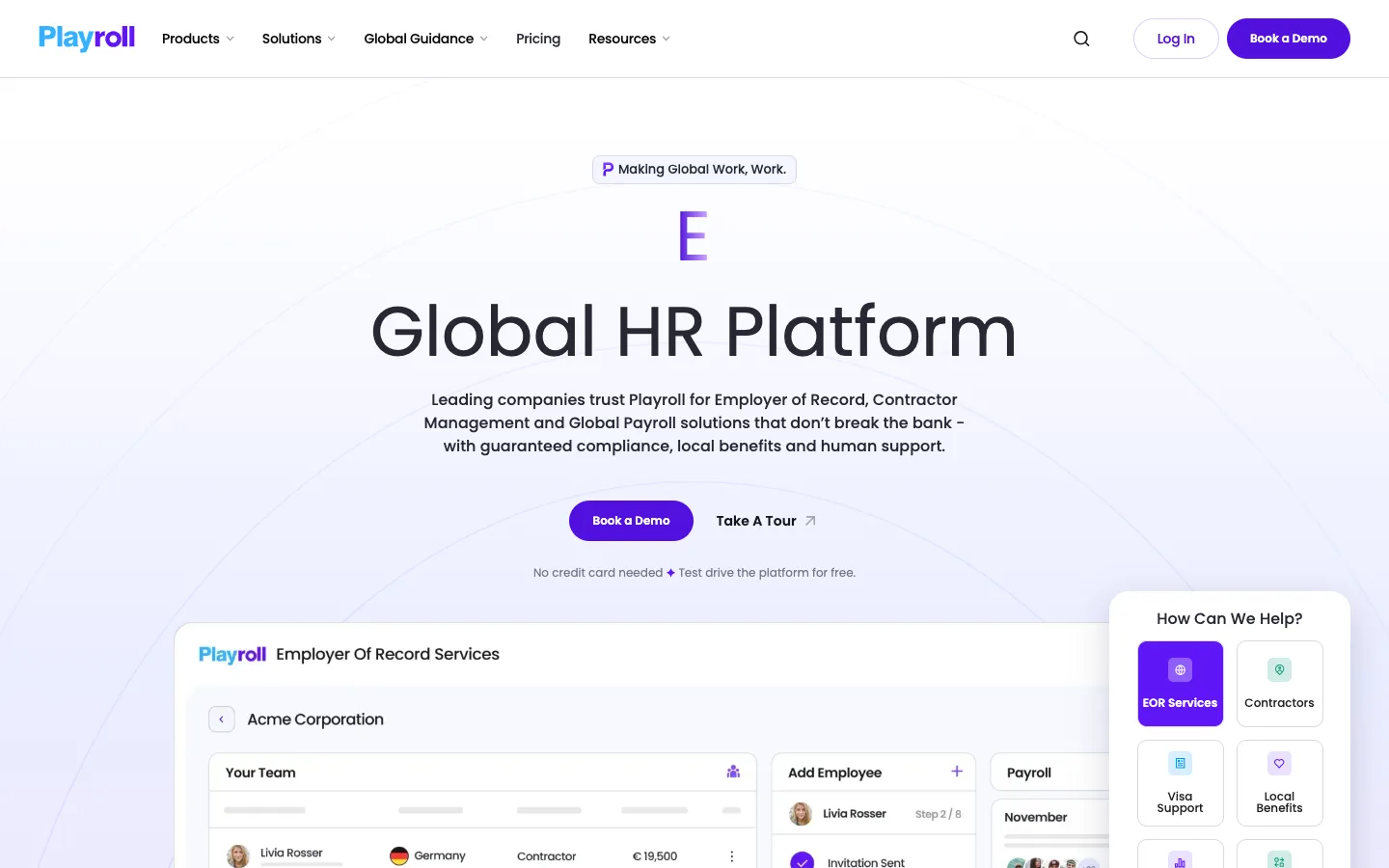
Quick Verdict (2026)
Playroll is a strong fit when you need compliant hiring in 180+ countries and can work with a mixed entities model.
Best for
Teams balancing global coverage and practical speed across multiple markets.
Not ideal for
Teams that only need one country and can justify setting up a local entity immediately.
Entity model
Mixed entities
Primary tradeoff
Entity model consistency varies by country.
Summary
Playroll is the EOR you pick when $399/mo matters more than $599/mo and you still need 180+ country coverage. Built on top of VAT IT Group’s 20-year-old global entity infrastructure, the platform launched in 2021 and has grown fast — 10,000+ employers, a clean UI, and dedicated CSMs included in the base price. For mid-market companies hiring across 5–15 countries that don’t want to pay Deel or Remote pricing, Playroll is the most credible budget option with genuine geographic reach.
The trade-off is maturity. Playroll is four years old. The platform works, but it doesn’t have the integration depth of Deel (100+ vs. Playroll’s handful), the owned-entity purity of Remote, or the enterprise compliance pedigree of G-P. If your legal team asks hard questions about entity ownership in a specific country, you may get less precise answers than you’d get from a provider that’s been in that market for a decade. For straightforward EOR hires in well-established markets, that’s fine. For complex terminations in France or navigating works council obligations in Germany, the risk calculus shifts.
Pick Playroll if
- You want $399/mo pricing with 180+ country coverage and dedicated CSM support.
- Your hiring plan spans 5-15 countries and includes Africa or Middle East markets.
Skip Playroll if
- You need mature integrations, full entity transparency, or enterprise-grade compliance track record.
- You run a large contractor program where paid contractor management erodes savings.
Playroll: Key Facts
A cleaner buying workflow is to pair this Playroll review with vendor comparisons, EOR pricing analysis, and market-level hiring demand before procurement approval.
What Playroll Does Well
Price-to-coverage ratio that’s hard to beat
At $399/mo per employee across 180+ countries, Playroll offers the widest coverage at the lowest published price point among credible EOR providers. Deel charges $599/mo for 160+ countries. Remote charges $599/mo for 85. Remofirst comes in around $199–$299/mo but covers fewer markets and has a thinner compliance track record. Playroll sits in a sweet spot: broad enough to handle a hiring map that spans Latin America, Europe, Africa, and Asia, cheap enough that a 10-person international team costs $47,880/year in EOR fees instead of Deel’s $71,880.
The pricing also includes a dedicated Customer Success Manager. Deel and Remote reserve dedicated CSMs for higher-tier plans or larger accounts. Playroll assigns one by default, along with an Employee Success Manager on the employee side. For a $399/mo base fee, that’s a notable inclusion — it means your People team has a named contact from day one, not a rotating support queue.
No onboarding or offboarding fees either. Playroll does require a refundable security deposit equal to one month’s employee salary, which is standard practice among smaller EOR providers to protect against client default. The deposit gets returned when the employment ends.
VAT IT Group infrastructure gives it a head start
Most EOR providers founded in 2021 would be running almost entirely on partner entities. Playroll is different. The company was built on top of VAT IT Group’s global entity infrastructure, which has been operating since 2000. VAT IT Reclaim (the parent) opened APAC offices in 2004, expanded across Europe in 2007, launched US entities in 2013, and added MENA and Singapore entities in 2014. That’s over two decades of corporate infrastructure that Playroll inherited on day one.
This matters because entity age correlates with compliance maturity. An entity that’s been filing payroll, managing employee disputes, and handling tax audits in Germany for 15+ years has institutional knowledge that a freshly registered GmbH doesn’t. Playroll won’t always tell you exactly which entities are inherited VAT IT structures and which are newer, but the inherited infrastructure covers key European, APAC, and MENA markets where compliance complexity is highest.
It also means Playroll has physical offices — not just registered addresses — in markets like South Africa, Israel, the UK, Netherlands, Germany, Singapore, India, Australia, and the US. For a four-year-old company, that’s an unusually global physical footprint.
Africa and Middle East coverage that reflects its roots
Playroll’s South African heritage shows in its regional depth. The company has entities and offices in South Africa (Cape Town and Johannesburg), Kenya, Nigeria, Uganda, Zimbabwe, Mauritius, and Turkey. For companies hiring across Sub-Saharan Africa — which is increasingly common for fintech, mining services, and remote engineering teams — Playroll’s ground-level presence matters.
Most global EOR providers treat Africa as an afterthought. Deel covers Nigeria, Kenya, Ghana, and South Africa but relies on partners for most of the continent. Remote doesn’t list most African markets. Playroll’s direct infrastructure in 7+ African countries, backed by VAT IT Group’s decades of operating there, gives it a genuine edge for Africa-heavy hiring plans.
The same applies to the Middle East. Playroll’s Tel Aviv office (opened 2025) and existing MENA entity infrastructure from VAT IT mean stronger coverage in Israel, UAE, and Saudi Arabia compared to competitors who typically partner with third-party firms in the Gulf.
White label EOR as a differentiator
Playroll offers a white-label EOR product that lets HR consultancies, staffing firms, and payroll aggregators resell Playroll’s EOR and global payroll under their own branding. This isn’t something most companies evaluating an EOR care about directly, but it signals two things: Playroll’s platform is modular enough to be embedded (good architecture), and the company has a revenue stream beyond direct-to-client EOR sales (financial stability).
For HR consultancies that serve mid-market clients expanding internationally, the white-label option means they can offer EOR without building the infrastructure. Playroll handles compliance, payroll, and entity management; the consultancy handles the client relationship. Launched in 2024, it’s still early, but it’s a meaningful differentiator that Deel, Remote, and Multiplier don’t offer in the same way.
Where Playroll Falls Short
Platform maturity lags behind Deel and Rippling
Playroll’s dashboard is clean and functional. It handles employee onboarding, contract management, payroll visibility, leave tracking, and expense management. But compared to Deel’s platform, which has evolved over six years with 100+ integrations, a robust API ecosystem, equity management, Slack bots, and equipment procurement, Playroll feels like it’s two product cycles behind.
The integration story is the clearest gap. Playroll connects to BambooHR and HiBob, plus an Open API for custom builds. Deel connects to BambooHR, Greenhouse, Xero, NetSuite, QuickBooks, Workday, and dozens more out of the box. If your tech stack includes an ATS (Greenhouse, Lever), accounting software (Xero, QuickBooks), or an HRIS beyond BambooHR/HiBob, you’re either building a custom integration via Playroll’s API or exporting CSVs manually. For a 5-person international team, that’s tolerable. For 50 employees across 10 countries, it’s a real operational drag.
The contractor management product also trails. Deel offers free contractor management for unlimited contractors in 150+ countries. Playroll charges $35/mo per contractor. If you’re managing 20+ contractors alongside EOR employees, that $700/mo difference adds up to $8,400/year — enough to partially close the per-employee pricing gap between the two providers.
Compliance track record is untested at scale
Playroll inherited VAT IT Group’s entity infrastructure, which is a genuine advantage. But Playroll itself has only been operating as an EOR since 2022. Four years of EOR-specific experience is thin when the compliance questions get hard.
Consider a scenario: you need to terminate an employee in Germany after their probation period, the employee contests it, and the case goes to a labor court. Deel has handled thousands of these across its six-year history. G-P has handled them for 14 years. Playroll’s team may be competent, but they haven’t been through the same volume of edge cases. The local lawyers and HR managers who handle these situations for Playroll may be experienced individuals, but the institutional muscle — the internal playbooks, the precedent database, the escalation paths — takes years to build.
This isn’t a dealbreaker for standard hires in straightforward markets. But if you’re hiring in France (where CDI termination is genuinely adversarial), Germany (where works council consultation is mandatory above certain thresholds), or Brazil (where labor courts heavily favor employees), you want a provider that’s been through the fire multiple times. Playroll’s pricing reflects this risk gap — you’re paying $200/mo less than Deel partly because you’re accepting a younger compliance operation.
Fewer user reviews mean less third-party validation
Playroll has a 4.7 rating on G2, which is strong. But the review volume is modest compared to Deel (3,500+ G2 reviews), Remote (1,000+), or even Multiplier (500+). Playroll earned 24 G2 badges in Spring 2025, but badges without a large review base are less informative. On Trustpilot, Playroll has only 11 reviews at a 3.9 rating — too small a sample to draw conclusions, but the score itself is notably lower than Deel’s 4.6 on the same platform.
For buyers who rely on peer reviews to validate a provider, this is a practical limitation. You’ll find fewer candid accounts of what happens when something goes wrong — a late payroll run, a botched termination, a compliance dispute. The positive reviews that do exist praise Playroll’s support responsiveness and platform usability, which aligns with what we’ve observed. But the lack of negative reviews at scale means you’re doing more due diligence on your own.
Onboarding speed is decent, not exceptional
Playroll’s case studies cite onboarding in 3 days (Modelwise) and less than 1 day (Marquis Finance, though that was for an existing employee transfer). For standard new hires, expect 3–7 business days in most markets — competitive with the industry average, but not as fast as Deel’s 2–3 day floor in the UK, Canada, and Singapore.
Playroll doesn’t publish country-by-country onboarding benchmarks on its site, which makes it harder to set expectations. Deel’s transparency here is a competitive advantage: you know before signing roughly how long each market takes. With Playroll, you’ll need to ask your CSM for country-specific timelines during the sales process.
For companies where offer-to-start speed is a competitive factor (hiring against other employers for the same candidate), the 1–3 day gap between Playroll and Deel in major markets can be material.
Pricing Breakdown
| Item | Cost |
|---|---|
| EOR per employee | $399/mo |
| Contractor management | From $35/mo per contractor |
| Security deposit | 1 month salary (refundable) |
| Onboarding fee | None |
| Offboarding fee | None |
| Visa & work permits | Add-on (quoted per case) |
| Background checks | Add-on (country-dependent) |
| Enhanced benefits | Add-on (country-specific packages) |
What’s included in the $399/mo base: Employment contract generation, local payroll processing, statutory benefits, tax withholding and filing, dedicated Customer Success Manager, Employee Success Manager, leave management, expense management, compliance documentation, and IP/invention rights protection.
What’s not included: Visa and work permit processing, background checks, enhanced benefits above statutory minimums, equipment procurement, and salary benchmarking (available as add-on tools).
Annual cost comparison (10 employees):
| Provider | Monthly/employee | Annual (10 EEs) |
|---|---|---|
| Playroll | $399 | $47,880 |
| Multiplier | $400 | $48,000 |
| Deel | $599 | $71,880 |
| Remote | $599 | $71,880 |
| Oyster HR | $699 | $83,880 |
At 10 employees, Playroll saves $24,000/year vs. Deel and $36,000/year vs. Oyster HR. That’s material — it’s another full-time hire in some markets. The savings narrow if you factor in Playroll’s $35/mo per contractor fee (Deel’s contractor management is free) and the cost of any enhanced benefits or add-ons. But on a pure EOR-to-EOR basis, Playroll is among the most cost-effective options with credible coverage.
Volume pricing: Playroll doesn’t publish volume discount tiers. Expect negotiation room at 15+ employees, particularly on annual contracts. The $399/mo is the published rate, not a ceiling — some third-party reviews cite rates as low as $265/mo depending on country and volume.
Playroll: Region-by-Region
Inherited VAT IT entity. Solid execution, but Deel onboards 1–2 days faster in this market.
Country guide → GermanyHas a Frankfurt entity. Functional for standard hires. For complex terminations, Deel and G-P have deeper in-house German legal expertise.
Country guide → NetherlandsAmsterdam office with local presence. Good for standard hires. Less proven for 30% ruling advisory than Atlas HXM.
Country guide → FranceParis entity via VAT IT infrastructure. CDI termination handling is the real test — ask for specifics during sales.
Country guide → SpainMadrid entity. Adequate for standard hires. Spain's labor reforms make an experienced provider worth the premium here.
Country guide → PolandWarsaw office. Strong option for nearshore Eastern European hiring at a lower cost than Deel.
Country guide → United StatesUS entity since 2013 via VAT IT. Also offers PEO through VensureHR partnership for domestic US hires.
Country guide → CanadaRichmond Hill entity. Provincial tax handling is functional. Rippling is stronger if you're already on their platform.
Country guide → BrazilSão Paulo entity. Onboarding slower than Deel here (7–10 days typical). CLT compliance handling is competent.
Country guide → ColombiaBogotá office. Reliable for the growing LatAm remote engineering market.
Country guide → MexicoMonterrey-area presence. Functional for standard hires. Ask about profit-sharing (PTU) handling specifics.
Country guide → ArgentinaCoverage available but currency controls and inflation make Argentina complex for any EOR. Verify entity type.
Country guide → South AfricaHome market. Cape Town and Joburg offices. Strongest compliance depth here — this is where Playroll was born.
Country guide → NigeriaLagos entity. Stronger African presence than most competitors. Good pick for West African hiring.
Country guide → KenyaNairobi office. Solid for East African tech and services hiring. More infrastructure here than Deel or Remote.
Country guide → GhanaCoverage available. Part of Playroll's broader West African network via VAT IT.
Country guide → RwandaCoverage available. Verify entity type — likely partner model in this market.
Country guide → EgyptCoverage available. Ask about social insurance handling and mandatory profit-sharing.
Country guide → IsraelTel Aviv office opened 2025. Strong local presence and dedicated team. Good for Israeli tech talent.
Country guide → UAEMENA entity infrastructure from 2014 via VAT IT. Established presence for Gulf hiring.
Country guide → Saudi ArabiaCoverage via MENA infrastructure. Saudization requirements make experienced local support essential — verify depth.
Country guide → QatarCoverage available. WPS compliance and sponsorship transfer are the key tests — ask for specifics.
Country guide → KuwaitCoverage available. Verify entity type and indemnity handling before committing.
Country guide → IndiaMumbai office with local entity. Competitive with Deel and Multiplier for Indian engineering talent.
Country guide → SingaporeEntity since 2014 via VAT IT. Functional, but Multiplier's Singapore HQ gives them an edge in this market.
Country guide → PhilippinesBGC (Manila) office. Good for BPO and engineering hires. 13th month pay handling included.
Country guide → IndonesiaCoverage available. Indonesia's labor law complexity requires verification of entity type and THR bonus handling.
Country guide → JapanCoverage available but Japan's EOR legality is murky. Same risk as any provider here — proceed carefully.
Country guide → AustraliaSydney office with local entity. Superannuation and modern award handling are functional.
Country guide →Deep dive: For detailed compliance analysis of Playroll in Asia, see our eor.asia review.
Deep dive: For Playroll’s Africa-specific coverage, see our eor.africa review.
Pros and Cons
How Playroll Compares
$200/mo more per employee but faster onboarding, deeper integrations, free contractor management, and a 6-year compliance track record.
Full comparison → RemoteSame price tier as Deel, 100% owned entities. Fewer countries but stronger compliance guarantee. Pick Remote over Playroll if entity ownership is non-negotiable.
Full comparison → RemofirstCheapest option at $199/mo but runs entirely on partner entities. Playroll's VAT IT infrastructure gives it a compliance edge worth the $200/mo premium.
Full comparison → MultiplierNearly identical pricing, strong APAC focus from Singapore HQ. Multiplier wins for APAC-heavy teams; Playroll wins for Africa and Middle East.
Full comparison →Case Studies
Professional services firm that expanded to 30+ countries using Playroll's EOR. Achieved 300% client growth and saved 50+ admin hours per month by consolidating global employment onto a single platform.
Read case study → ModelwiseGerman software startup that switched to Playroll and saved 40% on EOR fees ($65K+ annually on entity costs). Onboarded new employees in 3 days with flexibility for remote work across multiple countries.
Read case study → ExalateBelgian software company managing employees across 6 countries. Cut EOR costs by 20% after switching to Playroll, citing faster support response times and a service-oriented approach versus their previous provider.
Read case study → Marquis FinanceSouth African vehicle finance company that retained overseas talent in India and Zimbabwe. Achieved under 1-day onboarding for employee transfers and 40% savings on benefits costs.
Read case study →Real User Feedback
| Platform | Rating | Reviews |
|---|---|---|
| G2 | 4.7/5 | 24 badges (Spring 2025) |
| Capterra | — | Limited reviews |
| Trustpilot | 3.9/5 | 11 reviews |
What users praise:
- Dedicated CSM responsiveness — multiple reviews cite fast, named-contact support as a key differentiator
- Clean, intuitive platform UI that’s usable from day one without training
- Transparent pricing without hidden onboarding or offboarding fees
- Smooth contract management and amendment process for changing employee terms
- Compliance team proactively flagging local regulatory changes that affect employment terms
- Willingness to accommodate custom contract terms and non-standard employment arrangements
What users complain about:
- Limited HRIS integrations force manual data entry for companies not on BambooHR or HiBob
- Payslip delivery timing can vary by country, with some markets receiving payslips closer to pay date than ideal
- The refundable security deposit requirement creates cash flow friction, especially when onboarding multiple employees simultaneously
- Less visibility into which countries use owned entities vs. partner entities unless you ask directly
- Trustpilot score (3.9/5) lags behind competitors, though the sample size is too small for definitive conclusions
- Some users report that complex compliance questions require escalation beyond the CSM, adding response time
Our Final Verdict
Use Playroll if: You’re a mid-market company hiring across 5–15 countries, price-sensitive enough that $200/mo per employee matters, and you want a provider with real entity infrastructure (not just a broker of partners). Playroll is particularly strong for companies with hiring plans in Africa or the Middle East, where its VAT IT heritage gives it ground-level presence that Deel, Remote, and most competitors lack. If you’re choosing between Playroll and Remofirst purely on price, Playroll’s owned-entity infrastructure justifies the premium.
Skip Playroll if: Your legal team requires full transparency on entity ownership in every market and won’t accept “mixed model” as an answer. If integration depth matters (Greenhouse, Xero, NetSuite, Workday), Deel’s ecosystem is years ahead. If onboarding speed is a dealbreaker and you’re competing for candidates with other offers, Deel’s 2–3 day floor in major markets beats Playroll’s 3–7 day average. And if you’re an enterprise with 100+ international employees, G-P’s 14-year compliance track record is worth the higher price.
Bottom line: Playroll is a cost-first EOR with real global infrastructure behind it. At $399/mo with 180+ country coverage and dedicated CSMs, it is a strong fit for early multi-country hiring. The limits are clear: lighter integrations and a shorter compliance track record than Deel or G-P. For Africa- or Middle East-heavy hiring maps where Playroll’s VAT IT infrastructure outpaces any pure partner EOR, Playroll is our pick over Remofirst — and at $200/mo less than Deel per head, it earns serious consideration for any team building across 5–20 international markets.
Frequently Asked Questions
How much does Playroll cost?
$399/mo per employee — $200/mo less than Deel or Remote. Contractor management: $35/mo (Deel’s is free). Saves $24k/year on a 10-person team. Refundable security deposit: one month’s salary per hire — factor into cash flow. No setup or offboarding fees.
Does Playroll use owned or partner entities?
Both. VAT IT Group infrastructure (20+ years) — owned entities in key European, APAC, Middle East, Americas markets. Remaining countries via partners. Playroll doesn’t publish the breakdown; ask your CSM for each target market. Affects who sits across the table in a labor dispute.
How fast is Playroll’s onboarding?
3–7 business days in major markets (UK, Germany, Singapore, South Africa). Brazil, India, Indonesia: 7–14 days. Best-case 1–3 days in straightforward markets. Slower than Deel (2–5 days); comparable to Multiplier. Request country-specific timelines during sales.
Does Playroll’s VAT IT infrastructure make compliance meaningfully stronger than a pure partner EOR like Remofirst?
Yes, in practice. Playroll’s inherited VAT IT entities — operating since 2000 in key European, APAC, and MENA markets — have 20+ years of payroll and dispute history that a 3-year-old partner network doesn’t. In owned-entity countries, Playroll is the legal employer with direct liability. In a labor dispute or tax audit, that distinction matters. Remofirst at $199/mo uses partners everywhere; Playroll’s VAT IT backbone justifies the $200/mo premium for any company where the legal employer chain needs to be robust. For pure cost optimization, Remofirst wins. For compliance credibility with procurement teams, Playroll does. See Deel, Multiplier reviews.
Does Playroll require a security deposit?
Yes. Fully refundable — one month’s salary per employee at onboarding. Returned when employment ends. A $100k/year hire = $8,333 tied up. Onboarding 5+ simultaneously ties up meaningful cash. Factor into scaling planning.
Who should skip Playroll?
Legal teams requiring full entity transparency in every market. Companies needing deep integrations (Greenhouse, Xero, NetSuite, Workday) — Deel is years ahead. Competitive hiring where 2–3 day onboarding matters — Deel wins. Enterprise with 100+ international employees — G-P or Safeguard Global.
For market-level context beyond vendor features, see EOR pricing hidden costs and browse remote jobs by country to understand demand patterns.
Further Reading
- Remofirst EOR Review: The $199/mo Option
- Multiplier EOR Review: APAC Specialist at $400/mo
- Deel EOR Review: The Industry Default
- South Africa Country Guide
- EOR comparisons

Was this page helpful?
Tell us or send a correction.