

Quick Verdict (2026)
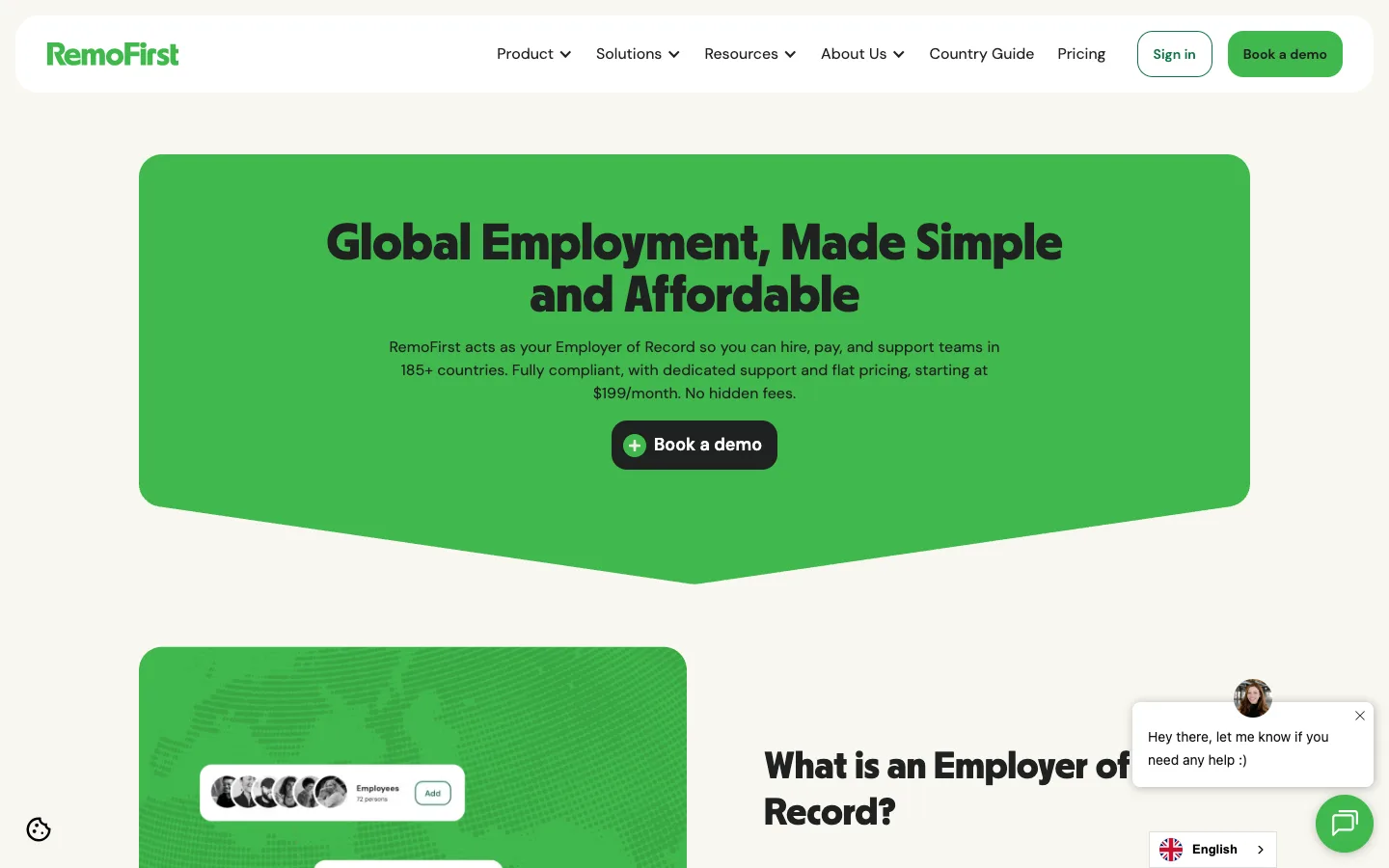
Remofirst is a strong fit when you need compliant hiring in 180+ countries and can work with a partner entities model.
Best for
Teams that prioritize country reach and can operate with partner-entity structures.
Not ideal for
Procurement workflows that require owned entities in every country.
Entity model
Partner entities
Primary tradeoff
Legal employer may be a local partner in some markets.
Summary
Pick Remofirst if cost is your top constraint: at $199/mo per employee, it is far cheaper than Deel at $599 and Multiplier at $400. For startups and small companies hiring their first handful of international employees with tight budgets, that pricing makes Remofirst viable where EOR otherwise wouldn’t be. The coverage is broad at 180+ countries, the contractor management free tier is genuinely useful, and the platform is simple enough that you won’t need a training session to figure it out.
The trade-off is everything you’d expect. Remofirst uses partner entities everywhere — no owned subsidiaries in any market. The platform is basic: limited integrations, minimal reporting, and no self-serve contract customization. Onboarding runs 5–10 business days in most countries, slower than Deel’s 2–5 day standard. If you’re a 50-person company hiring senior engineers in Germany or scaling a team of 30 in India, you’ll outgrow Remofirst quickly. But if your budget can’t stretch to $400–$600 per head per month and you need compliant employment in a few countries, Remofirst does the job at a price point nobody else matches.
Pick Remofirst if
- You need compliant hiring at the lowest monthly fee and can work with a basic platform.
- Your team is under 20 international employees and can tolerate 5-10 day onboarding.
Skip Remofirst if
- Your legal or compliance team requires owned entities in any market.
- You need advanced integrations, analytics, or consistently fast support.
Remofirst: Key Facts
Before final sign-off on Remofirst, review EOR comparisons, benchmark budget assumptions in the EOR cost guide, and align legal terms in the Employer of Record glossary.
What Remofirst Does Well
Price point that makes EOR accessible to startups
This is the reason Remofirst exists, and the reason you’re reading this review. At $199/mo per employee, the annual EOR cost for a single hire is $2,388 — compared to $7,188 at Deel or $4,800 at Multiplier. For a 5-person international team, that’s $11,940/year on Remofirst versus $35,940 on Deel. The $24,000 annual savings is material for a seed-stage startup or a bootstrapped company.
The pricing is flat-rate and transparent. No setup fees, no termination fees, no minimum contract length. You pay $199 per employee per month plus the actual salary and statutory costs. That simplicity matters because EOR pricing at other providers gets murky fast — Deel’s $599 base swells with background check fees, work permit surcharges, and premium support tiers. Remofirst’s price page is one of the most straightforward in the industry.
The economics change the hiring calculus. Companies that would otherwise classify workers as contractors (with all the misclassification risk that entails) can afford compliant employment through Remofirst. A startup paying a developer $4,000/month in Poland isn’t going to spend $599/month on Deel’s EOR — that’s a 15% overhead. Remofirst at $199/month drops it to 5%, which is closer to what a local payroll service would cost.
Broad country coverage without enterprise pricing
180+ countries is more coverage than most competitors offer. Deel covers 160+, Remote covers 85+, and Multiplier covers 150+. Remofirst’s partner-entity model makes this possible — it’s faster and cheaper to onboard a new local partner than to incorporate a subsidiary. The practical benefit: if you’re hiring across uncommon markets (think Eastern Europe, Southeast Asia, or parts of Latin America), Remofirst can probably cover it without sending you to a second provider.
That breadth matters when you’re a small team. Running two EOR providers means two invoices, two dashboards, two sets of compliance documentation. For a 3-person People team managing 10 international hires, consolidation on one provider saves hours of monthly admin even if that provider isn’t the strongest in any single market.
Free contractor management as a genuine product
Remofirst’s free contractor tier lets you onboard contractors in seconds, manage contracts, run identity checks, and handle expense reimbursements — all without paying anything. The $25/month premium tier adds automated multi-currency payments and one-click invoicing across 150+ countries.
This is a real product, not just a lead-gen page. Companies testing a new market with a contractor or two can start free, validate the working relationship, and convert to EOR ($199/mo) when they’re ready to formalize the employment. That contractor-to-EOR funnel mirrors what Deel does, except Deel’s EOR conversion costs three times more.
The free tier has limits — you handle payments outside the platform, which means manual bank transfers or separate payment tools. But for companies managing 5–15 contractors across a few countries, the free tier eliminates an entire software subscription.
Simple platform that doesn’t require training
Remofirst’s dashboard is stripped down compared to Deel or Rippling. That’s a weakness for large teams (covered below), but a genuine advantage for small ones. The interface shows your employees, their contract status, payroll timelines, and documents. There’s no 45-minute onboarding call needed. A founder or head of People who’s never used an EOR platform can figure it out in an afternoon.
The employee experience is similarly simple. Employees log into a portal to view their contract, submit expense claims, and access payslip history. It won’t win design awards, but it works without confusion. For a 10-person startup where the CEO is also the HR department, simplicity beats feature depth.
Where Remofirst Falls Short
Every employee sits on a partner entity
This is the fundamental trade-off that funds the $199 price point. Remofirst doesn’t own a single employing entity anywhere in the world. Every hire in every country goes through a local third-party partner firm. The partner is the legal employer; Remofirst is the management and coordination layer on top.
Why this matters: in a labor dispute, regulatory audit, or termination gone wrong, the entity on the other side of the table is a local firm you didn’t select, haven’t vetted, and may not be able to speak to directly. Remofirst manages the relationship, but the liability chain has a link you don’t control. Deel has this problem in roughly half its markets. Remote has it in none. Remofirst has it everywhere.
For straightforward employment — hire, pay, comply, repeat — partner entities work fine. The risk surfaces when something goes wrong. A wrongful termination claim in Germany, a tax audit in Brazil, or an employee benefits dispute in France all land on the partner entity first. Your recourse runs through Remofirst’s commercial contract with that partner, not through a direct legal relationship.
If your legal team won’t sign off on partner entities in key markets, Remofirst is off the table entirely. That eliminates it for many mid-market and enterprise buyers.
Platform lacks depth for growing teams
Remofirst’s simplicity becomes a limitation once you scale past 15–20 international employees. The reporting is basic — you can see headcount and costs, but there’s no customizable dashboards, workforce analytics, or trend visualizations. Deel’s platform shows cost-per-country breakdowns, compliance risk indicators, and payroll audit trails. Rippling offers full HRIS functionality with time tracking, performance management, and IT provisioning alongside EOR. Remofirst shows you a list of employees and their contract status.
Integrations are sparse. BambooHR and ADP Workforce Now are available. That’s roughly it for HRIS connectivity. No Greenhouse, no Workday, no Netsuite, no accounting platform sync. If you run BambooHR, you’re covered. If you use anything else (and most companies do), you’re exporting CSVs and manually reconciling data.
There’s no public API documentation that matches Deel’s developer-friendly approach. For a company with 50+ international employees running a mature tech stack, the manual overhead of keeping Remofirst synced with your HRIS and accounting tools costs real hours every month — hours that erode the savings from the $199 price point.
Onboarding is slower than the top tier
Remofirst doesn’t publish specific onboarding timelines the way Deel does (2–5 days) or Remote does (3–5 days). User reports and third-party reviews consistently cite 5–10 business days for standard hires in major markets, and longer for countries with complex registration requirements. Some customer testimonials mention 3-day completions, but that appears to be the exception rather than the norm.
The gap matters in competitive hiring. If you’re offering a role to a senior engineer who also has an offer from a company using Deel, your 7–10 day onboarding timeline versus their 3-day timeline creates a window where your candidate might accept the other offer. For roles where time-to-start is critical, that onboarding lag costs real hires.
The process itself — information collection, document upload, employment agreement generation, contract signing — is standard. Remofirst assigns a Hiring Success Manager to coordinate. But the manual coordination through partner entities adds time that platform-driven providers like Deel have automated away.
Customer support quality varies after onboarding
A pattern in Remofirst reviews: the onboarding experience gets strong marks, with dedicated managers who are responsive and knowledgeable. Post-onboarding support is less consistent. Routine queries about payroll timing, benefits details, or contract amendments can take 24–48 hours for a response, compared to Deel’s typical 30-minute chat response during business hours.
Remofirst advertises 24/5 support, but the depth of that support depends on the query. Simple payroll questions get quick answers. Complex compliance questions — termination procedures in specific countries, tax optimization strategies, benefits customization — often require escalation to the local partner, adding another layer of response time.
For a small team with straightforward employment needs, this is manageable. For a company dealing with a termination in France or a labor dispute in Brazil and needing same-day guidance, the support speed gap versus Deel or Remote is a real operational risk.
No owned IP in the compliance chain
When Remofirst coordinates your employee’s IP assignment clauses, those clauses sit in a contract between the employee and the local partner entity. The partner entity then assigns or licenses those rights to you per the commercial agreement with Remofirst. That’s one more link in the chain than you’d have with an owned-entity provider like Remote, where the employment agreement directly flows to a Remote-owned subsidiary.
For most roles, this extra step is immaterial. For engineering-heavy teams building proprietary technology in IP-sensitive industries (fintech, biotech, defense-adjacent), your legal team will want to scrutinize the partner-entity IP assignment chain country by country. Some jurisdictions — Germany’s Employee Inventions Act, India’s moral rights provisions — make IP assignment complex even with owned entities. Adding a partner intermediary doesn’t simplify things.
Pricing Breakdown
| Item | Cost |
|---|---|
| EOR per employee | $199/mo |
| Contractor management (free tier) | Free (onboarding, contracts, identity checks) |
| Contractor management (premium) | $25/mo per contractor |
| Background checks | Included in some markets (scope varies by country) |
| Work permits & visas | Quoted per case |
| Equipment procurement | Not offered natively |
| Dedicated account manager | Included (Hiring Success Manager) |
No hidden fees: Remofirst is explicit about not charging setup fees, termination fees, or minimum contract lengths. Your invoice shows three line items: Remofirst service fee, employee salary and payroll costs, and benefits. That transparency is genuinely better than most competitors, where add-ons can inflate the effective per-employee cost by 20–30%.
What’s included in $199/mo: Employment contract generation, local payroll processing, statutory benefits administration, tax withholding and filing, access to local compliance expertise, 24/5 support, IP protection clauses, and health insurance access.
What’s not included: Work permit/visa processing (quoted separately), hardware procurement and shipping (not offered), enhanced benefits above statutory minimums (country-dependent), and advanced platform features like workforce analytics.
Annual cost example: 10 employees at $199/mo = $23,880/year. The same 10 employees on Deel at $599/mo = $71,880/year. On Multiplier at $400/mo = $48,000/year. That $24,120–$47,880 annual savings is real money for a startup — it covers another full-time hire in many markets. The question is whether the service quality gap costs you more than the savings.
Remofirst: Region-by-Region
Partner entity. Functional onboarding. Lacks the owned-entity speed Deel and Remote offer in this market.
Country guide → GermanyPartner entity. Risky pick for complex terminations — owned-entity providers handle works council requirements more directly.
Country guide → IndiaPartner entity. Solid for small teams. At 10+ hires, Deel's owned entity and faster onboarding justify the price gap.
Country guide → BrazilPartner entity. Expect longer onboarding (10+ days). Termination cost modeling less transparent than Deel's.
Country guide → SingaporePartner entity. Functional but Multiplier's Singapore HQ gives them a clear edge in this market.
Country guide → CanadaPartner entity. Clean execution for standard hires. Provincial tax handling depends on local partner quality.
Country guide → AustraliaPartner entity. Works for 1–3 hires. Scaling teams should consider Deel or Rippling with owned entities here.
Country guide → FrancePartner entity. French labor law complexity makes this a weaker pick — Remote's owned entity is safer for serious France hiring.
Country guide → PhilippinesPartner entity. Good value for offshore support teams. Competitive with local PEO options at this price.
Country guide → PolandPartner entity. Strong value proposition for hiring developers — $199/mo EOR fee on a $4k–$6k salary is hard to beat.
Country guide → MexicoPartner entity. Functional for nearshore hiring from the US. Profit-sharing compliance depends on local partner expertise.
Country guide → NetherlandsPartner entity. Basic benefits only — Dutch employees expect competitive packages that Remofirst doesn't offer by default.
Country guide → NigeriaPartner entity. Coverage here is valuable — many competitors skip Nigeria entirely.
Country guide → KenyaPartner entity. Decent option for East African hiring at this price.
Country guide → South AfricaPartner entity. Basic but functional. Check partner BBBEE credentials if relevant to your operations.
Country guide → ColombiaPartner entity. Customer testimonials cite smooth onboarding here. Good LatAm alternative to Brazil's complexity.
Country guide →Deep dive: For detailed compliance analysis of Remofirst in Asia, see our eor.asia review.
Deep dive: For detailed compliance analysis of Remofirst in Africa, see our eor.africa review.
Pros and Cons
How Remofirst Compares
3x the price with faster onboarding, deeper platform, and owned entities in half its markets. Worth the premium for teams over 15 employees.
Full comparison → Multiplier2x the price but stronger APAC presence and more polished platform. The middle ground between Remofirst's budget and Deel's premium.
Full comparison → Remote3x the price, fewer countries, but owned entities everywhere. The compliance-first choice for regulated industries.
Full comparison → Oyster3.5x the price with stronger benefits packages and employee experience focus. Overkill for budget-first buyers.
Full comparison →Case Studies
Used Remofirst to hire in complex markets like Germany without setting up local entities. HR team cited clear compliance guidance and strong partnership with their legal team for multi-country expansion.
Read case study → 1 Of A Kind StudioFounder relocated from the Netherlands to Colombia and used Remofirst to stay compliant. Completed onboarding paperwork in 3 days, called the service 'a superpower' for solo founders managing international moves.
Read case study → Family for Every ChildInternational NGO uses Remofirst to legally employ talent worldwide without maintaining a large internal HR and finance team, enabling focus on their charitable mission.
Read case study →Real User Feedback
| Platform | Rating | Reviews |
|---|---|---|
| G2 | 4.5/5 | 160+ |
| Capterra | N/A | Limited reviews |
| Trustpilot | 3.7/5 | 49 |
Remofirst has significantly fewer reviews than Deel (3,500+ on G2) or Remote (1,000+). That’s partly because the company is younger (founded 2021 vs. Deel’s 2019) and partly because the customer base skews toward smaller companies that review less frequently. Take the ratings as directional, not definitive.
What users praise:
- Pricing transparency: no surprise charges, invoices match what was quoted
- Onboarding managers are responsive, knowledgeable, and personally invested during setup
- Platform simplicity — several users specifically mention not needing training to get started
- Contractor free tier saves money for companies testing new markets
- Compliance guidance during initial setup is thorough and country-specific
- Flexibility of no minimum contract commitments
What users complain about:
- Post-onboarding support drops off: response times slow from hours to days after the initial setup phase
- Contractor payment processing (on free tier) requires manual handling outside the platform
- Limited platform features compared to Deel: no advanced reporting, no expense management, no equity tracking
- Some users report inconsistency between local partners in different countries — one market is excellent, another is sluggish
- Benefits options feel bare-minimum, with limited ability to customize or enhance packages
- Lack of integrations forces manual data entry between Remofirst and other HR tools
Our Final Verdict
Use Remofirst if: You’re a startup or small company (under 20 employees internationally) with a tight budget, hiring in a few countries where you need compliant employment but can’t justify $400–$600/month per head. You don’t need advanced platform features, your HR tech stack is simple (or you’re fine with manual data management), and your hiring is for roles where 5–10 day onboarding isn’t a dealbreaker. Remofirst is the right pick when the alternative is either misclassifying contractors or not hiring internationally at all.
Skip Remofirst if: Your legal team requires owned entities in any market — Remofirst has zero. You’re hiring 20+ employees and need workforce analytics, HRIS integrations, or automated workflows. You’re making competitive offers where 2–3 day onboarding matters. You’re hiring in complex European markets (Germany, France, Netherlands) where termination law and works council requirements make owned-entity providers a safer bet. You’re in a regulated industry where your compliance team needs to audit the employing entity directly.
Bottom line: Remofirst occupies a unique position in the EOR market: it’s the only major provider where the price doesn’t make you wince. If budget is the main constraint for 5–15 international hires, we’d start here. At $199/mo, the annual savings over Deel ($4,800 per employee) or Multiplier ($2,400 per employee) are substantial enough to fund additional hires. The cost is real, though — partner entities everywhere, a basic platform, slower onboarding, and thinner support. For budget-conscious companies hiring 5–15 people internationally, those trade-offs are worth it. For everyone else, the savings don’t compensate for the service gaps once you hit scale. Start here if price is the constraint. Graduate to Deel or Multiplier when your team size and complexity demand it.
Frequently Asked Questions
How much does Remofirst cost?
$199/mo per employee — the cheapest major EOR. No setup, termination, or minimum contract fees. Salary and statutory costs are pass-through. For a 5-person team: $11,940/year versus $35,940 on Deel — $24k annual savings. Contractor free tier available; $25/mo premium for automated payments. Ask what’s included vs. per-country add-ons.
Does Remofirst use owned or partner entities?
100% partner. No owned entities in any country. A local partner firm is always the legal employer; Remofirst coordinates. Deel owns ~half its markets; Remote owns all. If your compliance team requires owned entities, Remofirst won’t work. The partner model is how they keep the price at $199/mo.
How fast is Remofirst’s onboarding?
5–10 business days in most markets. Brazil, Germany, France can stretch beyond 10 days. Deel does 2–5 days at 3x the price. Remofirst assigns a Hiring Success Manager, but partner workflows add steps. If competitive offers demand 3-day turnaround, Remofirst isn’t the fit.
Can we convert contractors to EOR through Remofirst?
Yes. Move from free or premium contractor tier to EOR at $199/mo. Conversion takes 5–10 business days — same as fresh onboarding. Deel offers smoother contractor-to-EOR conversion but at $599/mo. Remofirst keeps the cost low throughout the funnel.
When should we set up our own entity instead?
Entity setup: $15k–$50k and 2–6 months. Remofirst: $2,388/year per employee. Breakeven is 6–7 employees at the cheapest entity cost. Deel’s breakeven hits at 2–3 employees. Remofirst extends the window where EOR beats entity formation — useful for budget-conscious teams testing new markets.
We’re starting with Remofirst to save money. What breaks first as headcount grows, and when should we plan to switch providers?
The first friction point hits around 8–12 international employees: manual data management between Remofirst and your HRIS becomes a real time cost for your People team. At 15+ employees, the lack of integrations (no BambooHR, Rippling, or Greenhouse connectors) typically forces 2–4 hours/week of manual data reconciliation. The second break point is complex markets: if even one hire lands in Germany, France, or the Netherlands, Remofirst’s partner entities and limited in-house EU legal expertise create compliance exposure in termination or works council scenarios that a dedicated EOR handles better. The third is onboarding speed — at 20+ employees you’re hiring more competitively, and Remofirst’s 5–10 day onboarding vs Deel’s 2–5 days starts costing you candidates. Plan for the Deel transition around 15–20 international employees, or earlier if any hire lands in a high-complexity European market. Multiplier at $400/mo is the middle step for APAC-heavy teams. See Deel and Multiplier reviews.
Who should skip Remofirst?
Legal teams requiring owned entities. Companies making competitive offers where 2–3 day onboarding matters. Complex European markets (Germany, France, Netherlands) where termination law and works councils make owned-entity providers safer. Regulated industries needing to audit the employing entity. Scale to Deel or Multiplier when team size and complexity demand it.
For market-level context beyond vendor features, see EOR pricing hidden costs and browse remote jobs by country to understand demand patterns.
Further Reading
- Deel EOR Review 2026 — The market default at $599/mo. Faster onboarding, deeper platform, 3x the cost.
- Multiplier EOR Review 2026 — The middle ground at $400/mo. Stronger in APAC than Remofirst.
- Remote EOR Review 2026 — 100% owned entities for compliance-first buyers. $599/mo, fewer countries.
- Oyster EOR Review 2026 — Stronger benefits and employee experience at $699/mo. Different buyer profile.
- EOR comparisons

Was this page helpful?
Tell us or send a correction.