
Summary
Pick Atlas HXM if your legal team requires owned entities in every market: it claims 100% owned coverage across 160+ countries at $500/mo per employee. That combination, global scale without partner-entity risk at a price point below Deel and Remote : is genuinely rare.
The trade-offs are tangible. The 2023 rebrand from Elements Global to Atlas HXM still causes confusion during procurement and reference checks. Support response times run 24–48 hours for non-urgent tickets, acceptable for routine queries, problematic when a French employee gives notice on a Friday. The integration list is thinner than Deel’s or Rippling’s, and the contractor management features are bare-bones compared to what Deel offers for free. Atlas wins on the structural question of entity ownership. It loses on platform polish, support speed, and ecosystem breadth.
Pick Atlas HXM if
- You need owned-entity coverage above 85 countries without paying G-P pricing.
- Compliance structure matters more than ecosystem depth and fastest support.
Skip Atlas HXM if
- Your team relies on fast support turnaround for daily HR operations (Deel and Remote are faster).
- You need deep integration with Greenhouse, Lever, or non-enterprise accounting software (Deel or Rippling wins).
Atlas HXM: Key Facts
Scores
Aggregate score
4.2 / 5.0
Solid
Weighted calc: 4.3
Category average
4.0
+0.2 vs avg
Weight 20%
Global Coverage Depth
+0.8 vs avg
Weight 25%
Compliance & Entity Model
+0.2 vs avg
Weight 10%
Onboarding & Payroll Ops
+0.3 vs avg
Weight 20%
Pricing & Total Cost
+0.2 vs avg
Weight 15%
Platform & Integrations
+0.2 vs avg
Weight 10%
Support & Escalation
-0.1 vs avg
Atlas HXM: 3rd Party Reviews
| Platform | Score | Reviews |
|---|---|---|
 G2 ↗ G2 ↗ | 4.3 / 5 | 200+ reviews |
 Capterra ↗ Capterra ↗ | 4.2 / 5 | 100+ reviews |
 Trustpilot ↗ Trustpilot ↗ | 3.8 / 5 | 150+ reviews |
Atlas HXM: Platform Screenshots
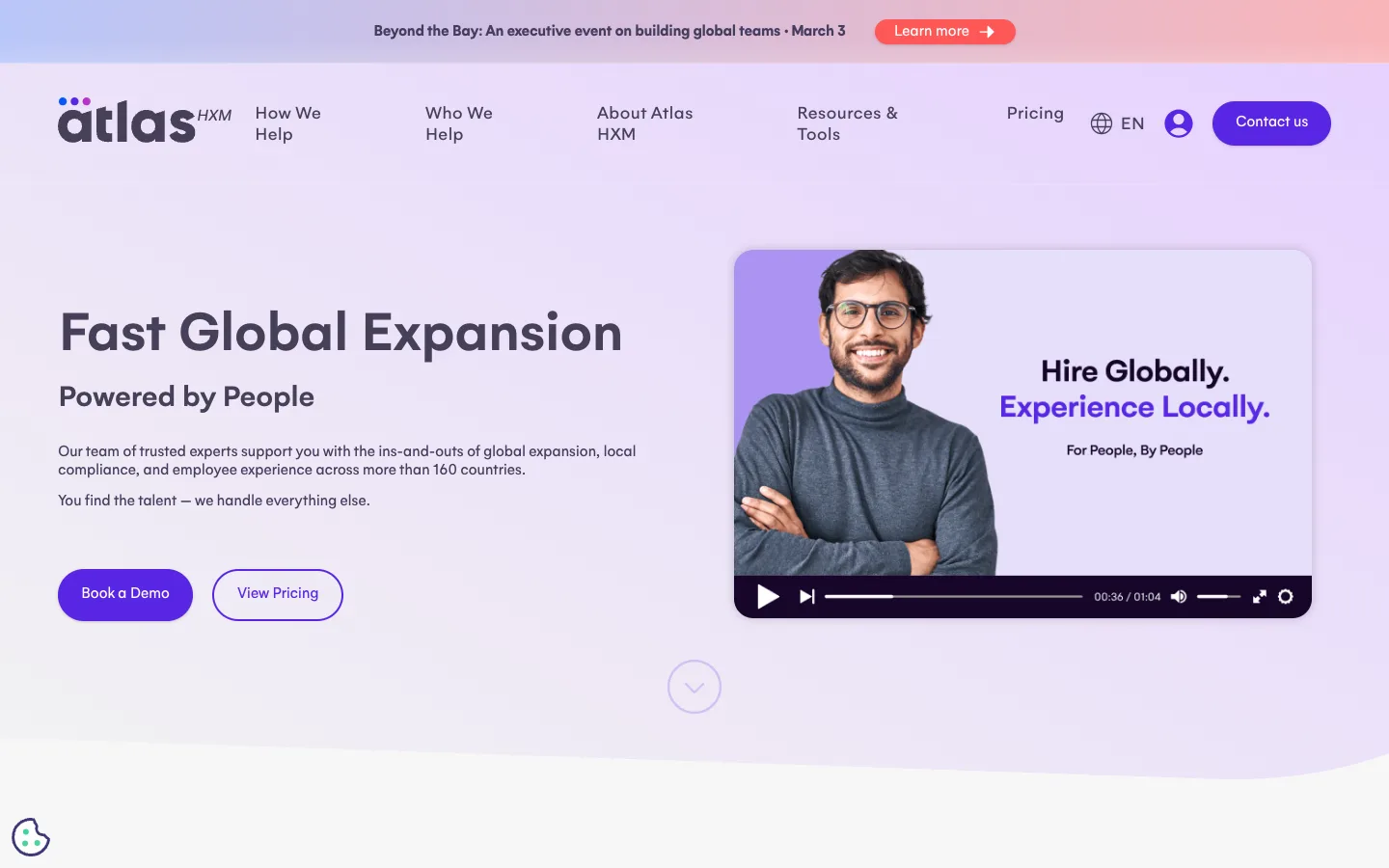
Atlas HXM platform overview
What Atlas HXM Does Well
100% owned entities at 160+ country scale
This is Atlas’s defining advantage, and the reason it belongs in any serious procurement shortlist. Owning the legal entity in every market means there is exactly one contract between your company and the employer of your international workers. No local partner firm in the middle. No intermediary that might handle your employee’s termination differently than your EOR promised. When a labor inspector in Germany or a court in Brazil wants to talk to the employer, Atlas is the employer, not some third-party firm that Deel or Multiplier contracted on your behalf.
Remote also runs 100% owned entities, but only covers about 85 countries. Deel covers 160+ but uses partner entities in roughly half. G-P covers 180+ with owned entities, but charges $800+/mo. Atlas is the only provider that offers the owned-entity-everywhere model at this country count and at this price tier. For legal and compliance teams that treat entity ownership as a binary requirement, and many regulated-industry buyers do, the competitor set shrinks to Atlas and G-P, and Atlas is 40% cheaper.
The caveat is worth stating directly: “100% owned” deserves scrutiny during procurement. Ask for the entity name and registration number in each country where you plan to hire. Some providers classify entities acquired through shell structures or dormant subsidiaries as “owned.” The claim should be verifiable with a corporate registry search in 15 minutes.
Pricing that undercuts the major owned-entity competitors
$500/mo per employee for a direct EOR model undercuts Remote ($599) and G-P (~$800) while covering 160+ owned-entity markets. Mid-market buyers with 20–100 international employees who already need owned entities get the clearest savings case versus G-P.
For deposits, FX, volume tiers, and worked annual cost examples, use the Atlas HXM pricing guide. Deel’s $599 list is comparable on headline fee, but roughly half of Deel’s countries use partner entities, so the owned-entity apples-to-apples set is Atlas, Remote, and G-P.
Direct employment eliminates partner liability chains
When Deel hires an employee in a partner-entity country, the contractual chain runs: your company → Deel → local partner firm → your employee. If something goes wrong, a wrongful termination claim, a payroll tax audit, a benefits dispute, the local partner is the legal employer and Deel coordinates from a layer above. That layer of indirection isn’t hypothetical risk. Companies that have been through labor disputes in partner-entity markets know the difference between one phone call and three.
Atlas’s direct model compresses the chain: your company → Atlas’s entity → your employee. One contract. One liability holder. One point of contact when things go wrong. For industries with regulatory scrutiny over employment relationships, financial services, healthcare, defense contracting, pharmaceuticals, this structural simplicity matters more than any feature comparison.
Established APAC operations from the Elements Global era
Atlas’s APAC roots predate most of its competitors. The company (then Elements Global Services) has been running entities in Singapore, Japan, South Korea, India, and Australia since 2016–2017, giving it nearly a decade of operational history in the region. That tenure translates to in-house teams who have processed thousands of payroll cycles, navigated multiple regulatory changes, and handled the edge cases that trip up newer entrants.
For companies building engineering or operations teams across Asia-Pacific, the practical benefit is fewer surprises. Atlas’s Singapore and Japan operations, in particular, run smoothly, onboarding in 3–5 days for standard hires, local compliance staff who answer in-region during APAC business hours, and benefits packages that reflect market expectations rather than statutory minimums. Multiplier has similar APAC depth from its Singapore headquarters, but Atlas offers it inside an owned-entity model.
Rebuilt technology platform
The 2023 rebrand wasn’t cosmetic. Atlas rebuilt its platform from the ground up, the old Elements Global interface was functional but dated. The new HXM platform handles onboarding, payroll, benefits administration, and compliance documentation in a unified dashboard. Real-time payroll visibility across countries is the standout feature: you can see payroll status, cost breakdowns, and statutory contribution details for every employee in every market from one screen.
The platform isn’t as polished as Deel’s or Rippling’s UI. Self-service options for routine tasks like contract amendments and benefit changes are more limited. But compared to where Atlas was two years ago, and compared to G-P’s platform, which still feels like enterprise software from 2015, it’s a meaningful upgrade that makes day-to-day management workable without constant CSM involvement.
Where Atlas HXM Falls Short
Rebrand confusion still hurts credibility
Three years after the Elements Global Services → Atlas HXM rebrand, the market hasn’t fully caught up. Google “Elements Global Services” and you’ll find more results, more review profiles, and more industry mentions than “Atlas HXM.” G2 reviews are split across both profiles, making it harder to gauge the company’s track record. Capterra shows the same fragmentation.
This creates real friction in procurement. When your VP of Finance asks the procurement team to vet Atlas HXM, their due diligence search returns thinner results than it should. Competitors with stronger brand continuity, Deel, Remote, Rippling, look more established in side-by-side comparisons even though Atlas has been operating longer. Reference checks become harder: a prospect asking “Has anyone used Atlas HXM?” gets fewer responses than “Has anyone used Elements Global?” This isn’t a product problem, but it’s a buying-decision problem that Atlas still hasn’t solved.
Support quality is inconsistent across regions
Atlas quotes 24–48 hours for non-urgent ticket resolution, with live chat limited to business hours in major time zones. In practice, users report that routine questions, payroll timing changes, benefits enrollment questions, contract amendment requests, regularly take 2–3 business days for first response. Urgent issues get escalated faster, but the definition of “urgent” isn’t always aligned between the client and the support team.
The regional disparity is notable. APAC support, drawing on legacy Elements Global teams, tends to be more responsive and knowledgeable. European and Americas support is more uneven. Deel and Remote both offer faster turnaround on routine queries, typically under 4 hours during business hours, with Deel’s chat support averaging 30-minute response times. For People teams managing 50+ international employees who need answers daily, that gap in responsiveness creates operational drag.
Dedicated account managers are available on enterprise plans, but mid-market clients on standard plans navigate general support queues. If you’re evaluating Atlas, ask specifically about support SLAs in the agreement, and push for guaranteed response time commitments, not just averages.
Fewer integrations than the top-tier platforms
Atlas connects to the major HRIS platforms: BambooHR, Workday, SAP SuccessFactors. That covers enterprise buyers who standardized on one of those systems. But the integration list stops shorter than it should. No native connections to Greenhouse, Lever, or Ashby for recruiting. No HiBob integration. No QuickBooks or Xero connector for finance teams that don’t run enterprise accounting software.
Deel offers 100+ integrations with a well-documented API. Rippling’s integration ecosystem is even broader. Atlas’s API exists but is less mature, and the pre-built connector library is roughly a third the size of Deel’s. For companies that rely on automated data flows between their ATS, HRIS, and EOR, and that’s most companies above 30 employees, missing integrations mean CSV exports, manual data entry, and reconciliation errors.
Atlas says the integration roadmap is a priority. But “coming soon” doesn’t help if you need Greenhouse sync today.
Contractor management is an afterthought
Atlas offers contractor payment processing, but calling it “contractor management” overstates the feature. You can generate invoices, process payments in multiple currencies, and track contractor engagements. What you can’t do: run automated misclassification risk assessments, convert contractors to EOR employees in a few clicks, or manage tax form collection (W-8BEN, 1099) natively.
Deel’s contractor platform is free, unlimited, and genuinely robust, it handles invoicing, compliance checks, milestone payments, and one-click conversion to EOR. That free contractor tool is how many companies first discover Deel, and the conversion path is a powerful sales engine. Atlas has nothing comparable. If contractors make up a meaningful portion of your international workforce, this gap matters.
Less brand recognition in talent markets
When a candidate in Berlin or São Paulo receives an employment contract from Deel, they’ve probably heard the name. When they receive one from Atlas HXM, they Google it. That moment of friction, “Who is this company and why are they my employer?”, affects offer acceptance rates, particularly for senior roles in competitive markets.
This isn’t about Atlas’s ability to legally employ someone. The employment relationship is identical regardless of brand recognition. But candidate experience during the offer stage matters, and brand unfamiliarity creates doubt. Companies hiring senior engineers, product managers, or finance professionals in competitive markets should factor this into their EOR selection, or plan to brief candidates on who Atlas is before extending offers.
Pricing Breakdown
Atlas HXM quotes from about $500/mo per employee. Teams of 20+ on annual billing often land in the $350–$450 band. Quote-based, no public list price.
| Item | Cost |
|---|---|
| EOR per employee | From ~$500/mo |
| Volume (20+ annual) | Often $350–$450/mo |
| Work permits & visas | Quoted separately |
| Salary deposit | Often 1–2 months gross salary (returned after offboarding) |
| FX markup | ~1–2% above mid-market |
All-in cost surprises buyers miss
Quote price is the floor. For a 20-person team at $9,000/month average salary (~$600/mo blended fee):
| Cost component | Monthly | Annual |
|---|---|---|
| EOR fees (20 × $600) | $12,000 | $144,000 |
| FX (~1.5% on $180K payroll) | ~$2,700 | ~$32,400 |
| Benefits markup (~$50/employee) | ~$1,000 | ~$12,000 |
| Operating total | ~$15,700 | ~$188,400 |
| Deposit (one-time, returned) | $180,000–$360,000 | - |
That is about $9,420/employee/year. Full deposit, FX, and volume modeling lives on the Atlas HXM pricing guide. Keep this review for entity model, support, and fit.
Atlas HXM: Top Regions
 United Kingdom
 Owned entity. Solid onboarding in 3–5 days. Benefits packages are functional but lean compared to Oyster HR in this market.
Country guide → Germany
 Owned entity with in-house legal staff. Termination support is competent, though G-P and Remote have deeper German employment law teams.
Country guide → Singapore
 One of Atlas's strongest markets. Entity since 2016, APAC team responds in-region. Multiplier's HQ proximity is the main alternative.
Country guide → India
India Owned entity. Fast onboarding (3–5 days). Strong for scaling engineering teams across multiple states.
Country guide → Brazil
 Owned entity. Onboarding runs 7–10 days due to registration timelines, Deel beats this by 2–3 days.
Country guide → Japan
Japan Owned entity with long operational history. Strong local compliance staff, but onboarding runs 7–10 days due to labor standards registration.
Country guide → Australia
 Owned entity. Clean execution. Consider Rippling if you already run their AU domestic payroll.
Country guide → Canada
 Owned entity. Provincial tax handling is solid. Onboarding in 3–5 days for standard hires.
Country guide →Pros and Cons
How Atlas HXM Compares
 Deel
Deel Same country count but partner entities in ~50% of markets. Faster onboarding (2–5 days), stronger integrations, free contractor platform. Pick Deel for speed and ecosystem; pick Atlas for entity ownership.
Full comparison → Remote
 Also 100% owned entities but only 85 countries. Better support responsiveness and IP protection tooling (Remote IP Guard). Pick Remote if 85 countries is enough; pick Atlas for broader coverage at lower cost.
Full comparison → G-P
G-P The 14-year incumbent with 180+ countries and 100% owned entities. Enterprise-grade but enterprise-priced. Atlas offers a comparable model at 40% less.
Full comparison → Multiplier
 $100/mo cheaper with strong APAC depth, but uses partner entities in many markets. If owned entities aren't a hard requirement, Multiplier is the budget pick.
Full comparison →Case Studies
Global NGO standardized employment conditions across 14 countries, converting nearly 100% of contractors to full-time employees under Dutch CLA standards to ensure pay equity worldwide.
Read case study → Swaps MonitorFinancial data provider achieved 20% workforce growth by hiring 11 people across Manila, Delhi, and Sydney through Atlas, ensuring compliance and enabling 24/7 global client support.
Read case study → UnearthodoxSwiss NGO simplified global hiring across multiple countries through Atlas, navigating India's complex payroll structure and completing onboarding within a month.
Read case study →eorHQ Final Verdict
Use Atlas HXM if: You need owned-entity EOR coverage in more than 85 countries and don’t want to pay G-P’s $800+/mo premium to get it. Atlas occupies a genuinely unique position: it’s the only provider offering 100% owned entities at 160+ country scale for $500/mo. That matters most for mid-market and enterprise companies (20–100 international employees) where legal and compliance teams treat entity ownership as a non-negotiable requirement. Financial services, healthcare, and defense contracting firms, where regulators scrutinize employment structures, are Atlas’s ideal buyers.
Skip Atlas HXM if: Your team relies on fast support turnaround for daily HR operations (Deel and Remote are faster). You need deep integration with Greenhouse, Lever, or non-enterprise accounting software (Deel or Rippling wins). Contractor management is a significant part of your international workforce strategy (Deel’s free contractor platform is in a different league). Or you need sub-3-day onboarding in every market to win competitive hiring situations.
Bottom line: Atlas HXM answers a question that matters to a specific, well-defined buyer: “Where can I get 100% owned entities in 160+ countries without paying G-P prices?” No other provider answers that question at this price point. The trade-offs are real, slower support, thinner integrations, a rebrand that still confuses the market, and contractor features that barely qualify. But the core structural advantage, direct legal employment without partner intermediaries at competitive pricing, is hard to replicate. For the compliance-first mid-market buyer who has already decided owned entities are non-negotiable, Atlas is the pick, ahead of G-P on price, and ahead of Deel on the structural question that actually matters.
Frequently Asked Questions
How much does Atlas HXM cost?
$500/mo per employee. Saves $29,700/year vs Remote ($599) and $90,000/year vs G-P (~$800) on 25 employees. Deel $599 but uses partners in ~50% of markets, Atlas claims 100% owned. For owned-entity comparison: Atlas vs Remote vs G-P.
Is Atlas HXM the same as Elements Global Services?
Yes. Rebranded 2023. Same entity, 160+ owned subsidiaries, same teams. Search both names for references and G2 reviews, more under Elements.
Does Atlas own all 160+ entities?
Atlas claims 100% direct ownership. Verify: ask for entity name and registration number per market; check local registry (Companies House UK, CNPJ Brazil, ACRA Singapore). 15-minute check removes ambiguity.
How fast is Atlas HXM’s onboarding?
3–5 days in UK, Singapore, Canada, Western Europe. 7–10 days in Brazil, Japan, India, parts of LATAM. Deel beats Atlas by 1–3 days in most markets; gap widens in LATAM. Work permits: 4–12 weeks. If speed is top criterion, Deel has the edge.
Can we transition from Atlas to our own entity?
Yes. Atlas offers transition support. 2–4 months: entity incorporation, contract re-execution, benefits transfer, statutory notifications. Atlas charges for advisory, get fee schedule at contract negotiation. Owned-entity model simplifies vs. partner arrangements.
Who should skip Atlas HXM?
Contractor-heavy (20%+ of workforce), Deel’s free contractor platform wins. Need contractor-to-EOR conversion or misclassification scoring, Atlas contractor module is basic. Time-to-hire primary criterion, Deel faster.
For market-level context beyond vendor features, see EOR pricing hidden costs and browse country hiring guides for local employment costs and compliance.
How does the rebrand from Elements Global Services affect existing clients or due diligence?
Rebranded in 2023, same entity and team. Owned-entity infrastructure, employment contracts, and legal relationships carried over unchanged. Confusion shows up in G2/Trustpilot: most review history is under “Elements Global Services.” Search both names for a complete picture. Atlas has been adding platform features post-rebrand, ask for a demo of the current Meridian platform rather than relying solely on pre-2023 references.
Sources
- Atlas HXM: Website, Pricing
- eorHQ pricing guide: Atlas HXM pricing
- G2: Global Employment Platforms
- eorHQ methodology: 6-dimension scoring
Related Decision Pages

Was this page helpful?
Tell us or send a correction.