
Summary
Borderless AI is the most AI-native EOR on the market, Alberni contract drafting, HRGPT, and a no-deposit model differentiate it from legacy providers. Pricing starts around $599/mo with claimed coverage in 170+ countries. Confirm all-in pricing, entity ownership, and offboarding terms in writing before you sign.
The trade-offs are verification and maturity. Two years of operating history, unclear entity ownership in many markets, and thin integrations make Borderless AI a calculated bet rather than a safe default. Compliance-conscious buyers should verify who the legal employer is in each target country before signing.
Pick Borderless AI if
- You want AI-assisted contract workflows and no salary deposits to preserve working capital.
- You are testing 1–3 hires in lower-risk markets (US, Canada, UK) and can verify entity ownership upfront.
Skip Borderless AI if
- Your legal team requires verified entity ownership in every market, Remote is the safer pick.
- You’re hiring in complex labor markets like Germany, France, or Brazil, or optimizing purely on cost (Remofirst at $199/mo or Multiplier at $459/mo).
Borderless AI: Key Facts
Scores
Aggregate score
3.8 / 5.0
Solid
Global average
4.1
-0.3 vs avg
Weight 10%
Support & Escalation
+0.1 vs avg
Strengths
- Support responsiveness consistently highlighted, with multiple customers citing fast reply times and dedicated CSMs
- HRGPT and Alberni praised for reducing dependency on support tickets for routine labor law questions
Limitations
- Response times vary by region and plan tier
- Complex cross-border compliance queries may require partner escalation
Weight 15%
Platform & Integrations
+0.1 vs avg
Strengths
- Platform UX described as clean and intuitive, especially for first-time EOR buyers
Limitations
- Limited HRIS integrations make data syncing manual for companies on BambooHR, Workday, or other systems
- Most customer stories involve small headcounts (3–25 employees), raising questions about enterprise scalability
Weight 10%
Onboarding & Payroll Ops
At avg
Strengths
- Onboarding speed reported at 3–7 days, faster than legacy providers these customers previously used
Limitations
- Complex markets may run slower than quoted timelines
- Self-serve contract generation limited vs fastest competitors
Weight 20%
Pricing & Total Cost
-0.3 vs avg
Strengths
- Published or benchmark pricing from $579/mo per employee
- Volume discounts often negotiable at 15+ headcount on annual billing
Limitations
- Add-ons (visas, benefits, background checks) can push all-in cost above headline fee
- FX markup and deposit terms should be confirmed contractually before signing
Weight 20%
Global Coverage Depth
-0.6 vs avg
Strengths
- No-deposit model appreciated by startups and mid-market companies managing cash flow
- 170+ countries on paper with broad geographic reach
Limitations
- Partner-only coverage can mean uneven execution outside flagship regions
Weight 25%
Compliance & Entity Model
-0.7 vs avg
Strengths
- Real-time payment processing through Nium partnership, particularly for contractor payments
- Broad market access through established local partner network
Limitations
- Contract templates have limited customization options for non-standard employment arrangements
- AI-generated contracts sometimes require manual corrections in markets with complex collective bargaining agreements
Borderless AI: 3rd Party Reviews
| Platform | Score | Reviews |
|---|---|---|
 G2 ↗ G2 ↗ | 4.9 / 5 | 50+ reviews |
 Trustpilot ↗ Trustpilot ↗ | 4.0 / 5 | 5+ reviews |
Borderless AI: Platform Screenshots
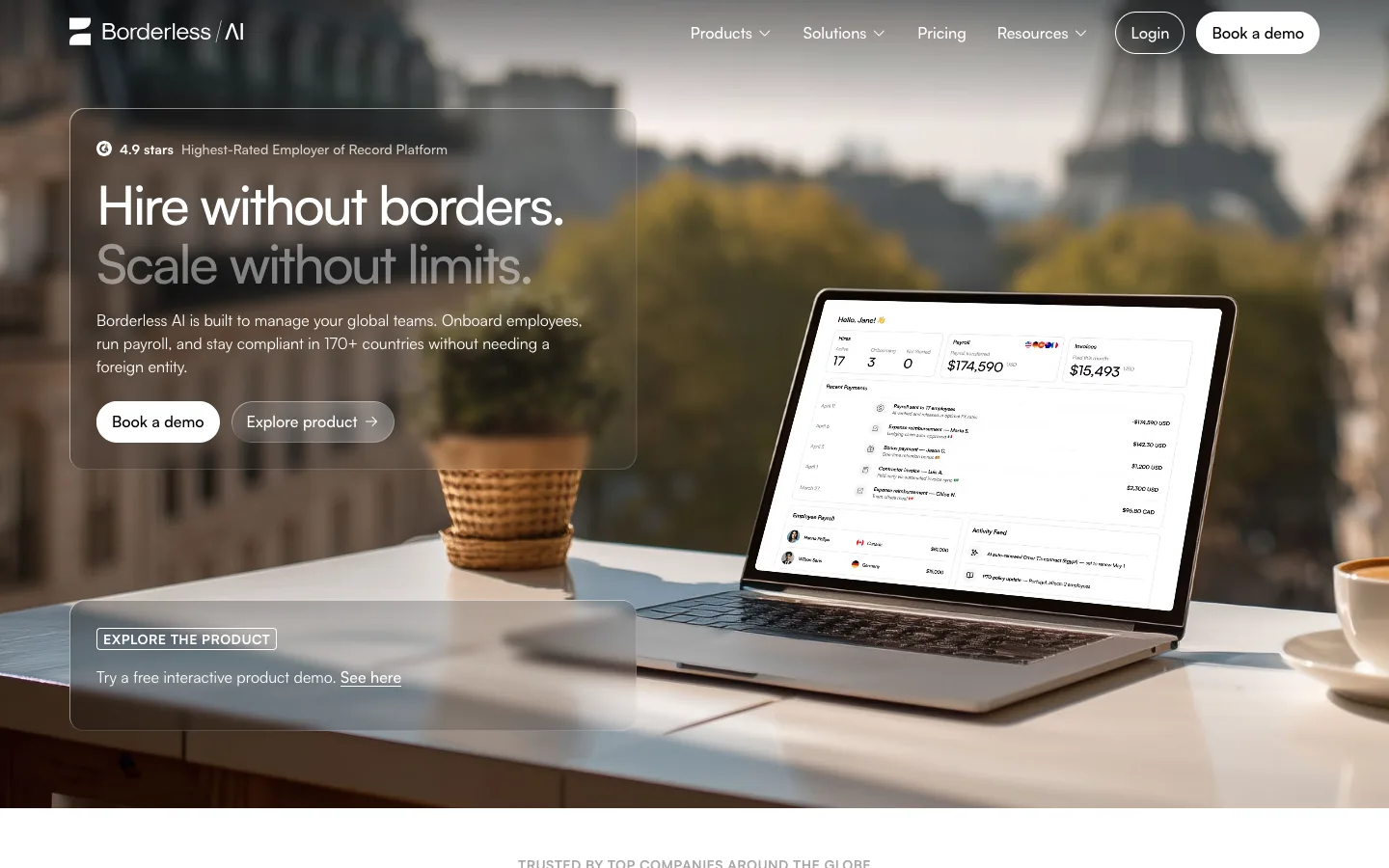
Borderless AI platform overview
What Borderless AI Does Well
The AI tooling is more than marketing
Most EOR providers have bolted “AI” onto their marketing pages without changing much about how the product works. Borderless AI built the product around it. Their Alberni AI agent, powered by Cohere’s Command R model with retrieval-augmented generation, handles three things that traditionally require a human: generating locally compliant employment contracts, answering country-specific labor law questions, and flagging compliance discrepancies in existing agreements.
The contract generation is the most practically useful. Input the employee’s country, role, and compensation details, and Alberni produces a draft employment agreement that accounts for local mandatory clauses, notice periods, and statutory benefits. Borderless claims this takes about 10 minutes versus the 7–10 business days typical of manual processes. Even if the real-world figure is 2–3x slower than advertised, that’s a meaningful speed improvement for HR teams generating contracts across multiple jurisdictions.
HRGPT, their AI search tool launched in January 2025 with strategic funding from Cohere, lets anyone query employment law questions in natural language. “What’s the probation period in Germany?” or “How much severance do I owe in Brazil after 3 years?” These are questions that normally require emailing your EOR’s support team and waiting hours. Getting an instant answer, even one that needs human verification for high-stakes decisions, saves real time during hiring planning.
The skepticism is warranted on reliability. AI-generated contracts still need human legal review in complex markets (Germany’s works council requirements, France’s collective bargaining agreements, Brazil’s CLT nuances). Borderless positions the AI as the primary workflow, not a supplement. For straightforward hires in well-documented markets, that probably works. For a senior hire in a country with layered employment protections, you’d want a human lawyer reviewing that contract before the employee signs it.
No deposit requirement frees up cash
Most EOR providers require 1–2 months of salary deposited upfront as a payroll float. For a $100,000/year employee, that’s $8,000–$17,000 locked up before the person starts. Multiply that by 10 hires across 5 countries, and you’re looking at $80,000–$170,000 in working capital tied up with your EOR provider.
Borderless AI doesn’t require deposits. That’s a genuine financial advantage for startups and mid-market companies where cash management matters. The working capital difference between Borderless and a provider requiring 2-month deposits can fund an additional hire’s first quarter of EOR fees.
This isn’t entirely altruistic, Borderless likely absorbs the float risk through their pricing or payment terms with Nium (their cross-border payments partner). But for the buyer, the outcome is the same: less cash locked up, faster commitment to new hires.
Support quality gets high marks early
Borderless AI’s G2 rating of 4.9/5 is the highest in the EOR category. They earned G2’s “Best Support” badge in Summer 2024. Customer testimonials consistently highlight responsive support with dedicated CSMs, even for smaller accounts.
Commerce7, which onboarded Canadian employees through Borderless AI, reported reducing onboarding time from 2 weeks to 4 days. Affiniti, a fintech company, cited 30-minute support response times during their $62 million fundraise when they needed to scale global hiring quickly. Levanta reported a 90% reduction in admin hours after switching to the platform.
The caveat: these are early-stage reviews from a company that’s still small enough for the founding team to personally manage key accounts. Every EOR provider has great support when they have 50 customers. The question is whether support quality holds at 500 or 5,000 customers. Deel’s support was universally praised in 2020–2021 too; by 2024, APAC response times had stretched to 8–12 hours.
Transparent cost calculator
Borderless AI publishes an employee cost calculator that breaks down country-specific costs: base salary, employer social contributions, transaction fees, FX fees, and the Borderless monthly fee. That level of pre-sale transparency is unusual. Most EOR providers require a sales call to get country-specific cost estimates.
For finance teams building headcount budgets across multiple countries, being able to model total employment costs without waiting for a sales rep to respond is a practical advantage. The calculator won’t replace a detailed quote for complex hires, but it compresses the early-stage evaluation process.
Where Borderless AI Falls Short
The entity ownership claim doesn’t add up
Borderless AI’s marketing says they operate “owned global infrastructure” across 170+ countries. Remote, which has made owned entities the core of its brand, covers about 85 countries and has raised $496 million to build that infrastructure. Deel, with $690+ million in funding, owns entities in roughly 80 markets and uses partners for the other 80+.
Borderless AI has raised $32 million. Setting up a single legal entity in one country costs $15,000–$50,000 in legal and registration fees, plus ongoing annual compliance costs of $5,000–$20,000. Even at the low end, owning entities in 170 countries would require $2.5 million just in setup costs, plus $850,000+ annually to maintain them, before hiring a single employee. That’s not impossible with $32M in funding, but it leaves very little for product development, sales, AI infrastructure, and the other things a startup needs.
The more likely reality: Borderless AI owns entities in a handful of core markets (Canada, the US, possibly the UK and a few others) and works through local partner entities elsewhere. That’s not inherently bad, Deel does the same thing and services thousands of companies. But marketing it as “owned infrastructure” when it’s almost certainly a partner model in most markets is the kind of claim that erodes trust with compliance teams who dig into the details.
Before signing, ask Borderless AI for a country-by-country breakdown of entity ownership. Specifically: in which countries is Borderless AI Inc. (or a subsidiary) the legal employer, and in which countries is a third-party local firm the employer? The answer matters for your liability chain.
Two years of operating history is thin
Borderless AI emerged from stealth in March 2024. The company was incorporated in 2022, but their public-facing operations are less than two years old. In EOR, track record matters because the hard compliance problems, wrongful termination disputes, tax authority audits, social security investigations, take 1–3 years to surface.
A provider that’s been operating for 18 months may never have faced a labor court challenge in Germany, a CLT dispute in Brazil, or a regulatory audit in India. Deel has handled thousands of terminations across dozens of jurisdictions. G-P has been doing this since 2012. That institutional knowledge can’t be replicated with AI alone.
For straightforward hires in low-risk markets (Canada, UK, US), Borderless AI’s limited track record probably doesn’t matter. For complex markets with strong labor protections, Germany, France, Brazil, Japan, you’re essentially trusting a 2-year-old company to handle situations they may not have encountered before. That’s a real risk that each buyer needs to price in.
Integration ecosystem is thin
Borderless AI integrates with ADP Workforce Now. That’s essentially it for major HRIS connections. Compare this to Deel’s 100+ integrations (BambooHR, Greenhouse, Xero, NetSuite, QuickBooks, Workday) or Rippling’s native HR stack.
For a 5-person startup hiring its first international employee, this doesn’t matter. For a 200-person company running Greenhouse for recruiting, BambooHR for HR, and QuickBooks for accounting, manually exporting and importing employee data between Borderless AI and three other systems creates hours of monthly admin work.
Borderless AI will likely build more integrations as they scale, but today, if your tech stack includes anything beyond ADP, expect manual data entry or CSV exports. That’s a real operational cost at scale.
Pricing sits in an awkward middle ground
At $579/mo per employee, Borderless AI costs less than Deel ($599/mo) and significantly less than G-P (~$800/mo), but substantially more than budget alternatives. Remofirst starts at $199/mo. Multiplier begins at $459/mo. Even Oyster HR, at $699/mo, offers a longer track record for a similar price point.
The no-deposit model saves cash upfront, which partially offsets the monthly fee for the first few months. But on an annualized basis, 10 employees on Borderless AI costs $69,480/year versus $47,880 on Multiplier, a $21,600 difference that buys a lot of manual compliance work.
Borderless AI’s argument is that AI automation reduces their operating costs, which should eventually translate to lower prices. That “eventually” is doing a lot of work. Today, you’re paying mid-tier pricing for a provider with a thin track record and limited integrations, plus the AI tooling. Whether the AI tooling alone justifies a $180/mo premium over Remofirst is a question each buyer answers differently.
No contractor management platform
Unlike Deel, which offers free contractor management for unlimited contractors in 150+ countries, Borderless AI’s contractor management is not a standalone free product. Borderless does offer contractor services, but it’s not the industry-standard free on-ramp that Deel and others provide. If your global workforce includes a mix of contractors and full-time employees, the inability to manage both through a single free-plus-paid platform is a friction point.
Pricing Breakdown
| Item | Cost |
|---|---|
| EOR per employee | $579/mo |
| Security deposit | None required |
| Contractor management | Available (pricing varies) |
| AI tools (HRGPT, Alberni) | Included in EOR fee; HRGPT free for non-customers |
| Work permits & visas | Custom pricing |
| Benefits administration | Included in base fee |
| Dedicated CSM | Included (per customer reports) |
What’s included in the base fee: AI-generated employment contracts, local payroll processing, statutory benefits administration, tax withholding and filing, Alberni AI agent access, HRGPT for labor law queries, and 24/7 in-house support.
What’s not included (or unclear): Work permit and visa processing, enhanced benefits above statutory minimums, equipment procurement, and custom contract provisions beyond standard templates. Borderless AI’s pricing page directs complex requirements to a sales call, which suggests custom pricing layers beyond the base $579/mo.
No-deposit advantage: On a $100,000/year employee, skipping a 2-month deposit saves $16,667 in working capital. For a 10-person international team, that’s $100,000–$170,000 not locked up with your EOR provider. Over a 12-month period, the cash flow benefit partially offsets the higher per-employee fee versus budget providers.
Annual cost example: 10 employees at $579/mo = $69,480/year. The same 10 employees on Deel at $599/mo = $71,880/year ($2,400 more). On Multiplier at $459/mo = $48,000/year ($21,480 less). On Remofirst at $199/mo = $23,880/year ($45,600 less). Borderless AI’s value proposition hinges on whether the AI tooling and no-deposit model justify the premium over cheaper alternatives.
For market fee benchmarks across providers, see the EOR pricing hub and EOR cost guide.
Borderless AI: Top Regions
 United States
 Core market. Likely an owned entity. Multi-state payroll handling reported as smooth by early customers.
Country guide → Canada
 Headquarters country, likely owned entity. Commerce7 onboarded in 4 days. Québec compliance handled well per customer reports.
Country guide → United Kingdom
 Entity ownership unclear. Standard onboarding but less proven than Deel or Remote for UK-specific employment tribunal risk.
Country guide → Germany
 High-risk test for a young provider. Works council handling and termination protection require deep in-country legal expertise. Ask about entity ownership.
Country guide → India
India Coverage available but limited public track record here. Deel and Multiplier have years more experience in the Indian market.
Country guide → Singapore
 Covered, but Multiplier (SG-headquartered) and Deel have deeper APAC operations. Ask about local entity status.
Country guide → Australia
 Available but unproven at scale. Modern Award compliance complexity makes established providers a safer choice for first AU hires.
Country guide → France
 French labor law is unforgiving to providers without deep local experience. Collective bargaining agreements and CSE requirements need human expertise beyond AI.
Country guide → Brazil
 CLT compliance demands years of in-country experience. Partner entity likely. Ask hard questions about termination handling.
Country guide → Netherlands
 Dutch employment law favors employees heavily. Limited track record here makes Deel or Remote safer picks for NL hires.
Country guide → Nigeria
 Coverage claimed. For African markets, verify the local partner entity and payroll processing timeline.
Country guide → South Africa
 Available but track record unclear. BCEA and LRA compliance complexity warrants asking about their local legal team.
Country guide →Pros and Cons
How Borderless AI Compares
 Deel
Deel $20/mo more, but 5+ years of operations, 100+ integrations, and free contractor management. The safe default for most companies.
Full comparison → Remote
 Fewer countries, same price, but every entity is owned. The compliance-first choice when entity ownership is non-negotiable.
Full comparison → Multiplier
 $179/mo cheaper, Singapore HQ with strong APAC support, more established. Better value unless AI tooling is a priority.
Full comparison → Remofirst
 Budget pick at one-third the price. Less polished platform but if cost is the primary driver, hard to ignore.
Full comparison →Case Studies
 Commerce7
 Canadian wine technology company onboarded first international employees in 4 days (down from 2 weeks with previous process). Used Borderless AI to expand into Canada without setting up a local entity.
Read case study → Affiniti
 Fintech company used Borderless AI during $62M fundraise to scale global hiring quickly. Reported 30-minute support response times and 3-day onboarding for new hires.
Read case study → Ritz-Carlton Yacht Collection
 Launched teams across 6 new regions (Europe and Asia) in one year, processing $70K+ in monthly payroll through the platform.
Read case study → Levanta
 Reported 90% reduction in admin hours and 100% onboarding compliance after switching to Borderless AI. Payroll processing time cut from days to hours.
Read case study →Compiled verdict (public sources)
Use Borderless AI if: You’re a startup or mid-market company hiring 5–20 employees across multiple countries, you value AI-assisted workflows that reduce HR admin time, and the no-deposit model matters for your cash flow. Borderless AI makes sense as a primary EOR if your hires are concentrated in straightforward markets (US, Canada, UK) and you’re comfortable being an early adopter with a provider still proving itself.
Skip Borderless AI if: Your legal team requires verified entity ownership in every market, Borderless AI’s claims need independent verification, and Remote is the safer pick here. You need deep HRIS integrations (Deel or Rippling). You’re hiring in complex labor markets like Germany, France, or Brazil where a provider’s termination and dispute experience is more important than their AI features. You’re optimizing for cost above all else (Remofirst at $199/mo or Multiplier at $459/mo).
Bottom line: Borderless AI is the most genuinely AI-native EOR provider on the market, and the tooling, Alberni, HRGPT, the cost calculator, represents where the industry is heading. For a small team testing AI-assisted contracts in straightforward markets (US, Canada, UK), we’d consider Borderless ahead of the incumbents, but verify entity ownership first. The no-deposit model is a real differentiator. But “where the industry is heading” isn’t the same as “ready for your most complex compliance needs today.” A 2-year operating history, unclear entity ownership, and thin integrations make Borderless AI a calculated bet, not a safe default. If you’re in a position to evaluate the provider firsthand, start with 1–3 hires in lower-risk markets, test the AI contract workflow, and verify entity ownership for your specific countries, Borderless AI could deliver real value. But for companies that need a proven, scaled EOR today, Deel and Remote remain the safer starting points.
Frequently Asked Questions
How much does Borderless cost per employee per month?
$579/mo per employee. That is $20 below Deel ($599) and $179 above Multiplier ($459). No security deposit. On 10 employees, Borderless is $2,400/year cheaper than Deel at list and $21,480/year more than Multiplier. You are paying for Alberni drafts and HRGPT, not a cheaper payroll engine.
Does Borderless own its entities or rely on third-party partners?
It markets owned infrastructure across 170 countries. A 2022 company with $32M raised is unlikely to own 170 entities. Treat Canada and the US as likely owned; treat the long tail as partners. Get a written country-by-country legal-employer list before you sign. If owned-entity coverage is non-negotiable, Remote is the cleaner pick.
How does Borderless’s AI contract generator work?
Alberni (Cohere Command R with RAG) takes country, role, and pay, then drafts a local agreement with mandatory clauses, notice periods, and statutory benefits. Borderless claims about 10 minutes versus 7–10 days for a manual draft. Treat it as a first draft. In Germany, France, or Brazil, have an employment lawyer review before the candidate sees it.
What AI features come free with a Borderless EOR plan versus a premium tier?
HRGPT is free without an EOR plan, so you can query labor-law questions before you buy. Alberni contract generation, payroll, and statutory benefits sit inside the $579/mo EOR fee. There is no published separate AI SKU. If a sales deck shows extra AI add-ons, get the price in writing.
How does Borderless use AI differently than Deel or Remote?
Deel and Remote added chat onto existing EOR products. Borderless built Alberni as the contract workflow: draft, labor-law Q&A, and discrepancy flags. Useful for 5–20 headcount teams generating contracts across several countries. It does not replace Deel’s 100+ integrations or Remote’s 100% owned entities.
Is Borderless’s AI safe for handling employee data?
We cannot verify a public SOC 2 report. HRGPT and Alberni process employment data (role, pay, country, contract clauses). Do not put passport scans or payroll files into a demo chat until you have a DPA, subprocessors list, and a written security attestation. For regulated buyers, missing public SOC 2 is a skip until legal signs off.
How trustworthy is Borderless compared to other EOR providers?
G2 is 4.9/5 on about 50 reviews. Trustpilot is 4/5 on 5 reviews. That is early-adopter sentiment, not Deel’s thousands of reviews. Founded 2022, $32M raised. Legitimate company, not a scam. Two years of operations is the payroll-risk constraint. Start with 1–3 hires in the US, Canada, or UK.
How does Borderless’s customer support compare to other EOR providers?
Customer reports cite 30-minute replies, dedicated CSMs, and 24/7 in-house support. That is the strongest early signal on this provider. The gap is integrations: ADP Workforce Now only, so tickets still appear when you need BambooHR or Workday sync. Fast chat does not replace a mature HRIS connector set.
Sources
- Borderless AI: Website, Pricing
- G2: Global Employment Platforms
Related Decision Pages

Was this page helpful?
Tell us or send a correction.