
Summary
Pick Vistra only if you’re an enterprise already running complex corporate services and need EOR as one module in that stack. The fit is strongest for multinationals with 200+ entities and APAC-heavy risk exposure. Vistra owns entities in 45+ jurisdictions, but speed and usability are behind modern EOR-first platforms.
The downside is execution speed and procurement friction. There’s no self-serve platform. Pricing isn’t published and requires enterprise sales conversations. The OverseasConnect portal is functional but looks like it was designed for fund administrators, not People teams. If you’re a startup hiring your first five international employees, or a mid-market company that wants to onboard someone in Brazil by next Friday, Vistra is the wrong tool. Deel, Remote, or Multiplier will get you there faster, cheaper, and with less friction. Vistra is for the company that already has 30 entities and needs one more provider to handle the 12 countries where setting up a subsidiary isn’t worth it.
Pick Vistra if these are priorities
- You need APAC-heavy compliance depth plus entity-management continuity under one vendor.
- You run enterprise procurement and can absorb quote-based pricing and slower onboarding.
Skip Vistra if these are non-negotiable
- You’re a startup or mid-market company hiring your first international employees.
- You need someone onboarded in days, not weeks.
Vistra: Key Facts
Scores
Aggregate score
3.8 / 5.0
Solid
Category average
4.0
-0.2 vs avg
Weight 25%
Compliance & Entity Model
+0.3 vs avg
Weight 20%
Global Coverage Depth
+0.5 vs avg
Weight 10%
Support & Escalation
-0.6 vs avg
Weight 15%
Platform & Integrations
-0.6 vs avg
Weight 10%
Onboarding & Payroll Ops
-0.7 vs avg
Weight 20%
Pricing & Total Cost
-1.1 vs avg
Vistra: Platform Screenshots
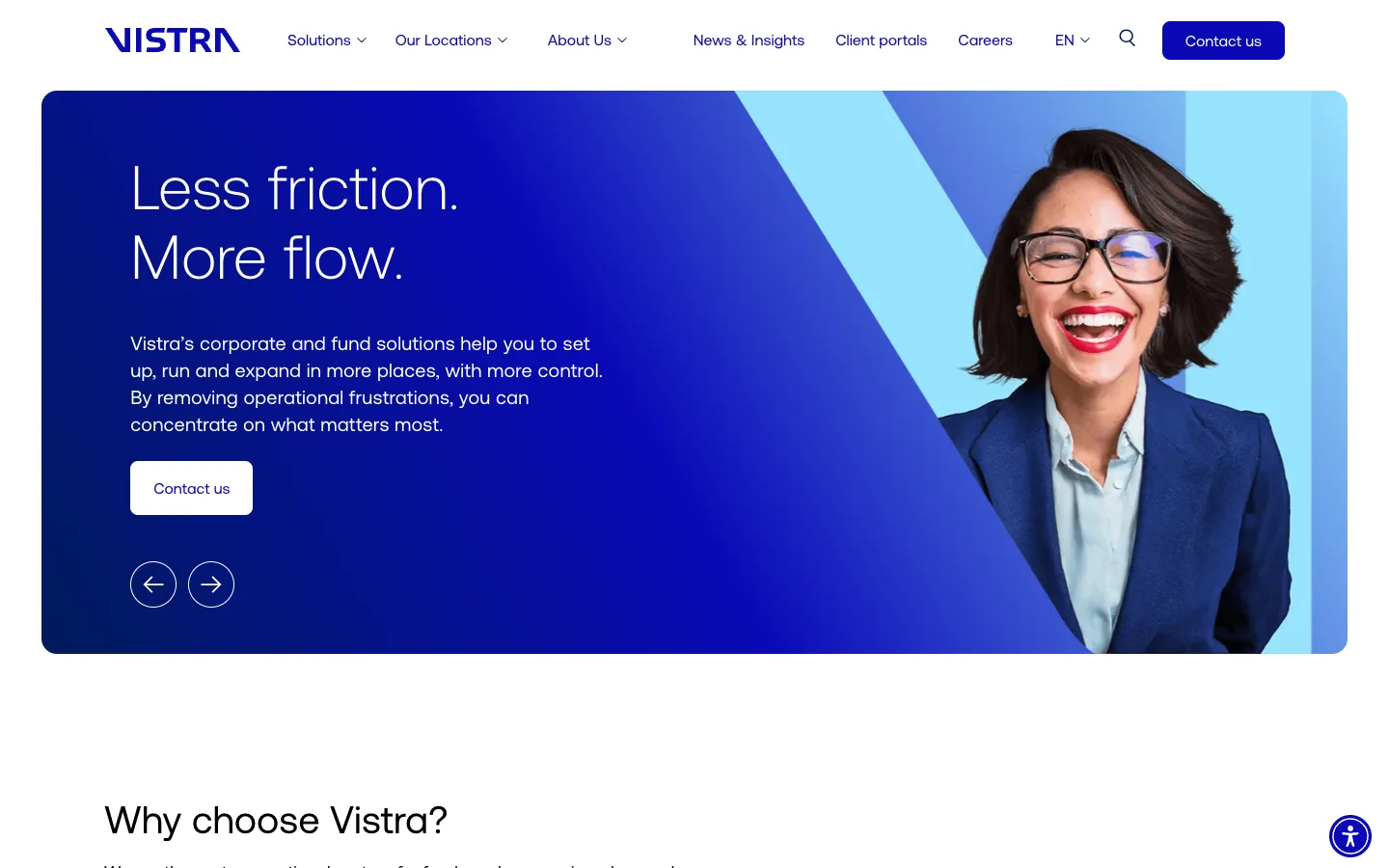
Vistra platform overview
What Vistra Does Well
Compliance infrastructure that predates EOR as a category
Most EOR providers built their compliance capabilities after launching. Vistra has been managing legal entities, fund administration, and corporate governance across Asia-Pacific since 1986. The EOR product sits on top of decades of corporate services infrastructure, local legal teams, established relationships with tax authorities, and entity management expertise that pure-play EOR providers are still building.
The practical impact: when you’re dealing with complex employment situations in Hong Kong, Singapore, Japan, or Australia, Vistra’s in-country teams have handled corporate compliance in those markets for 20–30 years. They’re not reading the employment act for the first time when your termination case comes in. In markets where labor disputes escalate to government agencies, having a provider with an established local reputation and existing regulatory relationships matters more than having a slick dashboard.
For regulated industries, financial services, insurance, asset management, this background is particularly relevant. Vistra already holds regulatory licenses in multiple jurisdictions and understands the compliance frameworks that apply to their own operations. That institutional knowledge transfers to how they handle employment compliance for clients.
APAC depth that pure-play EOR providers can’t match
The 2023 Tricor merger gave Vistra a combined APAC presence that no other EOR provider comes close to matching. Tricor was the dominant corporate services firm in Hong Kong, Singapore, and Malaysia for decades, with deep relationships across Greater China, India, Japan, and Southeast Asia. The merged entity has over 100 offices, and the densest concentration is in Asia-Pacific.
What this means for EOR specifically: in markets like Japan (where employment law is notoriously protective), South Korea, Taiwan, and Indonesia, Vistra has owned entities and in-house legal teams that have been operating for years. Deel partners with local firms in many of these markets. Remote doesn’t cover some of them at all. Multiplier has strong Singapore and India coverage but thins out across Northeast Asia.
If you’re hiring 10+ employees across APAC and compliance risk is your primary concern, not speed, not price, not platform experience, Vistra is the strongest option on the table. That’s a narrow use case, but it’s a real one for multinationals expanding into the region.
Entity management as a natural on-ramp to owned subsidiaries
Here’s something Vistra can do that Deel and Remote fundamentally cannot: help you transition from EOR to your own legal entity in the same market, managed by the same provider. Vistra’s core business is entity management, they manage over 200,000 legal entities globally for clients. When your headcount in Germany or Singapore crosses the threshold where your own entity makes financial sense (typically 15–20 employees), Vistra handles the incorporation, ongoing corporate secretarial work, tax filings, and payroll, all without switching providers.
This is a genuine differentiator for companies with a planned expansion path. Most EOR providers treat entity setup as someone else’s problem. Deel will refer you to a partner. Remote has started offering entity setup consulting, but it’s not their core competency. Vistra has done entity incorporation and management for four decades. The EOR-to-entity transition is a standard playbook for them, not an upsell experiment.
Enterprise-grade global payroll at scale
Vistra processes over 11 million payslips annually across 170+ countries through its global payroll platform. The payroll operation is a standalone business unit with 1,500+ dedicated professionals providing coverage across time zones. For multinationals that need EOR in 10 countries alongside managed payroll in 25 others, having both under one vendor eliminates the multi-provider coordination tax.
The OverseasConnect platform provides centralized reporting across all payroll countries, real-time dashboards, and bulk processing for multi-country pay runs. It integrates with Workday and Oracle, which is table stakes for enterprise HR tech stacks but something that smaller EOR providers (Oyster, Multiplier, Omnipresent) still struggle with. If your HRIS is Workday and your ERP is Oracle, Vistra’s integration layer is production-ready and battle-tested at scale.
Institutional credibility with regulated clients
Vistra serves 40% of the Fortune Global 500. That’s not a marketing claim, it’s a function of being one of the world’s largest corporate services firms. For procurement teams at large enterprises that require SOC audits, vendor risk assessments, financial stability checks, and regulatory compliance documentation from every supplier, Vistra passes those gates without friction. The BPEA EQT backing ($6.5 billion valuation at the Tricor merger) provides balance sheet stability that venture-funded EOR startups cannot match.
This matters less if you’re a 50-person startup. It matters a lot if you’re a publicly traded company where your board’s audit committee reviews vendor risk, or if you’re in financial services where regulators scrutinize every outsourced employment relationship.
Where Vistra Falls Short
No self-serve experience: everything goes through sales
Try signing up for Vistra’s EOR service on their website. You can’t. There’s no pricing page, no “Get Started” button that leads to a contract builder, no free trial. Every engagement starts with a sales conversation, scoping call, and custom proposal. For a company that needs to hire one person in the Netherlands next month, this process adds 2–4 weeks before you even have a contract in place.
Deel lets you generate an employment agreement in 15 minutes. Remote’s onboarding flow is self-serve for standard hires. Even G-P, which targets the same enterprise segment, has streamlined its initial engagement process. Vistra’s sales-first model reflects its corporate services DNA, these are the same teams that sell $500K/year entity management contracts, but it’s wildly out of step with how modern People teams want to procure EOR services.
If your use case is “we need someone hired in Singapore by the end of the month,” Vistra’s engagement timeline alone disqualifies it.
Pricing is opaque and almost certainly premium
Vistra doesn’t publish EOR pricing. Not on the website, not on third-party directories, not in analyst reports. Every quote is custom. Based on industry benchmarks and feedback from procurement teams who’ve evaluated Vistra, expect pricing in the range of $800–$1,500/mo per employee depending on country, headcount, and contract length.
For context: Deel charges $599/mo, Multiplier starts at $400/mo, and even enterprise-oriented G-P runs approximately $800/mo. Vistra’s pricing reflects the bundled corporate services overhead, you’re paying for the institutional compliance infrastructure, the 9,000-person organization, and the BPEA EQT cost of capital, whether or not you need all of that for a standard EOR hire.
The opacity itself is a problem. Modern procurement teams comparison-shop. When three competitors publish flat monthly fees and your option requires a 45-minute scoping call to get a ballpark, you lose to the providers that make it easy. Vistra’s pricing model assumes the buyer already knows they want Vistra and is comparing it against setting up their own entity, not against Deel.
Platform experience is a generation behind
OverseasConnect is functional. It processes payroll, generates reports, and provides employee self-service for basic queries. But put it next to Deel’s dashboard, Rippling’s unified HR platform, or even Remote’s contract management flow, and the gap is obvious. The interface was designed for payroll administrators managing bulk pay runs, not for People ops teams onboarding individual EOR employees.
Specific gaps: no self-serve contract generation, no built-in compliance tracker that shows employment law changes by country, no contractor management module, and no API marketplace with plug-and-play HRIS connections. The Workday and Oracle integrations exist but require implementation effort, these aren’t one-click connectors. For a company spending $100K+/year on EOR, the platform experience should be better than “it works.”
The EOR-first providers have invested hundreds of millions in product development over the past five years. Vistra’s technology investment has gone into global payroll processing at scale, not into the kind of user experience that makes a People team’s daily life easier. The result is a tool that finance teams tolerate and People teams resent.
Onboarding is slow by modern EOR standards
Vistra quotes onboarding timelines of “days” on its website, which is technically true in the same way that “a few” can mean seven. In practice, expect 5–15 business days for standard hires in most markets, and longer in countries requiring work permits or complex benefit enrollment.
Compare that to Deel’s 2–5 days, Remote’s 3–5 days, or Multiplier’s 3–7 days. The gap exists because Vistra’s onboarding process runs through account management teams and local office coordination rather than through an automated platform flow. Each hire involves manual steps, employment agreement review by local counsel, entity allocation confirmation, payroll setup coordination, that the EOR-first providers have automated.
For competitive hiring situations where you’re racing to close a candidate, every extra day increases the risk of losing them. If your primary reason for using EOR is speed-to-hire, Vistra’s process is a liability.
Small and mid-market companies are an afterthought
Vistra’s website, sales materials, and go-to-market strategy are built for enterprises with 500+ employees and existing multi-country operations. If you’re a Series A startup with 30 employees hiring your first person in Germany, Vistra’s sales team will take your call, but the minimum engagement economics, implementation timeline, and support model aren’t designed for you.
There’s no free contractor management tier (Deel offers this). No month-to-month pricing (most EOR-first providers allow it). No self-serve onboarding for simple hires. The minimum practical engagement typically involves annual commitments and multi-country scoping. For companies hiring fewer than 10 international employees, the overhead of working with Vistra exceeds the compliance benefit.
Pricing Breakdown
| Item | Cost |
|---|---|
| EOR per employee | Custom pricing, not published |
| Estimated range | $800–$1,500/mo per employee (varies by country) |
| Global payroll | Custom (per-payslip or per-employee pricing) |
| Entity setup & management | Separate engagement, custom pricing |
| Work permits & visas | Quoted per case |
| OverseasConnect platform | Included with services |
| Dedicated account manager | Included (enterprise accounts) |
What makes pricing hard to pin down: Vistra bundles EOR with broader corporate services. A client using Vistra for entity management in 15 countries who adds EOR in 3 more gets different pricing than a standalone EOR buyer. The commercial relationship is holistic, not transactional. This makes apples-to-apples comparison with Deel or Remote nearly impossible.
Volume dynamics: Enterprise clients with 50+ EOR employees and existing Vistra relationships negotiate significantly lower per-employee rates. But those discounts are relationship-dependent, not published tiers. A new client hiring 5 employees through Vistra’s EOR will pay a premium that makes Deel at $599/mo look like a bargain.
Annual cost example (estimated): 10 employees at an estimated $1,000/mo = $120,000/year. The same 10 employees on Deel at $599/mo = $71,880/year. On Multiplier at $400/mo = $48,000/year. The difference, $48,120–$72,000/year, buys you Vistra’s compliance depth and entity management infrastructure. Whether that’s worth it depends entirely on your risk profile and the complexity of your markets.
Hidden cost advantage: If you plan to transition from EOR to your own entity within 18–24 months, Vistra can handle both phases. Other providers charge entity setup fees ($15,000–$50,000 per country) through third parties. Vistra absorbs that into the ongoing relationship. Over a 3-year horizon with entity transitions, the total cost of ownership may actually favor Vistra despite higher monthly EOR fees.
For market fee benchmarks across providers, see the EOR pricing hub and EOR cost guide.
Vistra: Top Regions
Asia-Pacific
 Singapore
 Owned entity with deep Tricor heritage. Strongest APAC market, in-house legal and compliance team has operated here for 20+ years.
Country guide → Japan
Japan Owned entity. Genuine strength in a market where most EOR providers rely on partners. Handles strict termination rules better than Deel or Remote.
Country guide → Australia
 Owned entity. Solid execution with local payroll team. Less differentiated here, Deel and Remote both have strong AU operations.
Country guide → India
India Owned entity. Strong compliance infrastructure, but Multiplier and Deel offer faster onboarding and lower cost in this market.
Country guide → Philippines
 Owned entity via Tricor. Handles complex benefits and 13th-month compliance well. Onboarding slower than Deel.
Country guide → Indonesia
 Owned entity. One of Vistra's genuine differentiators, most competitors partner here. In-house team handles BPJS and manpower regulations directly.
Country guide →Europe
 United Kingdom
 Owned entity. Competent but unremarkable, Deel and Remote both onboard UK hires faster with better platform experience.
Country guide → Germany
 Owned entity with local legal team. Strong on works council and termination compliance. Slower onboarding than Deel (7–10 days vs 4–5).
Country guide → Netherlands
 Owned entity. Handles complex Dutch benefits and 30% ruling advisory. Good for enterprises, overkill for a single hire.
Country guide → France
 Owned entity. French labor law complexity plays to Vistra's strengths. More reliable for 10+ hires than partner-entity providers.
Country guide → Poland
 Partner entity. Functional but no differentiation over Deel or Remote, both of which offer lower cost in this market.
Country guide → Spain
Spain Partner entity. Adequate coverage but onboarding is slow. Deel or Oyster are better picks for Spanish hires.
Country guide →Americas
 United States
 Owned entity. Handles multi-state payroll. But Rippling and Deel are stronger for US-based hires with better platform integration.
Country guide → Canada
 Owned entity. Provincial compliance is solid. Unremarkable compared to Deel or Rippling in this market.
Country guide → Brazil
 Partner entity. Functional but Vistra lacks the onboarding speed of Deel (5–7 days) in this complex market.
Country guide → Mexico
 Partner entity. Basic coverage. Deel and Atlas offer stronger Mexican operations with faster onboarding.
Country guide → Colombia
 Partner entity. Limited differentiation. Deel or Ontop are better picks for Colombian hires.
Country guide → Argentina
 Partner entity. Handles peso-denominated payroll but currency controls make this a complex market for any provider.
Country guide →Middle East & Africa
 UAE
UAE Owned entity. Strong corporate services presence in Dubai. Handles free zone vs mainland employment distinctions well.
Country guide → Saudi Arabia
 Partner entity. Covers Saudization requirements but onboarding is slow (10–15 days). Deel and Safeguard Global are faster.
Country guide → South Africa
 Owned entity. Solid compliance handling. Less differentiated than in APAC markets.
Country guide → Nigeria
 Partner entity. Functional coverage but Deel and Remofirst offer faster onboarding and lower pricing in Nigeria.
Country guide → Kenya
Kenya Partner entity. Basic coverage. Consider Deel or Oyster for East African hires.
Country guide → Qatar
Qatar Partner entity. Handles WPS compliance. Limited differentiation over competitors in this market.
Country guide →Pros and Cons
How Vistra Compares
 Deel
Deel 10x faster onboarding, self-serve platform, free contractor tier. Less compliance depth in APAC but better for 90% of use cases.
Full comparison → G-P
G-P Closest enterprise competitor. 100% owned entities and broader coverage, but similar pricing tier and also lacks modern platform UX.
Full comparison → Remote
 100% owned entities with transparent pricing. Fewer countries but far better platform and self-serve experience.
Full comparison → Safeguard Global
 Similar enterprise positioning with broader country count. More modern EOR platform but less APAC depth than Vistra.
Full comparison →Case Studies
 ExaGrid
 Expanded into 15+ markets using Vistra's EOR, managed payroll, and entity services. Combined 5 owned entities, 9 non-resident payrolls, and 6 EOR arrangements through OverseasConnect for centralized reporting.
Read case study → EQT Portfolio Company
 Established 30+ legal entities across multiple jurisdictions within a three-month deadline for post-acquisition integration. Vistra executed a global project plan covering incorporation, compliance, and employment setup.
Read case study →Published case studies for Vistra’s EOR specifically are scarce, the company’s marketing leans heavily on its corporate services and entity management track record rather than isolated EOR wins. This is consistent with the positioning: EOR is one piece of a broader client relationship, not a standalone product with its own success stories. The ExaGrid example is the most detailed publicly available, and it illustrates how Vistra bundles EOR with payroll and entity management rather than selling EOR on its own.
eorHQ Final Verdict
Use Vistra if: You’re a multinational with existing entity management needs, APAC-heavy hiring where compliance depth matters more than speed, a plan to transition from EOR to owned entities in key markets, and an enterprise procurement process that values vendor stability and regulatory credentials. Vistra makes sense when EOR is 20% of what you need from a corporate services partner, not 100%.
Skip Vistra if: You’re a startup or mid-market company hiring your first international employees. You need someone onboarded in days, not weeks. You want transparent pricing you can compare without a sales call. You value platform experience and self-serve tools. You need contractor management alongside EOR. In all of these scenarios, which describe the majority of companies shopping for EOR in 2026, Deel, Remote, or Multiplier are better choices.
Bottom line: Vistra is the EOR you choose when you’ve outgrown the pure-play EOR providers, not when you’re shopping for one. The compliance depth is real, the APAC presence is unmatched, and the ability to manage the full corporate lifecycle under one roof is a genuine advantage for complex multinationals. But for the vast majority of companies using EOR today, teams of 5–50 international employees who need fast onboarding, clear pricing, and a modern platform, Vistra is over-engineered and under-optimized. For APAC-heavy multinationals with existing entity management needs and a plan to transition out of EOR in key markets, Vistra is the pick : no other provider manages 200,000+ legal entities globally while also offering EOR as a bridge product. For everyone else, start with Deel or Multiplier.
Frequently Asked Questions
How much does Vistra’s EOR cost?
Vistra doesn’t publish pricing, quote-based. Ask for all-in cost including setup, per-country surcharges, and any bundled services. Industry benchmarks: $800–$1,500/mo per employee for standalone EOR, 30–150% more than Deel ($599) and 2–3x Multiplier ($400). Existing Vistra clients and high-volume engagements get discounts. Push for a detailed line-item quote before committing.
Does Vistra use owned or partner entities?
Both. Owned in ~45 jurisdictions (APAC, Western Europe), Singapore, Hong Kong, Japan, UK, Germany have 15–30 year entity history. Remaining 40+ countries via partners. Higher owned ratio than Deel, lower than Remote (100%). Ask for country-by-country breakdown, compliance depth differs in partner markets.
How fast can Vistra onboard someone?
5–15 business days. Singapore/UK: 5–7 days. Brazil, Japan, Germany: 10–15 days. 2–3x slower than Deel or Remote. Bottleneck is manual onboarding through account managers, not local registration. If time-to-hire is critical, Deel or Remote is the better fit.
Can Vistra help us transition from EOR to our own entity?
Yes, Vistra’s strongest differentiator. They manage 200,000+ legal entities globally. Path: EOR in new market → grow to 15–20 employees → Vistra incorporates your subsidiary and transfers employees. One provider, one account team, minimal disruption. Deel and Remote can’t do this in-house. G-P has some entity capability but not at Vistra’s scale.
Is Vistra a good fit for startups?
No. Optimized for enterprises with 500+ employees and multi-country operations. Startups with fewer than 50 employees will overpay, wait longer for onboarding, and miss the self-serve tools that make Deel and Remote manageable. Vistra is for companies with a dedicated global mobility team and procurement process.
Does Vistra offer contractor management?
No. EOR covers full-time employees only. No contractor module, no conversion workflow, no misclassification risk tool. For mixed contractor/employee workforces, you’ll need Deel or Remote for the contractor side.
Who should skip Vistra?
Startups and mid-market companies hiring their first international employees. Anyone needing onboarding in days, transparent pricing without a sales call, or contractor management. Deel, Remote, or Multiplier serve most EOR buyers better. Vistra makes sense when EOR is 20% of what you need from a corporate services partner, not 100%.
For market-level context beyond vendor features, see EOR pricing hidden costs and browse country hiring guides for local employment costs and compliance.
What types of companies actually use Vistra’s EOR service?
Primarily enterprises with established global mobility teams: financial services firms managing regulatory filings across jurisdictions, multinationals expanding into markets where they already use Vistra for corporate secretarial or tax compliance, and large companies transitioning from EOR to their own subsidiary where Vistra can manage both sides. The typical Vistra EOR engagement is part of a broader corporate services relationship, not a standalone EOR purchase.
Sources
- Vistra: Website, Pricing
- G2: Global Employment Platforms
- eorHQ methodology: 6-dimension scoring
Related Decision Pages

Was this page helpful?
Tell us or send a correction.